
Blank Schedule Ongoing
Plan rehearsals, performances, and crew shifts with this free Blank Ongoing Schedule template, a printable weekly planner offering free download.
PDF
DOCX
1 downloads
0
likes
Download Files
- DOCX
A Blank Schedule Ongoing is a reusable weekly planning grid that lets theater companies, directors, and stage managers map out rehearsals, performances, and crew assignments across several consecutive weeks on one page. People most often reach for it when a production runs for more than a single week and the same daily structure needs to repeat with small variations. It’s free to download here in both PDF and DOCX, with no signup required.
What Is a Blank Schedule Ongoing?
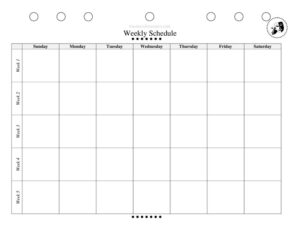
A Blank Schedule Ongoing is an open, unprinted weekly calendar template designed to be filled in by hand or on a computer. Instead of listing fixed dates, it organizes time into days of the week (Sunday through Saturday) repeated across Week 1 through Week 5, making it ideal for recurring routines. In a theater setting, it is typically issued by a stage manager or production coordinator and shared with cast and crew so everyone sees the same rolling plan. It documents who works when, which scenes are called, and how the production week flows from one to the next. Its strength is flexibility: the same blank grid serves rehearsals, tech weeks, or full performance runs.
When Do You Need a Blank Schedule Ongoing?
This template fits any situation where a weekly pattern repeats over a stretch of time. Common scenarios include:
- Rehearsal blocks: Plotting a five-week rehearsal period so actors know which days they are called and which evenings are free.
- Tech and dress rehearsals: Laying out the intensive final weeks where lighting, sound, and costume calls cluster on specific days.
- Performance runs: Tracking show nights, matinees, and dark days across a multi-week run.
- Crew shift planning: Assigning stagehands, board operators, and front-of-house volunteers to recurring weekly slots.
- Class or workshop series: Scheduling an ongoing acting class, dance intensive, or youth theater program that meets the same days each week.
- Venue booking overviews: Giving a theater manager a quick visual of which weeks and days a space is committed versus open.
What a Blank Schedule Ongoing Should Have
A complete ongoing schedule balances structure with room to write. At minimum it should include a clear label for each day of the week, a distinct row or block for each week so entries never bleed together, and enough space in every cell to note times, locations, or names. A good version also leaves header space to title the production or department, and a key or legend area where you can define abbreviations like “TBC” (to be confirmed) or color codes. Because this template repeats Week 1 through Week 5, it should make the boundaries between weeks visually obvious so a reader scanning the page instantly knows where one week ends and the next begins.
How to Fill Out a Blank Schedule Ongoing
The grid is built from seven day columns and five week rows. Work through it methodically:
- Add a title at the top — for example, the show name plus “Rehearsal Schedule” or “Performance Run.”
- Confirm the day headers run Sunday, Monday, Tuesday, Wednesday, Thursday, Friday, Saturday in the order your company prefers.
- Start with Week 1 and write the calendar dates above or beside each day so the abstract grid connects to real dates.
- In each day cell, enter the activity: call time, scene numbers, location, and who is needed.
- Repeat for Week 2 through Week 5, copying recurring entries and adjusting anything that changes that week.
- Mark dark days, days off, or holidays clearly so no one assumes a call.
- Add a short legend if you use abbreviations, then date the version and note who prepared it.
Tips for Theater Scheduling
Ongoing schedules succeed or fail on clarity. Always include start and end times, not just an activity name — “Act 2 run, 7:00–9:30 PM” tells far more than “rehearsal.” Keep cast names or roles attached to each call so people can find themselves at a glance. When a slot is tentative, mark it as such rather than leaving it blank, because a blank cell reads as a free day. If you fill in the DOCX version, use a consistent format for times and locations so the eye moves easily down each column. For runs longer than five weeks, print a second copy of the template and label it Weeks 6 through 10 to keep the visual pattern unbroken.
Sharing and Updating the Schedule
Because production plans change, treat this template as a living document. When you distribute it, add a version date so recipients can tell whether they are holding the current copy. Post the latest version on the callboard and pin it in any shared group chat or email thread. If you edit a single week, call out the change in a short note so people who already memorized their calls notice the difference. Keeping one master schedule, rather than several competing copies, prevents the missed-call mix-ups that derail rehearsals.
Common Mistakes to Avoid
- Leaving cells ambiguous: An empty box can mean “day off” or “not yet planned” — label which it is.
- Omitting times: Listing only the activity without a call time forces people to guess or ask.
- Forgetting the version date: Old copies circulate and cause people to show up at the wrong time.
- Overcrowding a cell: Cramming too much in one day box makes the schedule unreadable; abbreviate and add a legend.
- Ignoring days off: Failing to mark dark days can lead to burnout or assumed availability.
- Not naming the production: A grid with no title gets mixed up when a company runs more than one project.
Frequently Asked Questions
What is a Blank Schedule Ongoing used for? It is a reusable weekly grid for planning anything that repeats over several weeks, most commonly theater rehearsals, performance runs, and crew shifts. Because it covers Week 1 through Week 5 with every day of the week, it gives a single-page overview of a recurring routine. It works equally well for classes, workshops, and venue bookings.
How do I fill it out? Title the schedule, confirm the day-of-week headers, then write the date and activity into each cell starting with Week 1. Include call times, locations, and the people involved, and clearly mark any days off. Repeat down through Week 5, adjusting entries that change from week to week.
Is this template free to download? Yes. You can download the Blank Schedule Ongoing here for free in both PDF and DOCX formats, with no signup or payment required. Use the PDF to print and post on a callboard, or edit the DOCX on your computer.
Can I use it for things other than theater? Absolutely. While it is built with rehearsals and performances in mind, the same Sunday-through-Saturday, five-week layout suits staff rosters, fitness schedules, study plans, or any recurring weekly routine. Simply retitle it for your purpose.
What if my production runs longer than five weeks? Print or duplicate a second copy of the template and label the new sheet Weeks 6 through 10, keeping the same column order. This preserves the familiar visual pattern so cast and crew read each page the same way.
Does an ongoing schedule need to be signed or approved? There is no legal requirement to sign a planning schedule. However, many companies have the stage manager or production manager date and “issue” each version so everyone knows it is the authoritative copy. Approval practices vary by company and union agreement, so follow your own organization’s process.
This template is a general example provided for informational and organizational purposes only. It is not legal, employment, or contractual advice, and scheduling requirements may vary by organization, venue, and applicable union or labor rules. Consult a qualified professional or your company’s management for guidance specific to your situation.
Related Forms
- Lighting Cues Sheet
- Line Notes
- Comp Ticket Tracker
- Line Notes Breakdown
- Weekly Rehearsal Schedule
- Rehearsal Schedule
Browse more in Theater.