
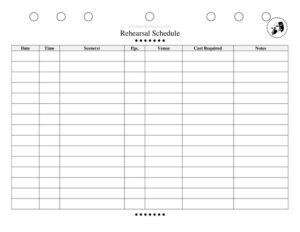
Rehearsal Schedule
Plan your production with a free Rehearsal Schedule template—organize scenes, cast calls, and dates with a free download in PDF and DOCX formats.
PDF
DOCX
5 downloads
0
likes
Download Files
- DOCX
A Rehearsal Schedule is a planning document used by stage managers and directors to map out every rehearsal session for a theatrical production, listing dates, times, locations, scenes, and the cast members required. The most common reason people use one is to keep an entire company organized so the right actors arrive at the right place at the right time. You can download this Rehearsal Schedule free in both PDF and DOCX formats, with no signup required.
What Is a Rehearsal Schedule?
A Rehearsal Schedule is a working calendar created by a production’s stage manager—often in collaboration with the director—that tells everyone involved when and where rehearsals happen and what will be covered. It documents the breakdown of a show into manageable sessions, identifying which scenes, songs, or acts are rehearsed and which actors, crew, or musicians are called. Beyond simple dates, it communicates expectations: call times, break periods, and any special needs such as a choreographer or a music director. For amateur and professional companies alike, a clear Rehearsal Schedule is the backbone of an organized, respectful rehearsal process that protects everyone’s time.
When Do You Need a Rehearsal Schedule?
Almost any group preparing a performance benefits from a written schedule. Common situations include:
- Mounting a full-length play or musical where dozens of scenes must be rehearsed across many weeks before opening night.
- Coordinating a community theater cast of volunteers who juggle day jobs and need plenty of advance notice for their call times.
- Running a school or university production where rehearsal rooms and student availability must be booked carefully around classes.
- Staging a dance recital, choir concert, or opera that requires separate sessions for blocking, choreography, and music.
- Organizing a one-off event such as a benefit showcase, variety night, or staged reading with limited rehearsal windows.
- Managing tech week, when lighting, sound, and costume runs must be slotted in alongside full run-throughs.
Types of Rehearsals to Schedule
A strong schedule reflects the different kinds of work a production demands. Reading rehearsals (table reads) come first, followed by blocking rehearsals where the director sets movement. Music and dance calls are scheduled for the cast members involved in specific numbers. Scene work or polish rehearsals focus on detail, while run-throughs combine everything. Finally, technical and dress rehearsals bring in crew, costumes, and the full production team. Listing the rehearsal type beside each session helps actors and crew prepare correctly.
What a Rehearsal Schedule Should Have
A complete Rehearsal Schedule should clearly identify the production and the company, then break each session down so there is no confusion. Essential elements include the production title and director or stage manager contact; the date, start time, and end time of each session; the rehearsal location or room; the scenes, acts, or musical numbers to be covered; the specific cast members or roles called; and any notes about breaks, breaks, costumes, props, or special staff. A consistent layout—one row per session—makes the document easy to scan and to update as the production evolves.
How to Fill Out a Rehearsal Schedule
Because productions vary widely, this template is designed to be adapted. Follow these steps to complete it:
- Add the production header. At the top, enter the show title, the producing company or venue, and the name and contact details of the stage manager or director who owns the schedule.
- List the date of each session. Work from your first rehearsal through opening night, entering one calendar date per row.
- Enter call and end times. For every date, record the start (call) time and the planned finish so cast can plan their day.
- Specify the location. Note the rehearsal room, studio, or stage, including any room number or address if you use multiple spaces.
- Identify what’s being rehearsed. List the scenes, acts, or songs and, where helpful, the rehearsal type (blocking, music, run-through).
- Name who is called. Write the roles or actor names required so nobody shows up unnecessarily or misses a needed session.
- Add notes. Flag breaks, costume or prop needs, accompanist or choreographer attendance, and reminders.
Tips for Building a Schedule the Cast Will Trust
The best schedules are realistic and stable. Avoid calling actors for long stretches when they only appear briefly—stagger calls so people aren’t sitting idle. Build in proper breaks; performers and crew work better when rested. Distribute the schedule early and in a format everyone can open, then announce changes promptly and clearly. Keep a master copy and date each version so the company always knows which schedule is current. When you respect cast time with a thoughtful plan, attendance and morale both improve.
Sharing and Updating the Schedule
A Rehearsal Schedule is a living document. Post a printed copy on the callboard or rehearsal-room wall, and share a digital version the whole company can reference. Use the DOCX file when you need to edit dates, swap scenes, or add tech rehearsals; use the PDF when you want a clean, fixed copy to print or email. Whenever you make changes, communicate them directly rather than relying on people to notice—stage managers often send a short note summarizing what moved.
Common Mistakes to Avoid
- Calling the entire cast to every rehearsal when only a few scenes are being worked, wasting people’s time.
- Leaving off end times, so actors can’t plan and rehearsals run later than expected.
- Forgetting to note the location when sessions move between rooms or buildings.
- Skipping breaks, which leads to fatigue and reduced focus during long sessions.
- Failing to mark the schedule version or date, causing people to follow an outdated copy.
- Squeezing tech and dress rehearsals into too little time at the end, leaving no margin for problems.
Frequently Asked Questions
What is a Rehearsal Schedule used for? It is used to plan and communicate every rehearsal session for a production, showing dates, times, locations, the material being rehearsed, and which cast members are called. It keeps the whole company coordinated and helps the stage manager run an efficient process.
Who creates the Rehearsal Schedule? Typically the stage manager prepares it in consultation with the director, who decides how scenes are prioritized. In smaller productions a producer, choreographer, or music director may help build it.
How far in advance should I distribute it? Share at least the first week or two of rehearsals before the process begins, and ideally the full schedule as early as possible. Volunteers and students especially need advance notice to arrange their availability around the call times.
Can I edit this template for a musical or dance show? Yes. The DOCX version is fully editable, so you can add columns or rows for music calls, choreography sessions, accompanists, or separate vocal and dance rehearsals as your production requires.
Is this Rehearsal Schedule free to download? Yes, it is completely free to download in both PDF and DOCX formats with no signup or payment required. You can use and adapt it for any production you are organizing.
How do I handle schedule changes once rehearsals begin? Update the master document, mark the new version with a date, and notify the cast and crew directly rather than expecting them to spot the change. Clear, prompt communication prevents missed calls and confusion.
This Rehearsal Schedule template is provided as a general example for informational purposes only and does not constitute professional, contractual, or legal advice. Production needs, venue rules, and union or labor requirements vary—consult the appropriate professionals or governing bodies for your specific circumstances.
Related Forms
- Box Office Count
- Entrance Exit Tracker
- Rehearsal Schedule Month
- Scene Breakdown Actors
- Preliminary Props List
- Storage Contents Tracker
Browse more in Theater.