
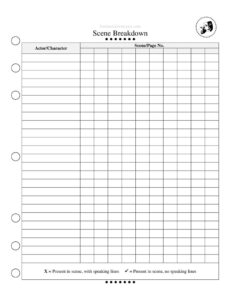
Scene Breakdown Actors
Download a free Scene Breakdown for Actors template to map objectives, beats, and entrances scene by scene; free PDF and DOCX download, no signup.
PDF
DOCX
7 downloads
0
likes
Download Files
- DOCX
A Scene Breakdown for Actors is a working document that lets a performer dissect a script scene by scene, tracking who is on stage, what they want, and how the action shifts moment to moment. Actors most often use it during rehearsal prep to organize objectives, beats, and cues into one reference sheet they can mark up and revise. You can download this template free in PDF and DOCX formats, with no signup required.
What Is a Scene Breakdown for Actors?
A Scene Breakdown for Actors is a structured analysis tool that an individual performer fills out for each scene their character appears in. Rather than a stage manager’s logistical chart, it focuses on the actor’s internal and external journey: the character’s objective, the obstacles in the way, the tactics used, and the emotional shifts between beats. It documents practical information too — which characters are present, entrances and exits, props handled, and important lines or cues. Used together, these notes turn a dense script into a navigable map. The breakdown becomes a private rehearsal companion that grows more detailed with each pass through the material, helping the actor make confident, specific choices on stage.
When Do You Need a Scene Breakdown for Actors?
The breakdown is most valuable in the table-work and early staging phases, but it stays useful right through performance. Common situations include:
- First read-through of a new role — to identify every scene your character appears in and get a sense of the overall arc.
- Rehearsal prep for a specific scene — clarifying what your character wants before you walk into the room so your choices feel grounded.
- Working out beats and tactic changes — breaking a long scene into smaller units so the emotional shifts are deliberate, not accidental.
- Tracking entrances, exits, and props — keeping practical staging straight when you have multiple costume changes or quick crosses.
- Memorization and cue work — pairing your lines with the cues that trigger them so pickups stay sharp.
- Auditions and self-tapes — quickly preparing a sides scene by mapping objective and tactics under time pressure.
What a Scene Breakdown Should Have
A complete breakdown captures both the storytelling and the mechanics of a scene. At minimum it should identify the scene by act, scene number, or page range, and list the characters present. It should state your character’s objective — what they are fighting for in that scene — along with the obstacle standing in the way and the tactics they try. Strong breakdowns divide the scene into beats, note the emotional starting and ending points, and record practical details such as entrances, exits, props, and key cue lines. Space for personal notes lets you capture a director’s adjustment or a discovery you want to remember. The goal is a one-glance reference that supports specific, repeatable acting choices.
How to Fill Out a Scene Breakdown for Actors
Work through the template scene by scene, ideally after at least one full read of the script:
- Identify the scene. Write the act and scene number, the page range, and the setting or location so you can find it instantly.
- List who is present. Note your character and every other character on stage, plus anyone referenced who affects the dynamic.
- State the objective. In a clear active phrase, write what your character wants in this scene — what they are trying to get or do.
- Name the obstacle. Record what stands in the way, whether another character, a circumstance, or an internal conflict.
- List tactics. Jot the strategies your character uses to pursue the objective, and where each one shifts.
- Break it into beats. Divide the scene into units, marking the moment each beat changes.
- Track entrances, exits, and props. Note when you enter and leave and any objects you handle.
- Capture emotional arc. Write where your character begins emotionally and where they end up.
- Add personal notes. Record director’s adjustments, cue lines, and discoveries to revisit.
Building a Beat-by-Beat Analysis
The heart of any actor’s breakdown is the beat work. A beat is a unit of action defined by a single intention or tactic; when your character changes what they want or how they pursue it, a new beat begins. Reading the scene aloud and marking every shift — a new subject, a sudden realization, a change in who holds the power — reveals these units naturally. For each beat, give it a short active verb such as to convince, to provoke, or to comfort. This keeps your playing specific and prevents the scene from flattening into one continuous mood. Over several rehearsals you will refine these labels, and the breakdown becomes a living record of how your interpretation deepens.
Using the Breakdown Through Rehearsal and Performance
A scene breakdown is not a fill-it-once-and-file document. Treat it as a draft you revise after every rehearsal. When a director gives an adjustment, log it in the notes column so you remember it next time. As blocking firms up, update entrances, exits, and prop handoffs. By tech week your breakdown should reflect the production as it actually exists, not the version you imagined on day one. Many actors keep the sheet in their script binder or rehearsal bag so it travels with them. Even during a run, a quick pre-show glance at objectives and beats helps refocus your intentions and keeps a long-running performance from going stale.
Common Mistakes to Avoid
- Writing vague objectives like “to be happy” instead of an active, playable goal aimed at another character.
- Skipping beats and treating a long scene as a single unbroken stretch, which flattens the performance.
- Confusing objective and obstacle — be clear about what your character wants versus what blocks them.
- Letting the breakdown go stale by not updating it after blocking and director notes change.
- Over-intellectualizing with pages of analysis you never actually play on stage.
- Ignoring practical cues such as entrances and prop handoffs, which causes missed moments in performance.
Frequently Asked Questions
What is a Scene Breakdown for Actors used for? It is a preparation and rehearsal tool that helps a performer analyze each scene their character appears in. It tracks objectives, obstacles, tactics, beats, and practical details like entrances and props so the actor can make specific, confident choices on stage.
How do I fill out a scene breakdown? Read the script first, then work through each scene by recording the act and scene number, who is present, your character’s objective and obstacle, the tactics they use, the beats, and any entrances, exits, or props. Add personal notes for director adjustments and revisit the sheet after each rehearsal.
What is the difference between an objective and a beat? An objective is the overall thing your character wants in the scene, phrased as an active goal. A beat is a smaller unit within the scene defined by a single tactic or intention, and a new beat begins whenever that intention shifts.
Is this the same as a stage manager’s scene breakdown? No. A stage manager’s breakdown is a logistical chart of which actors, props, and costumes are needed in each scene for the whole production. This template is the actor’s personal analysis of their own character’s journey through each scene.
Can I use this template for film or audition sides? Yes. The same structure works for film scenes and audition sides — simply break the sides into beats, identify your objective and obstacle, and note tactics. It is especially handy for preparing a self-tape quickly under time pressure.
How much does this template cost? Nothing. The Scene Breakdown for Actors template is completely free to download here in both PDF and DOCX formats, with no signup or account required, so you can print it or edit it digitally.
This template is provided as a general example for informational and educational purposes only and is not professional acting, directing, or other advice. Rehearsal practices and analysis methods vary by production, director, and training approach — adapt this tool to suit your process and the needs of your specific production.
Related Forms
- Multiple Location Schedule
- Props List
- Rehearsal Sign-In Sheet
- Preliminary Props List
- Preliminary Script Analysis
- Scene Breakdown
Browse more in Theater.