
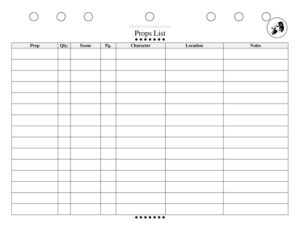
Props List
Use this free Props List template to track every stage prop by scene, owner, and storage location — organized and rehearsal-ready free download.
PDF
DOCX
11 downloads
0
likes
Download Files
- DOCX
A Props List is a master inventory document that tracks every physical object used on stage during a theatrical production, organizing each item by scene, character, and storage location. The most common reason people use one is to make sure no prop goes missing, gets misplaced, or arrives late during a performance. You can download this Props List template free in PDF and DOCX, with no signup required.
What Is a Props List?
A Props List is a working reference created by the props master, stage manager, or production team to catalog all the handheld and set-dressing items that actors interact with during a show. Unlike costumes or scenery, props are the movable objects — a letter, a teacup, a sword, a telephone — that bring scenes to life. The list documents what each prop is, where it appears, who handles it, and where it lives backstage when not in use. It serves as a single source of truth that keeps a busy production organized from the first rehearsal through closing night, ensuring continuity and accountability across an entire run.
When Do You Need a Props List?
Almost every staged production benefits from a Props List, but it becomes essential in certain situations:
- Building a show from scratch — when the director and props master first break down the script and identify every object that needs to be sourced, built, or borrowed.
- Coordinating prop tables backstage — to label which props sit on the stage-left versus stage-right table before curtain.
- Tracking presets and resets — when crew members must place props before each scene and return them after.
- Managing complex or fast scene changes — productions with dozens of props need a checklist to confirm everything is in place.
- Touring or transferring a production — the list doubles as a packing manifest so nothing is left behind at a venue.
- Handing off to a new stage manager or understudy run — a written record means continuity even when personnel change.
Types of Props to Track
A thorough Props List usually separates items into categories so nothing slips through the cracks. Hand props are objects actors carry or manipulate, such as books, keys, or weapons. Set dressing covers items that decorate the stage but aren’t directly handled, like framed pictures or vases. Consumables are props used up or replaced each performance, including food, drink, paper that gets torn, or breakaway glass. Personal props are small items an actor keeps on their person, such as a watch or a pair of glasses. Noting the category for each entry helps the team budget, prep, and replace items correctly.
What a Props List Should Have
A complete and useful Props List captures enough detail that any crew member can find, place, and return a prop without asking questions. Key elements include the production or show name, the prop name or description, the scene or act in which it appears, the character or actor who uses it, the source (purchased, built, rented, or borrowed), the storage or prop-table location, and a status column for tracking whether the item is acquired, in progress, or still needed. A notes column for special handling — fragile, consumable, or requires reset — rounds out a list that actually prevents problems rather than just recording them.
How to Fill Out a Props List
Since this is a flexible template you can adapt to any show, follow these steps to build a complete list:
- Title the document with the production name, theater or company, and the date or version so everyone references the current edition.
- Break down the script page by page and write each prop as a separate line item with a clear, specific name.
- Record the scene or act where each prop first appears, and note any later scenes it returns in.
- Assign the character or actor responsible for handling the prop on stage.
- Note the source — buy, build, pull from stock, rent, or borrow — and add a cost or budget figure if needed.
- List the storage location, such as stage-left prop table, prop cabinet, or a specific shelf.
- Set the status for each prop: needed, sourced, in build, or ready.
- Add notes for special handling, consumables, presets, or resets.
- Update continuously as items are acquired and rehearsals reveal new needs.
Keeping the List Useful Through Tech and Performance
A Props List is a living document, not a one-time inventory. During technical rehearsals, the props master and stage manager should walk the list scene by scene, confirming each item’s placement and flagging anything that doesn’t work in practice — a prop too heavy to carry quickly, a consumable that runs out faster than expected, or an object that simply reads wrong from the audience. Print a clean copy for the prop tables and a run sheet for each crew member assigned to presets and resets. After every performance, a quick check against the list confirms consumables are restocked and breakables are intact, so the next show starts from a known-good state.
Common Mistakes to Avoid
- Vague descriptions — writing “bottle” instead of “green glass wine bottle, half-full of tea” leaves room for the wrong item to appear.
- Forgetting consumables — failing to flag food, drink, or breakaway items means you run out mid-run.
- Omitting storage locations — a prop with no home backstage gets lost during chaotic scene changes.
- Not tracking status — without a status column, the team can’t tell what’s done and what still needs sourcing before opening.
- Using a single outdated copy — circulating an old version causes confusion; always date and version the list.
- Skipping resets — not noting which props must return to a preset position leads to continuity errors in later scenes.
Frequently Asked Questions
What is a Props List used for? A Props List is used to inventory and organize every physical object actors use during a production. It helps the props master, stage manager, and crew source items, set up prop tables, and confirm nothing is missing before each performance. It is the central reference that keeps a show running smoothly.
Who creates and manages the Props List? The props master or props coordinator usually builds the list during pre-production, often working from the director’s script breakdown. During the run, the stage manager and backstage crew rely on it for presets and resets. On smaller productions, one person may handle all of these roles.
How do I fill out this Props List template? Start by titling it with your production name, then add each prop as a line item with its scene, the character who uses it, its source, storage location, and status. Add notes for fragile or consumable items, and update the list throughout rehearsals as needs change.
What is the difference between hand props and set dressing? Hand props are items actors directly carry or manipulate on stage, like a letter or a cane. Set dressing decorates the stage but isn’t actively handled, such as a vase or wall art. Tracking both on the same list ensures the full stage picture is accounted for.
Can I customize this template for my show? Yes. The template is fully editable in DOCX, so you can add columns for budget, dimensions, or actor initials, and remove anything you don’t need. Tailor the categories and status labels to match how your production team works.
Is this Props List template free to download? Yes, this Props List template is completely free to download in both PDF and DOCX formats, with no signup or payment required. Use the PDF for printing prop-table copies and the DOCX to edit and customize it for your production.
This Props List template is a general example provided for informational purposes only and does not constitute professional production, legal, or financial advice. Production needs and theater requirements vary by company and venue — adapt the form to your specific show and consult your production team or a qualified professional as needed.
Related Forms
- Lighting Inventory Sheet
- Audition Sheet Musical
- Rehearsal Sign-In Sheet
- Costume Measurement Form
- Costume Changes
- Preliminary Props List
Browse more in Theater.