
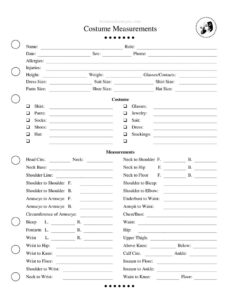
Costume Measurement Form
Download a free Costume Measurement Form template to record accurate actor sizing for theater productions, available in PDF and DOCX with no signup.
PDF
DOCX
29 downloads
0
likes
Download Files
- DOCX
A Costume Measurement Form is a worksheet used by wardrobe departments to record an actor’s body measurements so costumes can be built, altered, or pulled to fit precisely. The most common reason people use it is to capture every dimension a costumer needs in one organized place before a fitting or build begins. You can download it free in PDF and DOCX with no signup required.
What Is a Costume Measurement Form?
A Costume Measurement Form is a standardized document that a wardrobe supervisor, costume designer, or stitcher uses to log a performer’s measurements for a specific production. It typically gathers the actor’s name, the role or character, the show and date, and a structured list of body measurements such as chest, waist, hips, inseam, and sleeve length. The form documents who took the measurements and any notes about quick changes, allergies, or fit preferences. By keeping this information in a single sheet, costume shops avoid re-measuring, reduce alteration errors, and maintain a reliable reference throughout a production’s run.
When Do You Need a Costume Measurement Form?
Wardrobe teams reach for this form at many points in the production process. Common scenarios include:
- Pre-build fittings — before constructing a custom costume from scratch for a lead character.
- Costume rentals — supplying accurate sizes to a rental house so the right garments arrive.
- Large casts — measuring an ensemble or chorus efficiently during a single measurement call.
- Quick alterations — recording figures so a stitcher can take in or let out an existing piece.
- School and community theater — tracking student or volunteer actors who change between seasons.
- Touring or repertory shows — keeping records on file as cast members are replaced or recast.
What a Costume Measurement Form Should Have
A complete form balances identifying details with precise measurement fields. At minimum it should capture the performer’s name and contact information, the production title, the character or role, and the date measured. The core of the form is a clearly labeled measurement grid covering the major body dimensions for both upper and lower garments. It should also include space for footwear and headwear sizes, notes for special requirements, and the name of the person who recorded the measurements. Including units and a reminder to measure over appropriate undergarments helps keep every entry consistent across the cast.
How to Fill Out a Costume Measurement Form
- Production details: Write the show title, performance dates or season, and the costume designer or wardrobe supervisor’s name at the top.
- Performer identification: Enter the actor’s full name, phone or email, and the character(s) they play.
- Date and measurer: Record the date of the fitting and who took the measurements for accountability.
- Upper body: Measure and log chest/bust, waist, neck, shoulder width, arm length, sleeve, bicep, and back length.
- Lower body: Record hips, inseam, outseam, thigh, and rise for trousers, tights, or skirts.
- Height and weight: Note overall height and, if used, approximate weight to guide garment proportions.
- Extremities: Add hat/head circumference, glove size, and shoe size including width.
- Notes: Capture allergies, quick-change needs, mobility concerns, or fit preferences.
- Review: Confirm units are consistent and double-check any measurement that looks unusual before filing.
How to Take Accurate Measurements
The reliability of a Costume Measurement Form depends entirely on how the figures are taken. Use a flexible cloth tape measure and keep it snug but not tight, parallel to the floor for circumference measurements like chest, waist, and hips. Measure the performer in form-fitting clothing or appropriate undergarments so fabric bulk does not inflate the numbers. Have the actor stand naturally with arms relaxed, and take key measurements twice to confirm consistency. Always note your unit of measurement — inches or centimeters — and stick to one throughout the sheet. For period or structured costumes, a costumer may add measurements such as nape-to-waist or crotch depth, so leave room in the notes for production-specific dimensions.
Keeping Measurement Records Organized
For a production with a sizeable cast, a single completed form per actor becomes part of the wardrobe department’s working archive. Store the forms together in a binder or shared folder, organized by character or by actor surname, so any team member can pull the right sheet quickly during a build or a last-minute repair. Date each form clearly; an actor’s measurements can change between productions, and an outdated sheet can lead to costly alteration mistakes. When a role is recast, file the new performer’s form alongside the original rather than overwriting it, preserving a useful history of how garments were fitted over the show’s run.
Common Mistakes to Avoid
- Mixing units — switching between inches and centimeters on the same sheet, leading to misread numbers.
- Skipping the role name — recording measurements without the character, so it’s unclear which costume the figures support.
- Measuring over bulky clothing — adding inches that throw off the final fit.
- Forgetting footwear and headwear — these are easy to overlook but essential for a complete look.
- Not dating the form — relying on old measurements that no longer match the performer.
- Omitting the measurer’s name — leaving no one to clarify an ambiguous entry later.
Frequently Asked Questions
What is a Costume Measurement Form used for? It is used to record an actor’s body measurements so costumes can be built, altered, rented, or pulled to fit accurately. Wardrobe departments rely on it to avoid re-measuring and to keep consistent sizing records across an entire cast.
How do I fill out a Costume Measurement Form? Start with the production and performer details, then work systematically through upper-body, lower-body, and extremity measurements using a cloth tape. Add the date, the name of the person measuring, and any notes about fit or quick changes before filing the completed sheet.
What measurements should I take for a costume? The essential figures include chest or bust, waist, hips, inseam, sleeve length, neck, shoulder width, height, and shoe and head sizes. Period or structured costumes may require additional measurements, which you can record in the notes section.
Should I measure in inches or centimeters? Either unit works, but you must use the same one consistently across the entire form and ideally across the whole production. Always label the unit clearly so a stitcher or rental house reading the form later cannot misinterpret a number.
Is this form only for professional theaters? No. Community theaters, school drama programs, dance studios, film and TV productions, and cosplay makers all use the same basic measurement sheet. The form scales easily from a single custom build to a large ensemble call.
How much does this Costume Measurement Form cost? It is completely free to download here in both PDF and DOCX formats, with no signup or account required. You can print it for in-person fittings or edit the DOCX version to add production-specific measurement fields.
This Costume Measurement Form template is a general example provided for informational purposes only and is not professional tailoring, safety, or production advice. Measurement practices and costume requirements vary by production, garment type, and region — consult an experienced costumer or wardrobe professional for guidance specific to your needs.
Related Forms
- Comp Ticket Request Form
- Set Design
- Scene Breakdown
- Script Assignment Tracker
- Script Breakdown
- Rehearsal Sign-In Sheet
Browse more in Theater.