
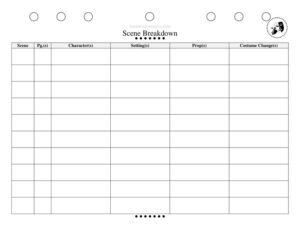
Scene Breakdown
Download a free Scene Breakdown template to organize cast, props, costumes, and locations scene by scene for any play or production—free PDF and DOCX.
PDF
DOCX
10 downloads
0
likes
Download Files
- DOCX
A Scene Breakdown is a production planning document that lists every scene in a play, film, or stage show alongside the cast, props, costumes, set pieces, and technical cues each scene requires. The most common reason directors, stage managers, and producers use one is to see at a glance exactly what is needed for every moment of the production so nothing is forgotten on the day. You can download it free in PDF and DOCX, with no signup required.
What Is a Scene Breakdown?
A Scene Breakdown is a chart created during pre-production that decomposes a script into its individual scenes and records the elements each scene calls for. It is typically prepared by the stage manager, assistant director, or production manager after reading the full script. Rather than describing the story, it catalogs the practical requirements—which characters appear, what props are handled, which costumes are worn, where the action takes place, and which lighting or sound cues fire. This makes the document a master reference for rehearsal scheduling, prop and costume tracking, and technical planning. Everyone from the wardrobe team to the lighting board operator can use the same breakdown to understand their responsibilities scene by scene.
When Do You Need a Scene Breakdown?
A Scene Breakdown becomes essential the moment a production moves from script reading into active planning. Common situations include:
- Scheduling rehearsals so only the actors required for a given scene are called, saving everyone’s time.
- Tracking props across a long play, ensuring each item is built, sourced, or borrowed and placed on the correct side of the stage.
- Planning costume changes, especially quick changes where an actor must shift looks between consecutive scenes.
- Coordinating set transitions so the crew knows which furniture and scenery move in and out between scenes.
- Briefing the technical team on lighting states, sound effects, and music cues tied to specific scenes.
- Budgeting and procurement, where producers total up all props, costumes, and set elements the show demands.
What a Scene Breakdown Should Have
A complete Scene Breakdown captures enough detail that any department head can plan from it without re-reading the script. Strong breakdowns include a clear scene identifier (act and scene number), a short location or setting label, the page or time range the scene covers, the list of characters present, and dedicated columns for props, costumes, set pieces, and technical cues. Many also note the approximate duration, the time of day within the story, and a brief synopsis line. Consistency matters more than elaborate formatting: use the same scene numbering and naming conventions throughout, and keep entries short and scannable so the chart stays usable during a fast-moving rehearsal or load-in.
How to Fill Out a Scene Breakdown
Work through the script methodically, one scene at a time, and complete each row before moving on. A reliable order is:
- Title the document with the production name, your name or role, and the date or revision number so the team always works from the current version.
- Number each scene using act and scene (for example, Act 1, Scene 2), matching the script exactly.
- Record the location or setting for the scene, such as “kitchen” or “forest clearing.”
- Note the page range the scene occupies so you can gauge its length.
- List every character who appears or speaks in that scene.
- Enter all props handled or referenced, from a letter to a sword.
- Add costumes, flagging any changes from the previous scene.
- Document set pieces and furniture that must be present or struck.
- Capture technical cues—lighting states, sound effects, music, and special effects.
- Write a one-line synopsis to jog memory during planning meetings.
Tips for Building a Usable Breakdown
Color-coding speeds the work considerably. Many stage managers highlight each character’s name in a consistent color across the document so they can spot at a glance which scenes a busy actor appears in. When you use the DOCX version, the table format lets you sort and filter—handy for generating a master prop list by copying the prop column, or building an actor’s personal call sheet by isolating their scenes. Keep one authoritative copy and distribute updated versions whenever the script changes, marking each with a revision date. For musicals, add a column for songs and choreography so the music director and choreographer can plan alongside the rest of the team.
Scene Breakdown vs. Related Production Documents
A Scene Breakdown is sometimes confused with a few neighboring tools. A French scene chart tracks entrances and exits within each scene to pinpoint exactly who is on stage at any moment; a Scene Breakdown is broader, covering all production elements. A prop list or costume plot focuses on a single department and is often derived from the breakdown rather than replacing it. A rehearsal schedule uses the breakdown’s character lists to decide who is called when. Think of the Scene Breakdown as the central hub from which these more specialized documents flow, which is why it is usually created first.
Common Mistakes to Avoid
- Inconsistent scene numbering that no longer matches the script, causing confusion in rehearsal.
- Forgetting silent or non-speaking characters who still appear on stage and need costumes and blocking.
- Leaving out small handheld props like keys, money, or notes that are easy to overlook but critical to the action.
- Ignoring quick changes—failing to flag when an actor has no time between scenes to change.
- Not dating revisions, so departments end up working from different versions of the breakdown.
- Cramming in too much narrative detail, turning a scannable chart into a paragraph nobody reads during a busy load-in.
Frequently Asked Questions
What is a Scene Breakdown used for? It is used to organize every practical element a production needs, scene by scene—cast, props, costumes, set pieces, and technical cues. The whole team references it during planning, rehearsals, and the technical run so each department knows its responsibilities for every scene.
Who creates the Scene Breakdown? Most often the stage manager, assistant director, or production manager prepares it after reading the complete script. On smaller productions the director may handle it personally, and the document is then shared with department heads who add detail relevant to their areas.
How is a Scene Breakdown different from a script? The script tells the story through dialogue and stage directions, while the Scene Breakdown extracts only the production requirements into a scannable chart. You read the script to create the breakdown, then use the breakdown—not the script—for day-to-day planning and tracking.
Does a Scene Breakdown work for film as well as theater? Yes, the same structure adapts well to film and video shoots, where it helps with scheduling shoot days, organizing locations, and tracking continuity. Film versions often add columns for shot type, interior or exterior, and day or night.
How much does this template cost? Nothing—this Scene Breakdown template is completely free to download in both PDF and DOCX formats, with no signup or payment required. You can edit the DOCX version freely to match your production’s exact needs.
Can I customize the columns for a musical or experimental piece? Absolutely. Open the DOCX file and add, remove, or rename columns—for example, adding songs, dance numbers, projection cues, or French scene notes—so the breakdown fits your specific show and workflow.
This Scene Breakdown template is provided as a general example for informational purposes only and is not professional production, legal, or contractual advice. Production requirements and conventions vary by company, venue, and project—adapt the document to your needs and consult your production team or an experienced stage manager as appropriate.
Related Forms
- Production Meeting Notes
- Storage Contents Tracker
- Lighting Inventory Sheet
- Callback Sheet
- Costume Changes
- Character Breakdown
Browse more in Theater.