
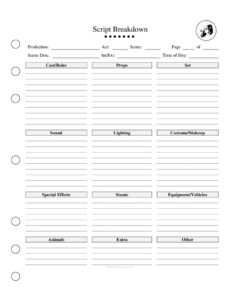
Script Breakdown
Download a free Script Breakdown template to organize props, cast, set, and effects scene by scene — free download in PDF and DOCX, no signup required.
PDF
DOC
6 downloads
0
likes
Download Files
- DOC
A Script Breakdown is the production document that translates a script into an organized, scene-by-scene list of everything needed to stage or shoot it — cast, props, set pieces, sound, lighting, costumes, and more. Stage managers, producers, and assistant directors use it most often to plan scheduling, budgeting, and rehearsals so nothing is forgotten on the day of performance or shoot. You can download this Script Breakdown template free in both PDF and DOCX formats, with no signup required.
What Is a Script Breakdown?
A Script Breakdown is a structured analysis that separates a script into its individual scenes and catalogs every physical, technical, and human element required to perform each one. It is typically prepared by a stage manager, production manager, or first assistant director after reading the script closely and identifying every cue, object, and person mentioned or implied. Rather than describing the story, it documents logistics: which actors appear, what props they handle, what the set looks like, and which departments — sound, lighting, costume, special effects — must deliver something. The completed breakdown becomes the master reference that drives scheduling, purchasing, hiring, and rehearsal planning across the entire production team.
When Do You Need a Script Breakdown?
A Script Breakdown earns its place whenever a production has more than a handful of moving parts. Common situations include:
- Pre-production planning — when a director and producer need to estimate costs, crew, and rental needs before committing to a budget.
- Scheduling rehearsals and shoots — grouping scenes by cast, location, or set so the calendar makes efficient use of everyone’s time.
- Building prop and costume lists — the breakdown feeds the props master and wardrobe team a complete inventory to source, build, or rent.
- Coordinating technical departments — lighting, sound, and special-effects teams use it to plan cues and effects for each scene.
- Managing complex elements — productions involving stunts, animals, vehicles, or pyrotechnics need every such moment flagged and assigned well in advance.
- Handing off between teams — when a stage manager updates a substitute or a touring crew inherits a show, the breakdown keeps everyone aligned.
What a Script Breakdown Should Have
A complete Script Breakdown captures both the identity of each scene and the resources it demands. The identifying details — production title, act, scene number, and page references — let anyone locate the scene in the script instantly. The descriptive details, such as the scene description, interior or exterior setting, and time of day, establish the mood and conditions. The bulk of the value lives in the element columns: cast and roles, props, set, sound, lighting, costume and makeup, special effects, stunts, equipment and vehicles, animals, extras, and an open field for anything else. A strong breakdown is consistent, color-coded or categorized by department, and updated whenever the script is revised.
How to Fill Out a Script Breakdown
- Production: Enter the title of the show or film at the top so the sheet is clearly attributed.
- Act and Scene: Record the act number and scene number being broken down, working through the script in order.
- Page x of y: Note the script pages this scene covers and the total, which helps gauge length and pacing.
- Scene Desc.: Write a short summary of the action so readers know what happens without re-reading the script.
- Int/Ext: Mark whether the scene is interior or exterior.
- Time of Day: Note day, night, dawn, or dusk to guide lighting and continuity.
- Cast/Roles: List every character who appears or speaks in the scene.
- Props: Itemize handheld and set-dressing objects the actors use.
- Set: Describe the location, backdrops, and furniture required.
- Sound, Lighting, Costume/Makeup: Record cues, looks, and wardrobe needs for each department.
- Special Effects, Stunts, Equipment/Vehicles, Animals, Extra, Other: Flag any of these elements present, then move to the next scene.
Tips for an Accurate Breakdown
The quality of a breakdown depends on careful reading. Go through the script at least twice — once to absorb the story, and again with a highlighter to mark every physical and technical element. Many productions assign a color to each category (props, costumes, set, and so on) so that a glance reveals which departments are involved in a scene. Be literal: if a character pours a glass of water, the glass and the water are both props, and the action may also create a sound or continuity note. Implied elements matter too — a scene set at night implies lighting work even if the script never says so. Number your scenes consistently with the script’s own structure to avoid confusion during revisions.
How It Fits Into the Production Workflow
Once the breakdown is complete, it becomes the backbone of several downstream documents. Producers pull from it to build budgets, since every prop, costume, and effect carries a cost. Stage managers and ADs use it to create a shooting or rehearsal schedule, grouping scenes that share a set or cast to minimize changeovers. Department heads extract their own lists — the props master takes the props column, wardrobe takes costume and makeup — so each team works from a single source of truth. Keeping the breakdown current as the script changes prevents the costly errors that arise when one department is working from an outdated page.
Common Mistakes to Avoid
- Skipping background elements — forgetting extras, set dressing, or ambient sound that the audience expects but the script only implies.
- Inconsistent scene numbering — using numbers that don’t match the script makes coordination with other departments error-prone.
- Vague entries — writing “props” instead of naming each item leaves the props team guessing.
- Ignoring revisions — failing to update the breakdown after script changes leads to missing or surplus elements.
- Overlooking safety-critical items — stunts, animals, vehicles, and special effects need early flagging because they require permits, rehearsal, or specialists.
- Not noting time of day or int/ext — omitting these makes lighting and continuity planning far harder.
Frequently Asked Questions
What is a Script Breakdown used for? It is used to organize a script into scenes and list every element — cast, props, set, sound, lighting, costumes, and effects — needed to produce each one. The document drives scheduling, budgeting, and department coordination throughout pre-production and the run of the show.
Who fills out a Script Breakdown? In theater it is usually the stage manager or production manager, and in film it is often the first assistant director. Whoever prepares it reads the script in detail and consults with department heads to confirm requirements.
How do I fill out the props and cast columns? List each item or character by name rather than using general labels — for example, write “letter, candlestick, teacup” instead of just “props.” Specificity lets the props master and casting team work directly from your sheet without having to reread the script.
Should I do a separate breakdown for every scene? Yes — the value of the document comes from analyzing each scene individually so nothing is overlooked. Many teams use one row or one sheet per scene and then compile them into a master schedule.
Is this Script Breakdown template free to download? Yes. You can download it free in both PDF and DOCX formats with no signup required, and edit the DOCX version to match your production’s needs.
Can I add or remove categories? Absolutely. The template includes common columns such as stunts, animals, and special effects, but you can delete categories you don’t need or add custom ones in the “Other” field to fit your specific show.
This Script Breakdown template is provided as a general example for informational purposes only and does not constitute legal, financial, or professional production advice. Production requirements, safety regulations, and permit rules vary by jurisdiction and venue — consult qualified professionals for your specific project.
Related Forms
- Multiple Location Schedule
- Audition Sheet
- Production Schedule
- Sound Cues Sheet
- Weekly Rehearsal Schedule
- Props List
Browse more in Theater.