
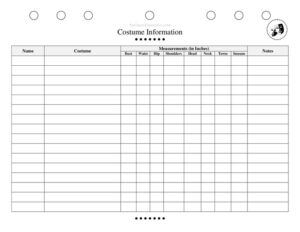
Costume Information Sheet
Download a free Costume Information Sheet template to track actor measurements, pieces, and quick changes for any production—free download in PDF and DOCX.
PDF
DOCX
33 downloads
0
likes
Download Files
- DOCX
A Costume Information Sheet is a single-page reference that records everything a wardrobe team needs to know about one actor’s costume in a production—measurements, garment pieces, accessories, and special notes. Most theaters and film crews use it to keep fittings, quick changes, and laundry organized across a busy run, and you can download it free here in PDF and DOCX with no signup required.
What Is a Costume Information Sheet?
A Costume Information Sheet is a costuming document used by wardrobe supervisors, costume designers, and stage managers to capture the details of an individual performer’s wardrobe. It typically lives in the production’s costume bible and is created for each actor or each character. The sheet documents who wears what, in which scene, along with the actor’s measurements and any items the wardrobe department must track. It serves as a master reference during fittings, dress rehearsals, the run of the show, and strike. When productions involve many cast members, multiple costume changes, or rented and built pieces, this sheet keeps the entire wardrobe operation accurate and repeatable from one performance to the next.
When Do You Need a Costume Information Sheet?
Wardrobe teams reach for this form whenever costumes need to be tracked methodically rather than from memory. Common scenarios include:
- Building the costume plot for a play or musical with a large ensemble and several scenes.
- Recording an actor’s measurements at an initial fitting so garments can be built, altered, or pulled from stock.
- Coordinating fast quick changes backstage, where dressers need to know exactly which pieces come off and go on.
- Managing rented or borrowed costumes that must be returned in good condition with every piece accounted for.
- Handing off wardrobe duties to a new crew member, swing, or understudy who needs to step in cleanly.
- Documenting costume condition, laundry instructions, and repairs across a long run or tour.
What a Costume Information Sheet Should Have
A complete sheet links a specific performer to a specific look. At minimum it should identify the production and the actor, list the character or characters played, and break down the costume by scene or act. It should record body measurements relevant to the garments being built or fitted, an itemized list of every piece and accessory, the source of each item (built, pulled, rented, or actor-owned), and notes on quick changes, dressing order, and care. Including a space for the date, the designer or supervisor’s name, and a photo or sketch reference makes the sheet far more useful during dress rehearsals and reliable across the entire run.
How to Fill Out a Costume Information Sheet
Because this template is a flexible single page, complete it section by section:
- Production details: Enter the show title, theater or company name, and the date the sheet was created or updated.
- Actor and character: Write the performer’s name and the character (or characters) they play, plus understudy or swing information if applicable.
- Measurements: Record the actor’s key measurements—height, chest or bust, waist, hips, inseam, neck, sleeve, shoe size, and hat size—taken at the fitting.
- Costume breakdown: List each look by scene or act, noting the pieces that make up that look.
- Itemized pieces: Enter every garment and accessory—tops, bottoms, outerwear, footwear, hats, jewelry, and props worn—on its own line.
- Source and status: Mark whether each item is built, pulled from stock, rented, or actor-owned, and note its current condition.
- Quick-change and dressing notes: Describe the order of dressing, any pre-sets, and changes that happen offstage.
- Care instructions: Add laundry, pressing, and repair notes.
- Reference and sign-off: Attach or describe a photo or sketch, then add the designer or wardrobe supervisor’s name.
Types of Costume Tracking Sheets
The Costume Information Sheet is one of several related wardrobe documents, and it helps to know how it fits with the others. A costume plot is the big-picture chart showing every character’s look in every scene across the whole show. A quick-change sheet zeroes in on the timed backstage changes that happen during performance. A measurement sheet captures only an actor’s body dimensions for building or shopping. The Costume Information Sheet pulls these threads together for a single performer, making it ideal for fittings and individual actor binders. Many productions use all of them side by side, with this sheet acting as the per-actor hub.
Tips for an Accurate, Useful Sheet
Take measurements over the kind of undergarments the actor will wear in the show, and note the date because bodies and casting can change. Use consistent piece names so the laundry crew, dressers, and designer all speak the same language. Photograph each completed look from the front and back and store the images with the sheet. Update the sheet whenever an alteration, swap, or repair happens, and keep a master copy in the costume bible while dressers work from copies backstage. For rentals, log condition on arrival so any damage at strike is clear.
Common Mistakes to Avoid
- Leaving measurements undated, so old numbers get used for a recast or re-fitting.
- Listing a vague “outfit” instead of itemizing every individual piece and accessory.
- Forgetting to note the source of an item, so rentals get mixed in with stock at strike.
- Skipping quick-change and dressing-order notes that backstage crew rely on under pressure.
- Omitting care instructions, leading to shrunken, faded, or damaged costumes mid-run.
- Keeping only one copy that lives with one person, leaving the team stranded if they’re out.
Frequently Asked Questions
What is a Costume Information Sheet used for? It is used to document and track everything about one performer’s costume in a production, including measurements, each garment and accessory, the source of each item, and quick-change notes. Wardrobe teams rely on it during fittings, dress rehearsals, the run of the show, and strike.
Who fills out a Costume Information Sheet? The costume designer, wardrobe supervisor, or a wardrobe crew member usually completes it, often at the actor’s first fitting. The actor or stage management may add information, but the wardrobe department typically owns and updates the sheet.
What measurements should I include? Include the measurements relevant to the garments being built or fitted—commonly height, chest or bust, waist, hips, inseam, neck, sleeve, shoe size, and hat size. Always note the date the measurements were taken, since they can change with casting or over a long run.
How is this different from a costume plot? A costume plot maps every character’s looks across the entire show at a glance, while a Costume Information Sheet focuses on one performer in detail. Most productions use both together, with this sheet serving as the per-actor reference.
Can I edit this template for my production? Yes. The DOCX version is fully editable, so you can add or remove sections, rename fields, and tailor the layout to a play, musical, opera, dance piece, or film. The PDF is ideal for printing clean copies for the costume bible and backstage stations.
Is this Costume Information Sheet free to download? Yes, it is completely free to download in both PDF and DOCX, with no signup or account required. You can print as many copies as your cast needs and reuse the template across multiple productions.
This Costume Information Sheet template is a general example provided for informational purposes only and is not professional or legal advice. Production needs, rental agreements, and wardrobe practices vary—adapt the form to your specific show and consult your designer, producer, or other qualified professional as needed.
Related Forms
- Storage Contents Tracker
- Theater Wallet Cards
- Comp Ticket Request Form
- Rehearsal Report
- Actor Breakdown
- Audition Sheet Musical
Browse more in Theater.