
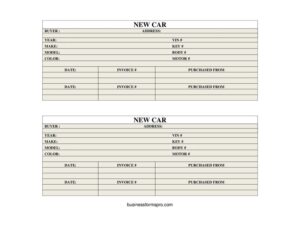
New Car Inventory Card
Track every vehicle in stock with a free New Car Inventory Card template — record VIN, make, model, key number and more, free download.
PDF
DOCX
0
likes
Download Files
- DOCX
A New Car Inventory Card is a single-vehicle record used by dealerships and fleet managers to capture the key identifying details of a car the moment it arrives in stock. The most common reason people use one is to keep accurate, at-a-glance control of every unit on the lot — what it is, where it came from, and where its keys live. You can download this template free in both PDF and DOCX, with no signup required.
What Is a New Car Inventory Card?
A New Car Inventory Card is a compact inventory document that records the essential specifications and acquisition details of one new vehicle. It is typically created by a dealership’s inventory clerk, sales manager, or fleet administrator when a car is received, and it travels with the vehicle’s file until the unit is sold. The card documents identifiers such as the VIN, year, make, model, color, and internal tracking numbers, alongside purchase information like the invoice number and where the car was purchased from. In short, it serves as the master reference sheet that ties a physical car on the lot to its paperwork, keys, and sales status.
When Do You Need a New Car Inventory Card?
This card is useful any time a vehicle enters or moves through your inventory. Common situations include:
- Receiving new stock: A new car arrives from the manufacturer or auction and needs to be logged before it hits the lot.
- Tracking keys: Pairing a key number to a body number so staff can locate the right keys quickly for test drives.
- Reconciling floor plan financing: Matching invoice numbers and purchase sources to lender records and monthly audits.
- Preparing for a sale: Recording the buyer and sale date when the vehicle is finally sold and removed from inventory.
- Conducting a physical lot audit: Walking the lot and verifying that each VIN and body number on file is physically present.
- Managing a small fleet: Keeping a tidy record of each company vehicle’s identifiers and acquisition history.
What a New Car Inventory Card Should Have
A complete card captures both the vehicle’s permanent identity and the details that change over its time in stock. The permanent identity comes from the manufacturer: the VIN, year, make, model, body number, motor number, and color. The acquisition details establish accountability and traceability: the date received, the invoice number, and who the car was purchased from. The operational details — the key number and eventually the buyer — make the card useful day to day, helping staff find keys and mark the unit as sold. Together these fields make the card a self-contained snapshot that anyone in the dealership can read without pulling additional files.
How to Fill Out a New Car Inventory Card
Work through the fields in a logical order, starting with the vehicle’s permanent details and finishing with sale information:
- Year: Enter the model year of the vehicle exactly as shown on the manufacturer’s documentation.
- Make: Record the manufacturer brand, such as Toyota, Ford, or Honda.
- Model: Write the specific model and trim, for example “Camry SE” or “F-150 XLT.”
- VIN #: Copy the full 17-character vehicle identification number carefully — double-check each character.
- Body #: Enter your internal body or stock number used to track the unit on the lot.
- Motor #: Record the engine or motor number if applicable to your tracking system.
- Color: Note the exterior color or factory color code.
- Key #: Write the key tag number so staff can match keys to the vehicle.
- Purchased From: Identify the source — the manufacturer, distributor, auction, or dealer.
- Invoice #: Enter the invoice or reference number tied to the acquisition.
- Date: Record the date the vehicle was received into inventory.
- Buyer: Leave blank until sold, then enter the buyer’s name to mark the unit as no longer in stock.
Organizing and Filing Your Inventory Cards
For the card to stay useful, store the cards in a consistent system. Many dealerships file by body number or VIN so any unit can be pulled instantly, while others keep cards in a binder organized by purchase date. Whichever method you choose, keep blank cards near the receiving area so new arrivals are logged immediately rather than from memory later. If you maintain a parallel digital spreadsheet, use the same field names — year, make, model, VIN, body number, key number — so the paper card and the database always agree during audits.
How It Differs From a Sales Record
It helps to understand what this card is not. A New Car Inventory Card tracks a vehicle’s presence and identity in stock; it is not a purchase agreement, title, or bill of sale. The single “Buyer” field exists only to mark the unit as sold and link it to the deal paperwork — the actual sale terms, financing, and warranties live in separate documents. Treating the inventory card as a quick-reference index, rather than a contract, keeps your records clean and your audits fast.
Common Mistakes to Avoid
- Transposing the VIN: A single wrong digit can mismatch the car to its title and financing — verify it twice.
- Leaving the key number blank: Without it, staff waste time hunting for keys when a customer wants a test drive.
- Forgetting to date the card: The received date is essential for floor plan interest and aging reports.
- Vague purchase source: “Auction” alone isn’t enough — name the specific source for traceability.
- Not updating the buyer field: An unmarked sold unit can stay on inventory reports long after it leaves the lot.
- Inconsistent body numbers: Using different stock numbers across systems makes reconciliation a headache.
Frequently Asked Questions
What is a New Car Inventory Card used for? It is a single-vehicle record that captures a car’s identifying details — VIN, year, make, model, color, and internal tracking numbers — along with its acquisition and key information. Dealerships and fleet managers use it to keep accurate control of every unit in stock and to speed up lot audits.
How do I fill out the card? Start with the permanent vehicle details (year, make, model, VIN, body number, motor number, color), then add operational and acquisition details (key number, purchased from, invoice number, and date received). Leave the buyer field blank until the vehicle is sold, then fill it in to mark the unit as gone.
Is a New Car Inventory Card a legal document? No, it is an internal tracking and record-keeping tool rather than a contract or title. The actual sale, financing, and ownership transfer are handled by separate legal documents such as a bill of sale and the vehicle title.
Where does the key number come from? The key number is usually the number stamped on the key tag your dealership assigns when a vehicle arrives. Recording it on the card lets any staff member quickly match a set of keys to the correct car.
Can I use this for a small fleet instead of a dealership? Yes. Fleet managers can use the same fields to log each company vehicle’s identity, purchase source, and key location, making it easy to track and verify the fleet during inventory checks.
How much does this template cost? Nothing — it is completely free to download in both PDF and DOCX formats, with no signup or payment required. You can print it as-is or edit the DOCX version to match your own inventory numbering system.
This New Car Inventory Card template is a general example provided for informational purposes only and does not constitute legal, financial, or tax advice. Inventory, titling, and dealer record-keeping requirements vary by jurisdiction — consult a qualified professional to ensure your records meet applicable regulations.
Related Forms
- Store Closing Procedure Checklist
- Computer Inventory
- Salad Bar Items Inventory Spreadsheet
- Lost And Found Log
- Fire Emergency Checklist
- Sterilization Log
Browse more in Log and Inventory.