
Recommendation for a Raise
Download a free Recommendation for a Raise letter template to help a deserving employee secure a salary increase, available in PDF and DOCX free download.
DOCX
0
likes
Download Files
- DOCX
A Recommendation for a Raise is a short business letter in which one person formally urges a decision-maker to grant another employee a pay increase. The most common reason people use it is to put their support for a colleague or direct report in writing so a manager or HR can act on it. You can download this template free in PDF and DOCX formats with no signup required.
What Is a Recommendation for a Raise?
A Recommendation for a Raise is a persuasive letter written by a supervisor, team lead, mentor, or senior colleague who believes someone on the team has earned higher compensation. It is addressed to the person who controls salary decisions — often a department head, business owner, or HR manager. The letter names the employee, states the request plainly, and then explains the reasoning behind it. Unlike a casual conversation, it creates a documented, considered case that can be reviewed, forwarded, and referenced during budget or performance discussions. It is a courtesy and an advocacy tool rolled into one, signaling that the writer stands behind the request and is available to answer follow-up questions.
When Do You Need a Recommendation for a Raise?
This letter is useful any time you want to formally champion someone’s compensation. Common situations include:
- A manager wants to recommend a high-performing direct report for a salary bump during the annual review cycle.
- A team lead notices a colleague has quietly taken on far more responsibility without a corresponding pay adjustment.
- An employee returns from a major project, certification, or milestone that warrants recognition.
- A department head is preparing the budget and wants written justification on file for a proposed increase.
- A mentor or senior peer wants to support a junior employee whose contributions might otherwise go unnoticed by leadership.
- You are responding to a retention concern — a valued team member is at risk of leaving, and you want to make the case to keep them with better pay.
What a Recommendation for a Raise Should Have
A strong letter is brief, specific, and confident. It should clearly identify who is being recommended and who the request is going to. It should state the request up front rather than burying it. The body must give concrete details — accomplishments, added responsibilities, measurable results, or consistent reliability — that justify the increase. It should maintain a professional, respectful tone toward the decision-maker, who ultimately owns the call. Finally, it should invite further discussion and close with a polite thank-you and the sender’s name. Avoiding vague praise in favor of evidence is what turns a friendly note into a convincing argument.
How to Fill Out a Recommendation for a Raise
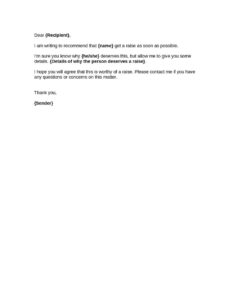
- Recipient: Replace {Recipient} with the name of the person who decides on pay — for example, “Dear Ms. Alvarez” or “Dear Mr. Chen.” Use a formal salutation.
- Employee name: In the line recommending that {name} get a raise, insert the full name of the person you are advocating for so there is no ambiguity.
- Pronouns: Update {he/she} to match the employee, or rephrase to use their name again if you prefer to avoid pronouns entirely.
- Details: Replace {Details of why the person deserves a raise} with two to four specific, evidence-based reasons — projects completed, revenue influenced, hours covered, skills gained, or sustained excellent performance. This is the heart of the letter.
- Closing: Keep the offer to answer questions, then sign with your own name in place of {Sender}. Add your job title and contact details beneath your name if helpful.
Writing Persuasive Details
The single most important section is the body where you explain why the person deserves a raise. Generic statements like “she works hard” rarely move a budget. Instead, anchor your reasons in observable facts. Did the employee take on a teammate’s workload during a vacancy? Did they lead a launch, close a difficult account, reduce errors, or earn a credential that benefits the team? Quantify wherever you can — percentages, dollar figures, deadlines beaten, or volume handled. If a number isn’t available, describe the impact in concrete terms a decision-maker can verify. Tying the request to the value the employee delivers makes it far easier for the recipient to approve.
Tone and Timing
Tone matters as much as content. Address the decision-maker as a respected peer, not a gatekeeper to be pressured. Acknowledge that the final decision is theirs while making your support unmistakable. Timing also helps: sending the letter ahead of review cycles, budget planning, or after a notable achievement increases its chances. Keep the letter to a single page; busy leaders are more likely to read and act on something concise. If the request is part of a formal review, pair the letter with any supporting documents your organization uses.
Common Mistakes to Avoid
- Being vague — offering praise without specific accomplishments or measurable results.
- Forgetting to replace a placeholder, such as leaving {name} or {he/she} in the final letter.
- Demanding rather than recommending; the tone should respect that the recipient owns the decision.
- Making it too long — a rambling letter loses the reader and dilutes the request.
- Suggesting a specific dollar amount when you don’t have the authority or information to do so, unless your role calls for it.
- Sending it to the wrong person; confirm who actually approves raises before addressing the letter.
Frequently Asked Questions
What is a Recommendation for a Raise letter? It is a short business letter in which one person formally asks a decision-maker to grant another employee a pay increase. It names the employee, states the request, and explains the reasons behind it. It serves as documented advocacy that can be reviewed and forwarded.
Who should write this letter? Typically a supervisor, team lead, mentor, or senior colleague who has direct knowledge of the employee’s work writes it. The writer should be someone whose opinion carries weight with the person who controls compensation. Even a peer can write one if they have credible insight into the employee’s contributions.
How specific should the details be? As specific as possible. Cite concrete accomplishments, added responsibilities, and measurable outcomes rather than general compliments. The more verifiable evidence you provide, the easier it is for the recipient to justify approving the raise.
Does this letter need to be signed or notarized? No notarization is required — this is an internal business letter, not a legal contract. You should sign it with your name and, ideally, your job title and contact information so the recipient can follow up. A digital signature or typed name is usually fine for internal use.
Is this letter legally binding? No. A recommendation expresses your support but does not obligate the company to grant a raise. The decision remains entirely with the person or process that approves compensation. The letter’s purpose is to influence and document, not to guarantee an outcome.
How much does this template cost? Nothing — it is completely free to download from Business Forms Pro in both PDF and DOCX formats, with no signup required. You can edit the DOCX version freely to match your situation, recipient, and the employee you’re recommending.
This template is a general example provided for informational purposes only and does not constitute legal, financial, or human-resources advice. Company policies and applicable employment rules vary by employer and jurisdiction — consult your HR department or a qualified professional before acting on compensation matters.
Related Forms
- New Product Announcement
- Past-Due Account
- Landlord Eviction For Cause
- Introducing New Salesperson
- 60 Days Past Due Letter
- Cease and Desist Harassment
Browse more in Business Letters.