
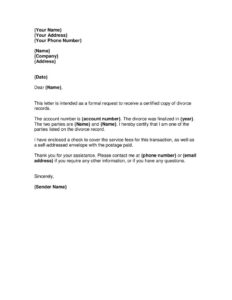
Request For Divorce Records
Use this free Request for Divorce Records letter template to formally ask for a certified copy of a divorce decree, with free PDF and DOCX download.
PDF
DOCX
2 downloads
0
likes
Download Files
- DOCX
A Request for Divorce Records is a formal letter you send to a court clerk, vital records office, or county recorder to obtain a certified copy of a divorce decree or record. People most often use it when they need official proof of a finalized divorce for remarriage, name changes, or legal and financial matters. You can download this template free in both PDF and DOCX formats, with no signup required.
What Is a Request for Divorce Records?
A Request for Divorce Records is a written letter that asks the office holding a divorce file to release a certified copy to a qualifying party. It is typically sent by one of the divorcing spouses, an attorney, or another authorized individual to the court or vital records agency that processed the case. The letter documents who is requesting the record, which divorce is involved, and confirms the requester’s eligibility to receive it. Because divorce records can contain sensitive personal details, many agencies restrict access to named parties or their representatives. This form provides a clean, professional way to make that request while including the certification and payment details most offices require.
When Do You Need a Request for Divorce Records?
A certified divorce record is required more often than people expect. Common situations include:
- Remarriage: Many states require a certified copy of your divorce decree before issuing a new marriage license.
- Name changes: Updating your name with the Social Security Administration, DMV, passport office, or banks may require proof of divorce.
- Immigration matters: Visa or residency applications frequently call for certified documentation of a prior marriage’s dissolution.
- Financial and legal needs: Refinancing a mortgage, settling an estate, or resolving benefits and pension questions may require the official record.
- Replacing lost documents: If your original decree was misplaced, damaged, or destroyed, a request restores your access to a certified copy.
- Genealogy or personal records: Keeping a complete personal archive of major life events.
What a Request for Divorce Records Should Have
To be processed smoothly, the letter should clearly identify both the requester and the record being sought. A complete request includes your full name, mailing address, and contact details; the recipient office’s name and address; the names of both parties to the divorce; the year the divorce was finalized; any account or case number; a certification that you are entitled to the record; and confirmation that the required fee and a self-addressed stamped envelope are enclosed. Including all of this up front reduces back-and-forth and speeds up turnaround.
How to Fill Out a Request for Divorce Records
- Enter {Your Name}, {Your Address}, and {Your Phone Number} at the top so the office knows exactly who is requesting the record and how to reach you.
- Address the letter to the correct office using the {Name}, {Company} (the court or vital records agency), {Address}, and {Date} fields.
- Open with the salutation Dear {Name}, naming the clerk or department contact if you have one.
- State the request and insert the {account number} or case number tied to the divorce file.
- Fill in the {year} the divorce was finalized to help staff locate the correct record.
- List both parties in the {Name} and {Name} fields exactly as they appeared at the time of the divorce.
- Keep the certification line confirming you are one of the parties listed on the record.
- Note that you have enclosed a check for service fees and a self-addressed, postage-paid envelope.
- Add your {phone number} and {email address} for follow-up questions, then sign off with {Sender Name}.
How Records Offices Handle These Requests
Divorce records are typically maintained by the clerk of the court in the county where the divorce was granted, though some states centralize records through a state vital records office or department of health. Access rules vary: certified copies are usually limited to the spouses, their attorneys, and sometimes immediate family, while informational copies may be more widely available. Before mailing, it helps to confirm the office’s exact fee, accepted payment methods, and any identity verification it requires. Some offices ask for a photocopy of a government-issued ID alongside the request. Sending a check made out to the correct payee and a self-addressed stamped envelope, as this template notes, keeps the process moving and avoids rejected requests.
Certified Copies vs. Informational Copies
It is worth knowing which type of record you actually need. A certified copy carries an official seal and signature and is the version accepted for legal purposes such as remarriage, name changes, and immigration. An informational copy contains the same information but is marked as not valid for official use and is often used for personal reference. This request letter is designed to obtain a certified copy, so specify that clearly and confirm the office can provide one before sending payment.
Common Mistakes to Avoid
- Sending it to the wrong office: Confirm whether the county court or the state vital records office holds the file before mailing.
- Omitting the case or account number: Without it, staff may be unable to locate older records quickly.
- Using current names instead of names at the time of divorce: List the parties as they appeared on the original record.
- Guessing the fee: An incorrect check amount can delay or reject your request — verify the current fee first.
- Forgetting the return envelope: Skipping the self-addressed, postage-paid envelope slows delivery of your copy.
- Leaving out contact details: Always include a phone number and email so the office can reach you with questions.
Frequently Asked Questions
What is a Request for Divorce Records? It is a formal letter sent to a court clerk or vital records office asking for a certified copy of a divorce decree or record. It identifies the requester, the parties to the divorce, and the case details, and confirms the requester’s right to access the file.
Who can request a divorce record? Access rules vary by jurisdiction, but certified copies are usually limited to the spouses named on the record, their attorneys, and in some cases immediate family or legal representatives. Many offices require proof of identity before releasing a certified copy.
How do I fill out this request letter? Add your name and contact information, address it to the correct records office, and include the case or account number, the year the divorce was finalized, and both parties’ names. Then confirm you are a party to the record and enclose the fee and a return envelope.
Does this request need to be notarized? Many offices do not require notarization for a basic records request, but some ask for a notarized signature or a copy of a photo ID for certified copies. Check the requirements of the specific office before mailing.
Is there a fee for divorce records? Yes — courts and vital records offices charge a service fee per certified copy, and the amount varies by location. This letter template, however, is completely free to download and use.
How long does it take to receive the record? Processing times range from a few days to several weeks depending on the office, the age of the record, and request volume. Including a self-addressed, postage-paid envelope and the correct fee helps avoid delays.
This template is a general example provided for informational purposes only and is not legal advice. Procedures and access rules for divorce records vary by state and county — consult the relevant records office or a qualified professional for guidance specific to your situation.
Related Forms
- Shareholder Ballot
- Reservation Request Letter
- Work Order
- Stained Items Release Form
- Day Off Request Form
- Suede Leather Items Release Form
Browse more in Request and Authorization.