
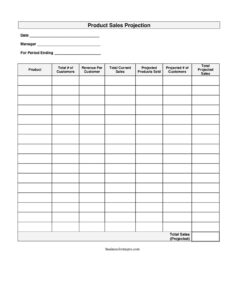
Sales Projection
Forecast revenue with a free Sales Projection template that maps customers, revenue per customer, and projected sales — free download in PDF and DOCX.
PDF
DOCX
2 downloads
0
likes
Download Files
- DOCX
A Sales Projection is a forecasting worksheet that estimates how much a product or product line will sell over an upcoming period, based on customer counts and revenue per customer. Sales teams most often use it to set targets, plan inventory, and brief leadership on expected revenue. You can download this Sales Projection template free in both PDF and DOCX, with no signup required.
What Is a Sales Projection?
A Sales Projection is a structured estimate of future sales for a given product over a defined period. It is typically prepared by a sales manager, account lead, or business owner and presented to executives, finance, or operations. The document captures where sales stand today and where they are expected to land, translating assumptions about customer volume and average revenue into a single projected sales figure. Unlike a sales report, which records what already happened, a projection looks forward. It serves as both a planning tool and a benchmark: once the period closes, actual results can be compared against the projection to measure accuracy and refine future forecasts.
When Do You Need a Sales Projection?
A Sales Projection becomes useful any time you must estimate revenue before it arrives. Common situations include:
- Quarterly or annual planning — setting product-level revenue targets for the period ending on a specific date.
- Budgeting and cash flow — giving finance a credible number to plan expenses, payroll, and purchasing against.
- Inventory and supply decisions — using projected products sold to order stock or schedule production without overcommitting.
- Sales territory or manager reviews — comparing a manager’s projection to actual results to evaluate performance.
- Investor or lender conversations — supporting a funding request with a defensible, product-by-product revenue forecast.
- New product launches — modeling expected customer counts and revenue per customer before a product hits the market.
What a Sales Projection Should Have
A complete Sales Projection ties together a few interlocking numbers so the math is transparent and easy to defend. It should clearly identify the period, the responsible manager, and the product, then walk from current sales to projected sales using customer volume and average revenue. The strongest projections show their assumptions: how many customers you expect, what each is worth, and how that compares to where you are now. When every figure is visible, reviewers can question one input without discarding the entire forecast — which is exactly what makes the document trustworthy.
- A clear period and preparation date.
- The manager or owner accountable for the numbers.
- The specific product being forecast.
- Current performance and forward-looking projections side by side.
- The customer and revenue-per-customer assumptions behind the total.
How to Fill Out a Sales Projection
- Date: Enter the date you are preparing the projection so readers know how current the assumptions are.
- Manager: Write the name of the person responsible for the forecast and its accuracy.
- For period ending: State the close date of the period being projected — for example, the end of a quarter, month, or fiscal year.
- Product: Name the specific product or product line this projection covers. Use one sheet per product for clarity.
- Total # of customers: Record how many customers currently buy this product.
- Revenue per customer: Enter the average amount each customer spends on the product.
- Total current sales: Multiply current customers by revenue per customer, or pull the actual figure from your records.
- Projected products sold: Estimate the number of units you expect to sell during the period.
- Projected # of customers: Enter the customer count you expect to reach.
- Total projected sales: Multiply projected customers by revenue per customer to arrive at the forecasted revenue total.
How to Build Realistic Assumptions
The credibility of a Sales Projection rests entirely on its inputs. Rather than guessing a final revenue number and working backward, build it from the bottom up: start with how many customers you realistically expect and what each is likely to spend. Ground those estimates in history — last period’s actuals, seasonal patterns, your sales pipeline, and known wins or losses. If you are projecting growth, name the driver, whether that is a new marketing campaign, a price change, or an expanded territory. It often helps to prepare conservative, expected, and optimistic versions so leadership can see the range. A projection that admits uncertainty is far more useful than one that pretends to be exact.
Projection vs. Quota vs. Budget
These terms are easy to confuse but serve different purposes. A sales projection is an honest estimate of what you believe will happen. A quota is a target assigned to a salesperson or team, which may be set higher than the projection to motivate effort. A budget is a financial plan that often relies on the projection but commits the organization to specific spending levels. Keeping these separate prevents a common pitfall: treating an aspirational quota as if it were a realistic forecast, which leads to overspending and cash shortfalls when results fall short.
Common Mistakes to Avoid
- Inflating customer counts to hit a desired total — the math only helps if the inputs are honest.
- Using a stale revenue-per-customer figure that ignores recent price changes or discounting.
- Forgetting the period end date, which makes the projection impossible to evaluate later.
- Mixing multiple products on one sheet, so weak and strong performers hide each other.
- Ignoring seasonality and assuming every period performs like an average month.
- Never comparing projection to actuals, so forecasting accuracy never improves over time.
Frequently Asked Questions
What is a Sales Projection used for? It is used to estimate future revenue for a product so you can plan inventory, set budgets, and establish targets. By breaking the forecast into customer counts and revenue per customer, it shows leadership exactly how a revenue number was derived. It also becomes a benchmark to measure actual results against once the period ends.
How do I calculate total projected sales? Multiply your projected number of customers by your revenue per customer to get total projected sales. You can cross-check this against projected products sold times the product’s price. If the two figures diverge sharply, one of your assumptions likely needs adjusting.
How is a projection different from current sales? Total current sales reflect what is happening now or recently, while projected sales estimate what will happen by the period’s end. Showing both side by side makes the expected growth — or decline — visible at a glance. The gap between them is your forecasted change for the period.
Who should prepare the Sales Projection? Usually the sales manager, account owner, or business owner responsible for the product prepares it, since they understand the customer base and pricing best. The manager’s name is recorded on the form to establish accountability. Finance or leadership then reviews and consolidates individual projections.
Is a Sales Projection legally binding? No. A projection is an internal planning estimate, not a contract or guarantee of results. It carries no legal obligation, though it should still be prepared honestly, especially if shared with investors or lenders.
Is this Sales Projection template really free? Yes. You can download it free in PDF and DOCX with no signup or payment required. Use the editable DOCX to plug in your own products and assumptions, or print the PDF for review meetings.
This Sales Projection template is a general example provided for informational purposes only and does not constitute financial, accounting, or tax advice. Forecasting practices and reporting requirements vary by industry and organization — consult a qualified financial professional before relying on any projection for business decisions.
Need to work out sales tax? Use our free Sales Tax Calculator to add or remove sales tax from any amount in seconds.
Official resource: for the rules that apply to your situation, see the U.S. Small Business Administration.
Related Forms
- Livestock Bill Of Sale
- Rebate Tracker
- Proposal Form
- Ebay Auction Worksheet
- Sales Phone Log
- New Customer Form
Browse more in Sales.