
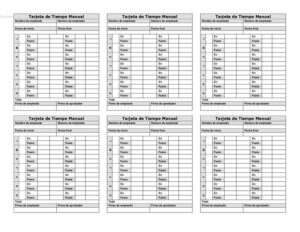
Tarjeta De Tiempo Manual Miniatura
Download a free Tarjeta de Tiempo Manual Miniatura template to track employee hours by hand in a compact format — free PDF and DOCX download, no signup.
PDF
DOCX
0
likes
Download Files
- DOCX
The Tarjeta de Tiempo Manual Miniatura is a compact, hand-filled timecard used to record an employee’s daily start times, stop times, breaks, and total hours worked. People most often reach for it when they need a simple paper way to track hours without a punch clock or payroll software. It is free to download here in both PDF and DOCX formats, with no signup required.
What Is a Tarjeta de Tiempo Manual Miniatura?
A Tarjeta de Tiempo Manual Miniatura is a miniature manual time card — a small, single-sheet document that an employee or supervisor completes by hand to log working hours over a defined pay period. It is typically issued by an employer, a small-business owner, or an office manager and kept on file as the source record for calculating wages. The card documents who worked, on which days, the times they clocked in and out, any unpaid breaks, and the resulting total hours. Because it is compact, it suits a desk drawer, a clipboard at the time-tracking station, or a wallet-sized pocket. It serves as both a payroll input and a basic attendance record.
When Do You Need a Tarjeta de Tiempo Manual Miniatura?
- You run a small business or shop without an electronic punch clock and need a reliable paper record of hours.
- You employ hourly workers, contractors, or temporary staff whose pay depends on exact start and stop times.
- You manage a job site, restaurant, or retail floor where employees record their own time on a clipboard.
- You need a portable, pocket-sized way to track field hours away from the main office.
- You want a backup paper trail in case digital time-tracking systems fail or are unavailable.
- You need to document attendance and hours for an audit, a wage dispute, or year-end recordkeeping.
What a Manual Time Card Should Have
A complete miniature manual time card should leave no doubt about who worked and how long. At minimum it should capture the employee’s name and identifying information, the pay period or week covered, and the company or department. Each working day needs a row with the date, time in, time out, and any break taken. The card should also provide a place to total daily and weekly hours, distinguish regular hours from overtime, and include signature lines for both the employee and the supervisor or manager who verifies the entries. Clear column labels keep the small format readable and reduce errors during payroll calculation.
How to Fill Out a Tarjeta de Tiempo Manual Miniatura
- Write the employee’s full name and, if used, an employee or badge number at the top of the card.
- Enter the company or department name so the card can be matched to the correct payroll group.
- Record the pay period start and end dates, or the week ending date, so totals tie to the right cycle.
- For each workday, write the date in the date column.
- Enter the time in when the shift begins, using a consistent format such as AM/PM or 24-hour time.
- Note the start and end of any unpaid break or lunch in the break columns.
- Enter the time out when the shift ends.
- Calculate and write the total hours for that day, subtracting unpaid breaks.
- Add up the daily totals to get regular hours, and note any overtime separately.
- Have the employee sign and date the card, then have the supervisor review and sign to approve.
Tips for Accurate Manual Time Tracking
Because a manual time card relies on handwriting, small habits make a big difference. Ask employees to record times in real time rather than reconstructing them at the end of the week, which reduces guesswork and rounding errors. Use a consistent time format across every entry — mixing 12-hour and 24-hour notation is a common source of confusion. Decide in advance how breaks are handled and whether time is rounded to the nearest five or fifteen minutes, then apply that rule the same way for everyone. Write legibly in ink, and have someone other than the employee verify the totals before they reach payroll. Keep completed cards organized by pay period so they are easy to retrieve later.
Recordkeeping and Why It Matters
A time card is more than a payroll worksheet — it is a record you may need to keep on file. Many jurisdictions require employers to retain accurate records of hours worked for a set number of years, and a signed manual card can serve as evidence if a question arises about pay, attendance, or overtime. Store completed cards securely, whether in a physical folder or as scanned copies, and limit access to those who handle payroll. If you transition to a digital system later, your historical paper cards remain a valuable archive. Note that specific retention periods and overtime rules vary by location, so confirm the requirements that apply to your workplace.
Common Mistakes to Avoid
- Filling in times from memory at the end of the week instead of recording them as shifts happen.
- Mixing time formats so that 1:00 could mean morning or afternoon.
- Forgetting to subtract unpaid breaks before calculating daily totals.
- Leaving the pay period or week-ending dates blank, making it unclear which cycle the card covers.
- Skipping the employee or supervisor signature that verifies the entries are accurate.
- Using pencil or correction fluid in a way that makes the record look altered or unreliable.
Frequently Asked Questions
What is a Tarjeta de Tiempo Manual Miniatura used for? It is a compact paper time card used to manually record an employee’s start times, stop times, breaks, and total hours for a pay period. Employers use it as the source record for calculating wages and tracking attendance, especially when no electronic punch clock is available.
How do I fill out a manual time card correctly? Start with the employee’s name, company, and pay period, then record the date, time in, break, and time out for each workday. Subtract unpaid breaks to get daily totals, add them for the week, and have both the employee and supervisor sign to confirm accuracy.
Does a manual time card need to be signed? While a signature is not always legally required, having both the employee and a supervisor sign is strongly recommended. The signatures confirm the hours are accurate and approved, which helps prevent disputes and supports the record if it is ever reviewed.
Is a paper time card still valid for payroll? Yes. A clearly completed and signed manual time card is a legitimate basis for calculating pay and documenting hours worked. Many small businesses rely on paper cards, though you should keep them organized and retain them according to the recordkeeping rules in your area.
How long should I keep completed time cards? Retention requirements vary by jurisdiction, but many employers keep payroll and time records for several years. Check the rules that apply to your location and industry, and when in doubt keep records longer rather than discarding them too soon.
How much does this time card template cost? Nothing — the Tarjeta de Tiempo Manual Miniatura is completely free to download from Business Forms Pro in both PDF and DOCX formats. There is no signup required, and you can print or edit it to match your own pay periods and labels.
This template is provided as a general example for informational purposes only and does not constitute legal, financial, or tax advice. Wage, overtime, and recordkeeping requirements vary by jurisdiction and over time, so consult a qualified professional or your local labor authority to ensure your time-tracking practices comply with the rules that apply to you.
Official resource: for the rules that apply to your situation, see the U.S. Department of Labor.
Related Forms
- Payroll Statement
- Absentee Report Form
- Job Acceptance Letter
- Education Verification
- Promotion Request Letter
- Shift Trade Request
Browse more in Employment.