
Education Verification
Download a free Education Verification letter template to confirm a job applicant's degree, dates, and GPA with any school. Free PDF and DOCX download.
DOCX
0
likes
Download Files
- DOCX
An Education Verification letter is a formal request an employer sends to a school, college, or university to confirm that a job applicant actually attended and earned the credentials they listed. It is the standard tool HR teams use to validate degrees during the hiring process, and you can download it free in PDF and DOCX with no signup required.
What Is an Education Verification Letter?
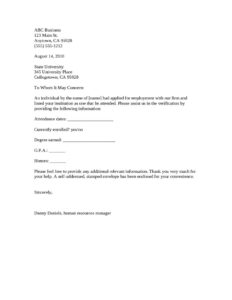
An Education Verification letter is a written request issued by an employer’s human resources department to an educational institution. It asks the school’s registrar or records office to confirm details an applicant provided on a resume or application — typically the dates the person attended, whether they are currently enrolled, the degree they earned, their grade point average, and any honors received. The letter documents that the employer made a good-faith effort to confirm credentials, and it creates a paper trail for the hiring file. It is a routine part of background screening alongside employment and reference checks, and is usually sent before a final offer is extended or shortly after a conditional offer.
When Do You Need an Education Verification Letter?
Employers and HR professionals reach for this letter at several points in the hiring and recordkeeping cycle. Common situations include:
- Confirming a degree before extending an offer — when a role requires a specific diploma, certification, or graduate credential.
- Verifying claims on a resume or application — checking that the listed institution, dates, and degree match school records.
- Screening for licensed or regulated positions — where proof of education is legally or contractually required.
- Validating GPA or honors for entry-level hiring — when academic performance is a selection criterion for recent graduates.
- Detecting resume fraud — confirming that a degree was actually completed and not merely attended.
- Updating personnel records — documenting credentials for promotions, audits, or compliance reviews.
What an Education Verification Letter Should Have
A clear, professional verification letter should include several core elements so the receiving institution can respond quickly and accurately. Start with your company’s letterhead: business name, full mailing address, and phone number. Add the date and the complete name and address of the school you are contacting. The body should clearly name the applicant being verified, state the reason for the request, and list the specific items you need confirmed — attendance dates, enrollment status, degree earned, GPA, and honors. Close with a polite thank-you, your signature, and your title. Including a self-addressed, stamped envelope and your contact details encourages a prompt reply.
How to Fill Out an Education Verification Letter
- Add your company information. Replace the placeholder business name, street address, city, state, ZIP, and phone (e.g., “ABC Business, 123 Main St., Anytown, CA 95928, (555) 555-1212”) with your own.
- Enter the date. Use the date you are sending the letter so the school can timestamp its response.
- Address the institution. Fill in the school’s name and address (e.g., “State University, 345 University Place, Collegetown, CA”). Use the registrar’s office where possible.
- Insert the applicant’s name. Replace [name] with the full legal name the applicant used while enrolled.
- List the items to verify. Leave blank lines for the school to complete: Attendance dates, Currently enrolled? (yes/no), Degree earned, G.P.A., and Honors.
- Invite extra detail. Keep the line inviting any additional relevant information.
- Sign and title the letter. Replace “Danny Daniels, human resources manager” with your name and role, and enclose the self-addressed, stamped envelope mentioned in the closing.
Tips for Getting a Faster Response
Schools receive many verification requests, so a few small steps speed things up. Many institutions now route verifications through a third-party clearinghouse or an online portal rather than responding to letters directly — call the registrar first to confirm their preferred method. If the school accepts written requests, include a signed authorization or release from the applicant, because privacy rules often prevent schools from releasing records without the student’s consent. Provide the applicant’s date of birth or student ID if you have it, since common names can slow a search. Finally, the self-addressed, stamped envelope referenced in the template genuinely improves return rates, so don’t skip it.
Education Verification vs. Employment Verification
These two documents are easy to confuse because they often travel together in a background check, but they serve different purposes. An Education Verification letter goes to a school and confirms academic credentials — dates attended, degree, GPA, and honors. An Employment Verification letter goes to a former employer and confirms work history, job title, and dates of employment. Use the education version when the credential itself matters to the role, and pair it with employment verification when you need a complete picture of an applicant’s background.
Common Mistakes to Avoid
- Forgetting applicant consent. Many schools will not release records without written authorization, so include a signed release.
- Using a nickname. Always list the applicant’s full legal name as it appeared during enrollment, not a preferred or shortened name.
- Omitting your contact details. Without a phone number or return envelope, responses stall or never arrive.
- Addressing it to the wrong office. Send the request to the registrar or records department, not a general admissions address.
- Being vague about what you need. List each item — dates, enrollment status, degree, GPA, honors — so the school can answer precisely.
- Acting on a degree before it is confirmed. Wait for the written reply before relying on the credential for a final decision.
Frequently Asked Questions
What is an Education Verification letter used for? It is used by employers to confirm that a job applicant actually attended an institution and earned the credentials they claimed. The letter requests attendance dates, enrollment status, degree, GPA, and honors directly from the school. It protects employers from resume fraud and documents due diligence in the hiring file.
How do I fill out the Education Verification template? Replace the sample company details with your own, add the date and the school’s address, and insert the applicant’s full legal name where the placeholder appears. Then list the items you want the registrar to confirm, sign with your name and title, and enclose a self-addressed, stamped envelope. Editing takes only a few minutes in the DOCX version.
Does the applicant need to give permission? Yes, in most cases. Educational records are protected by privacy rules, and many schools require a signed release from the applicant before they will release any information. It is best practice to collect that authorization at the application stage and reference or attach it with your request.
Is this verification letter legally binding? The letter itself is a request, not a contract, so it is not binding in the way an agreement would be. However, the completed response from the school becomes part of your hiring records and may be referenced if a credential is later disputed. Keep both the request and the reply on file.
How long does education verification take? It varies by institution. A response by mail can take one to three weeks, while online portals or verification clearinghouses may confirm within a day or two. Calling the registrar first to learn their process is the fastest path.
Is this template really free to download? Yes. The Education Verification letter is completely free to download in both PDF and DOCX formats, with no signup or payment required. You can customize the DOCX to match your company letterhead and reuse it for every applicant.
This template is a general example provided for informational purposes only and is not legal, HR, or compliance advice. Privacy and background-check requirements vary by jurisdiction and by institution — consult a qualified professional or your legal counsel before relying on this document in your hiring process.
Official resource: for the rules that apply to your situation, see the U.S. Department of Labor.
Related Forms
- Injury Report
- Consent to Release Personnel Information
- Interview Schedule
- Employment Confirmation Letter
- Project Time Card With Approval
- Employee Checkout
Browse more in Employment.