
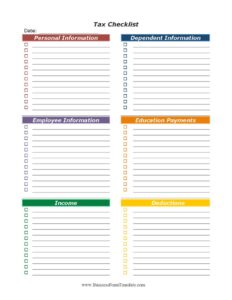
Tax Checklist
Use this free Tax Checklist template to gather every document and detail you need before filing — organized, complete, and ready as a free download.
PDF
1 downloads
0
likes
Download Files
A Tax Checklist is a single organized worksheet that helps you collect every document, number, and detail you need before preparing or filing your tax return. People most often use it to avoid scrambling at the last minute — gathering income statements, deduction records, and dependent information in one place. This Tax Checklist template is free to download in PDF and DOCX, with no signup required.
What Is a Tax Checklist?
A Tax Checklist is a preparation tool used by individual taxpayers, families, and small business owners — and often provided by accountants and tax preparers — to make sure nothing is overlooked before a return is completed. Rather than being filed with any tax authority, it documents what you have on hand: personal and dependent details, employment and income sources, education payments, and potential deductions. It serves as a working reference you can hand to a preparer or use yourself when entering figures into tax software. By organizing the inputs in advance, the checklist reduces errors, speeds up filing, and helps you confirm you have supporting paperwork for every line you intend to claim.
When Do You Need a Tax Checklist?
A Tax Checklist is useful any time you are getting ready to file, but it becomes especially valuable in these situations:
- Before your first appointment with a tax preparer — so you arrive with everything they will ask for instead of making a second trip.
- When your situation changed during the year — a new dependent, a new job, a side income source, or a return to school.
- If you have multiple income sources — wages, freelance work, interest, dividends, or rental income that each generate separate documents.
- When you claim education credits or deductions — tuition statements and student loan interest records are easy to forget.
- For families with dependents — to confirm you have Social Security numbers, dates of birth, and care expense records for each child.
- At the start of tax season every year — as a reusable routine so you build the same complete file annually.
What a Tax Checklist Should Have
A complete Tax Checklist captures the inputs needed to prepare an accurate return without forcing you to file the form itself. The essential sections include a preparation date, your personal identifying information, details for each dependent, employee and employment information, education payment records, all sources of income, and the deductions you plan to claim. Each section should leave space to note whether the supporting document is in hand, pending, or not applicable. The strongest checklists also include a place to flag follow-up items — a missing statement, a number you need to confirm, or a question for your preparer — so nothing falls through the cracks before the filing deadline.
How to Fill Out a Tax Checklist
- Date: Enter the date you are preparing the checklist so you can track which tax year and version it applies to.
- Personal information: Record your full legal name, Social Security or taxpayer ID number, address, and filing status. If filing jointly, include your spouse’s details too.
- Dependent information: List each dependent with their full name, relationship to you, date of birth, and Social Security number. Note any child or dependent care expenses.
- Employee information: Capture employer names and the wage statements you expect (such as W-2 forms), plus any withholding amounts shown.
- Education payments: Document tuition paid, scholarships received, and student loan interest, attaching or referencing the relevant statements.
- Income: List every income source — wages, self-employment, interest, dividends, retirement distributions, and other earnings — and check off the supporting document for each.
- Deductions: Note potential deductions such as mortgage interest, charitable donations, medical expenses, and retirement contributions, with records to back each one.
Organizing Your Supporting Documents
The checklist works best when paired with a simple filing system. As you check off each item, drop the matching document into a labeled folder — physical or digital — so the paperwork and the checklist stay together. Group documents the same way the checklist is organized: one section for income statements, one for deduction receipts, and one for dependent and education records. Keep your prior-year return nearby, since it often lists the same income sources and deductions you will encounter again. This habit not only speeds preparation but also leaves you with an audit-ready file if a tax authority ever requests substantiation for a claim.
How It Differs From the Tax Return Itself
It is important to understand that a Tax Checklist is not a tax return and is never submitted to a tax authority. The return is the official document that calculates what you owe or are refunded; the checklist is the preparation step that ensures the return is accurate and complete. Think of the checklist as the shopping list and the return as the finished meal — one feeds the other. Because it is an internal planning tool, you can adapt the checklist freely, add custom rows for unusual income or deductions, and reuse it year after year without any formal requirements.
Common Mistakes to Avoid
- Forgetting secondary income — small freelance payments, interest, or dividends are easy to miss but still reportable.
- Wrong or missing Social Security numbers for dependents, which can delay credits or trigger rejection of an e-filed return.
- Claiming deductions without records — list only what you can support with a receipt or statement.
- Overlooking education payments such as tuition statements or student loan interest that may qualify for credits.
- Not updating the checklist when your filing status, dependents, or employment changed during the year.
- Mixing tax years — always label the checklist with the correct year so documents do not get confused.
Frequently Asked Questions
What is a Tax Checklist used for? It is a preparation worksheet that lists every document and detail you need before filing your tax return. Using it helps you gather personal information, dependent records, income statements, and deduction proof in one organized place so nothing is missed.
How do I fill out a Tax Checklist? Start by entering the date and your personal information, then work through dependents, employment, education payments, income, and deductions. Check off each item as you confirm you have the supporting document, and flag anything still outstanding to follow up on later.
Do I need to submit the Tax Checklist with my return? No. The checklist is a personal organizing tool and is never filed with any tax authority. Only your actual tax return and required schedules are submitted; the checklist simply helps you prepare them accurately.
Is a Tax Checklist legally binding? No, it is not a binding document or a tax filing. It carries no legal weight on its own and exists purely to help you organize information before completing the official forms.
How much does this Tax Checklist template cost? It is completely free to download from Business Forms Pro in both PDF and DOCX formats, with no signup or payment required. You can reuse and customize it for each tax year.
Can I reuse the same checklist every year? Yes. Many people keep a fresh copy for each tax year, updating the date and adjusting for any changes in dependents, income, or deductions. The DOCX version makes it easy to edit and save year over year.
This Tax Checklist template is provided as a general example for informational purposes only and is not legal, financial, or tax advice. Tax rules and documentation requirements vary by jurisdiction and change over time — consult a qualified tax professional or accountant for guidance specific to your situation.
Need to work out sales tax? Use our free Sales Tax Calculator to add or remove sales tax from any amount in seconds.
Official resource: for the rules that apply to your situation, see the IRS.
Related Forms
Browse more in Tax Schedules.