
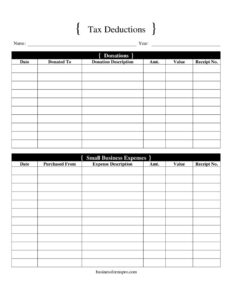
Tax Deductions
Track charitable donations and small business expenses with this free Tax Deductions template, available as a PDF and DOCX download to simplify tax time.
PDF
DOCX
2 downloads
0
likes
Download Files
- DOCX
A Tax Deductions worksheet is a simple recordkeeping form used to log charitable donations and small business expenses throughout the year so you have organized, receipt-backed totals at tax time. Most people reach for it because scrambling to reconstruct a year of deductible spending in April is stressful and error-prone. This template is free to download in PDF and DOCX, with no signup required.
What Is a Tax Deductions Worksheet?
A Tax Deductions worksheet is a personal or business tracking document that records expenses and contributions you may be able to deduct when filing your income taxes. It is typically maintained by an individual taxpayer, freelancer, or small business owner rather than issued by an authority. The form documents the date, recipient or vendor, a description, the amount or value, and a receipt number for each entry. Its purpose is to create a clear, itemized trail that supports the deductions you claim and makes it easy for you or your accountant to total figures, cross-check receipts, and complete the relevant tax schedules accurately.
When Do You Need a Tax Deductions Worksheet?
This form is useful anytime you want to capture deductible activity as it happens rather than relying on memory. Common situations include:
- You donate cash, goods, or property to qualifying charities and want to track each gift and its value.
- You run a small business or side hustle and need to log purchases of supplies, equipment, or services.
- You are self-employed or a freelancer separating business spending from personal spending.
- You expect to itemize deductions instead of taking the standard deduction and need supporting detail.
- You want a single place to record receipt numbers so documents can be located quickly during an audit or review.
- You are preparing year-end summaries to hand to a tax preparer or accountant.
What a Tax Deductions Worksheet Should Have
A complete worksheet pairs identifying information with two clear sections: one for donations and one for business expenses. Each line entry should capture a date, the party involved (who you donated to or purchased from), a plain description, the dollar amount or fair value, and a receipt or reference number. Including the taxpayer name and tax year at the top keeps multi-year records from getting mixed up. The strongest worksheets leave room for running totals and a note about how each value was determined, since donated goods and certain expenses may need a fair-market-value or cost basis.
How to Fill Out a Tax Deductions Worksheet
- Enter your Name exactly as it appears on your tax return so the record matches your filing.
- Write the Year the worksheet covers; use a separate sheet for each tax year.
- In the Donations section, record the Date of each gift.
- Fill in Donated To with the full name of the charity or organization.
- Add a Donation Description, such as “cash gift” or “five bags of clothing.”
- Enter the Amt. (quantity or cash amount) and the Value (dollar value or fair market value of goods).
- List the Receipt No. tied to the donation acknowledgment.
- In the Small Business Expenses section, record the purchase Date.
- Enter Purchased From (the vendor or supplier name).
- Add the Expense Description, then the Amt., Value, and Receipt No. for that purchase.
Types of Deductions You Might Track
Although this worksheet focuses on two broad categories, the entries within each can vary widely. Charitable donations may include cash contributions, donated household goods, used vehicles, or appreciated property, each of which can carry different valuation rules. Small business expenses might cover office supplies, software subscriptions, professional services, mileage-related purchases, marketing costs, or equipment. Keeping descriptions specific—”laser printer toner” rather than just “supplies”—helps you and your preparer categorize each entry onto the correct line of a tax return later. When in doubt about whether something qualifies, log it anyway; it is easier to remove an entry than to recover a lost record after the year closes.
Tips for Reliable Recordkeeping
Update the worksheet regularly instead of saving everything for tax season. Attach or file the matching receipt for every line, and use the Receipt No. field as the link between this sheet and your physical or digital files. For donated goods, jot down how you arrived at the value, since thrift-store pricing or appraisal notes support fair-market-value claims. Keep business and personal expenses strictly separate, and store completed worksheets with your tax documents for the recommended retention period. A consistent file-naming habit—year plus category—makes retrieval painless if questions arise later.
Common Mistakes to Avoid
- Recording an amount without a corresponding Receipt No., leaving the deduction unsupported.
- Mixing personal purchases into the business expenses section.
- Estimating donated-goods value with no basis or note explaining the figure.
- Skipping the Year field and combining multiple tax years on one sheet.
- Using vague descriptions that make it impossible to categorize entries later.
- Waiting until tax season to enter a full year of transactions from memory.
Frequently Asked Questions
What is a Tax Deductions worksheet used for? It is a tracking tool for logging charitable donations and small business expenses you may be able to deduct on your tax return. The worksheet keeps the date, recipient or vendor, description, value, and receipt number in one place. This makes totaling figures and supporting claims far easier at filing time.
How do I fill out the donation section? For each gift, enter the date, the organization you donated to, a short description, the cash amount or fair value, and the receipt number from the acknowledgment. Use the value field for the dollar worth of non-cash items. Keep your supporting receipt filed under the same receipt number for quick reference.
Does this worksheet need to be notarized or witnessed? No. A Tax Deductions worksheet is a personal recordkeeping document, not a legal instrument, so it does not require notarization or witnesses. What matters is that each entry is accurate and backed by a receipt or acknowledgment you can produce if asked.
Can I use this for both personal and business deductions? Yes. The template has a dedicated section for charitable donations and a separate section for small business expenses, so you can track both on one sheet. Keep the categories distinct, and use a separate worksheet for each tax year to avoid confusion.
Is this Tax Deductions template really free? Yes, it is completely free to download here in both PDF and DOCX formats, with no signup or payment required. You can print the PDF to fill in by hand or edit the DOCX version on your computer. Use as many copies as you need.
Will tracking expenses guarantee the deduction is allowed? No. This worksheet organizes your records, but whether a specific expense or donation qualifies depends on current tax rules and your individual circumstances. Good records support a deduction, but eligibility and valuation rules vary, so confirm details with a qualified tax professional.
This template is a general example provided for informational purposes only and is not legal, financial, or tax advice. Tax rules, deduction eligibility, and recordkeeping requirements vary by jurisdiction and change over time. Consult a qualified tax professional or accountant about your specific situation before filing.
Need to work out sales tax? Use our free Sales Tax Calculator to add or remove sales tax from any amount in seconds.
Official resource: for the rules that apply to your situation, see the IRS.
Related Forms
Browse more in Tax Schedules.