
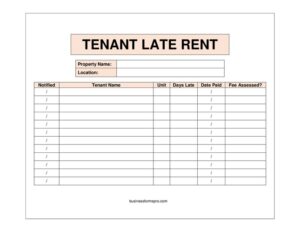
Tenant Late Rent Log
Track overdue payments accurately with our free Tenant Late Rent Log template, recording dates, amounts, and late fees for every tenant—free download.
PDF
DOCX
0
likes
Download Files
- DOCX
A Tenant Late Rent Log is a simple record-keeping document landlords use to track when rent is paid late, how much was owed, and what late fees applied. The most common reason people use it is to keep an organized, date-stamped history of overdue payments in case a dispute, eviction, or tax question arises. You can download this template free in both PDF and DOCX formats—no signup required.
What Is a Tenant Late Rent Log?
A Tenant Late Rent Log is a running ledger maintained by a landlord or property manager that documents every instance a tenant fails to pay rent on time. It typically captures the tenant’s name and unit, the rent due date, the date payment was actually received, the amount owed versus the amount paid, any late fee charged, and notes about the circumstances. The log serves as a factual, chronological record rather than a legal demand. Landlords use it to spot patterns of chronic lateness, to calculate cumulative fees, and to support any future notice, mediation, or court filing with clear, contemporaneous evidence rather than relying on memory.
When Do You Need a Tenant Late Rent Log?
A late rent log is useful any time payment timing matters, which—for a landlord—is nearly always. Common situations include:
- Recurring late payments: A tenant who consistently pays a few days late, where you want a documented pattern before issuing a notice.
- Calculating late fees: Recording the exact number of days overdue so the correct fee can be applied per your lease.
- Preparing for eviction or a pay-or-quit notice: Courts and notices benefit from a precise payment history.
- Managing multiple units or tenants: Keeping each tenant’s payment behavior separate and traceable.
- Year-end accounting and taxes: Reconciling collected rent, outstanding balances, and fee income.
- Responding to tenant disputes: When a tenant claims they paid on time, your dated log provides a clear counter-record.
What a Tenant Late Rent Log Should Have
A complete log balances simplicity with enough detail to stand up later. At minimum it should identify the property and tenant, then record each late event clearly. Essential elements include:
- Tenant name and unit or property address.
- The rent due date for the period in question.
- The date payment was actually received (or marked unpaid).
- The full rent amount due and the amount actually paid.
- The number of days late and the late fee assessed.
- The remaining balance, if partially paid.
- A notes column for context—bounced check, partial payment, promised date, or communication received.
How to Fill Out a Tenant Late Rent Log
Work through the log entry by entry, updating it each time rent is late:
- Enter the tenant and property: Write the tenant’s full name and the unit number or address at the top so the log is tied to a specific lease.
- Record the rent due date: Note the date rent was contractually due for the period, typically the first of the month.
- Log the date received: When payment arrives, write the actual receipt date; if still unpaid, mark it as outstanding.
- Note the amount due and paid: Record the full rent owed and the amount actually received to flag any partial payments.
- Calculate days late: Count from the due date (or the end of any grace period) to the received date.
- Apply the late fee: Enter the fee charged according to your lease terms.
- Show the balance: List any remaining amount owed after the payment.
- Add notes: Briefly document anything relevant—reason given, payment method, or a follow-up promise.
Tips for Keeping an Accurate Log
The value of a late rent log lies in its consistency and accuracy. Update it the same day a payment arrives or the moment it becomes overdue, rather than reconstructing entries weeks later. Use objective, neutral language in the notes section—stick to facts like “check returned for insufficient funds” instead of opinions or frustration. Keep the log alongside copies of receipts, bank deposit records, and any written communication with the tenant so the entries can be corroborated. If you manage several rentals, maintain a separate log per tenant or per unit to avoid confusion. Storing both a printed copy and a digital backup ensures you do not lose months of records to a single mishap.
How a Late Rent Log Differs From a Notice
It is important to understand that a Tenant Late Rent Log is a private record, not a legal demand. A pay-or-quit notice or late rent notice is a formal document delivered to the tenant requiring action, often with strict timing and content rules set by local law. The log, by contrast, is the behind-the-scenes documentation that supports such a notice—it shows the history that justifies it. Keeping a thorough log first makes drafting an accurate notice far easier, because you already have exact dates and amounts at hand. Many landlords use the log as the source of truth and then issue separate, jurisdiction-compliant notices when action becomes necessary.
Common Mistakes to Avoid
- Filling it out from memory: Delayed entries lose accuracy; record events promptly.
- Forgetting the grace period: If your lease grants a grace period, calculate days late from its end, not the due date.
- Charging fees not allowed by the lease or local law: Late fees must follow your lease and any local caps.
- Mixing tenants on one sheet: Combine records and you risk confusion and disputes.
- Leaving the notes blank: Context like partial payments or returned checks matters later.
- Not backing up the log: A single lost document can erase your only payment evidence.
Frequently Asked Questions
What is a Tenant Late Rent Log used for? It is used to document every time a tenant pays rent late, including the due date, the date received, amounts, and any late fee. Landlords rely on it to track patterns, calculate fees correctly, and keep evidence in case of a future dispute or legal proceeding.
Is a late rent log legally required? No, keeping a log is generally not required by law, but it is a strongly recommended best practice. Accurate, contemporaneous records make it much easier to support a notice or court case and to defend against tenant claims about payment timing.
Does a Tenant Late Rent Log need to be signed or notarized? No. Because it is an internal record kept by the landlord rather than an agreement between parties, it does not require a signature, witness, or notarization. Its credibility comes from being consistent, dated, and supported by receipts.
How do I calculate the days late? Count from the rent due date—or from the end of any grace period your lease provides—to the date the payment was actually received. The resulting number determines whether a late fee applies and how much, based on your lease terms.
Can I use this log in court or for an eviction? A detailed log can serve as supporting documentation, but it is not a substitute for the legally required notices and filings that vary by jurisdiction. Pair it with receipts and proper notices, and follow your local procedures closely.
How much does this template cost? Nothing—the Tenant Late Rent Log is completely free to download in PDF and DOCX formats with no signup. You can print it for handwritten use or edit the DOCX to fit your properties.
This template is a general example provided for informational purposes only and is not legal, financial, or tax advice. Landlord-tenant rules, late fee limits, and notice requirements vary by jurisdiction—consult a qualified attorney or professional for guidance specific to your situation.
Official resource: for the rules that apply to your situation, see HUD.
Related Forms
- Tenant Lease Breaking Request Letter
- Rental Agreement Violation
- Notice of Lease Termination
- Landlord Change of Ownership
- Tenant Repair Deductible
- Landlord Proof of Residency
Browse more in Landlord Documents.