
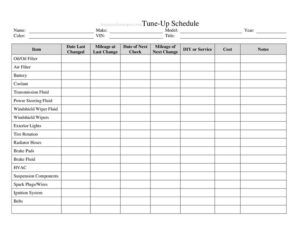
Tune-Up Schedule
Track every service interval with our free Tune-Up Schedule template, helping you log mileage, dates, and maintenance tasks; free download in PDF and DOCX.
PDF
DOCX
2 downloads
0
likes
Download Files
- DOCX
A Tune-Up Schedule is a maintenance planning document that lays out when each routine service task should be performed on a vehicle, based on mileage or time intervals. The most common reason people use one is to stay ahead of wear-and-tear and avoid costly breakdowns by knowing exactly what is due and when. You can download this Tune-Up Schedule for free in both PDF and DOCX formats, with no signup required.
What Is a Tune-Up Schedule?
A Tune-Up Schedule is a simple chart or table that organizes a vehicle’s recurring maintenance into clear intervals, such as every 3,000 miles, 30,000 miles, or once per season. It is used by individual car owners, fleet managers, dealerships, and auto repair shops to document what service was completed, when, and at what odometer reading. Rather than relying on memory, the schedule turns vague intentions into a written plan that lists each task, its recommended frequency, the date it was last done, and when it is next due. It serves as both a planning tool and a service history record that supports resale value and warranty compliance.
When Do You Need a Tune-Up Schedule?
A Tune-Up Schedule is useful any time you want to manage vehicle upkeep proactively instead of reactively. Common situations include:
- Buying a used vehicle — you want to start a clean maintenance record and catch up on any overdue services.
- Managing a fleet — a business tracking multiple cars, vans, or trucks needs a consistent schedule for each unit.
- Selling a car — a documented tune-up history reassures buyers and can increase resale value.
- Preserving a warranty — many manufacturer warranties require proof that scheduled maintenance was performed on time.
- Preparing for long trips or seasons — drivers map out fluid changes, tire rotations, and inspections before heavy use.
- Running a repair shop — service advisors give customers a clear roadmap of upcoming recommended work.
Types of Maintenance Intervals
Most tune-up plans group tasks by how often they recur. Short-interval items, such as oil and filter changes or tire pressure checks, may appear every few thousand miles. Mid-interval items like air filter replacement, tire rotation, and brake inspection often fall around 15,000 to 30,000 miles. Long-interval items — spark plugs, timing belts, transmission fluid, and coolant flushes — may be spaced 60,000 miles or more apart. A good Tune-Up Schedule reflects all three tiers so nothing slips through the cracks.
What a Tune-Up Schedule Should Have
To be genuinely useful, a complete Tune-Up Schedule should include vehicle identification details, a clear list of maintenance tasks, recommended intervals expressed in miles and/or time, the date and odometer reading each task was last completed, the next-due target, the service provider or technician, and a notes column for parts used or observations. Including space for cost helps with budgeting, and a signature or initials field adds accountability when multiple people share responsibility.
How to Fill Out a Tune-Up Schedule
- Enter vehicle information. Record the make, model, year, and VIN at the top so the schedule clearly belongs to one vehicle.
- List each maintenance task. Write out items such as oil change, tire rotation, brake inspection, air filter, spark plugs, and fluid flushes in the task column.
- Set the recommended interval. Beside each task, note the manufacturer-recommended mileage or time frame from your owner’s manual.
- Log the last service. Fill in the date and odometer reading when each task was last completed.
- Calculate the next-due point. Add the interval to the last-service figure to get a target mileage or date.
- Identify the provider. Note the shop, dealership, or person who performed or will perform the work.
- Add cost and notes. Record what you paid and any parts numbers, fluid types, or warnings the technician mentioned.
- Confirm completion. Initial or check off each task once it is done to keep the record current.
Building Your Schedule Around the Owner’s Manual
The single best source for accurate intervals is the vehicle manufacturer’s maintenance guide, usually found in the owner’s manual or the manufacturer’s website. Different makes and engines call for very different schedules — a turbocharged engine may need more frequent oil changes, while a vehicle driven in dusty conditions might require earlier air filter swaps. Use the manual to set your baseline intervals, then adjust for your real driving habits. “Severe service” schedules apply to short trips, towing, extreme heat or cold, and stop-and-go traffic, and they shorten many of the recommended intervals.
Keeping the Record Useful Over Time
A Tune-Up Schedule only helps if it stays current. Update it immediately after each service while the receipt is in hand, and keep the document with your other vehicle records. If you maintain it digitally in the DOCX version, you can sort by next-due date to see what is coming up. For sellers, attaching a complete schedule alongside receipts creates a credible paper trail that demonstrates the car was cared for, which often shortens negotiations and supports a stronger asking price.
Common Mistakes to Avoid
- Using generic intervals instead of the figures specified for your exact make, model, and engine.
- Tracking only mileage and ignoring time-based intervals like brake fluid or coolant that degrade even on low-mileage cars.
- Forgetting to log the odometer reading, which makes it impossible to calculate the next-due point accurately.
- Leaving the notes column blank, so you lose track of which parts or fluids were used.
- Updating the schedule sporadically, letting it fall out of sync with the vehicle’s actual service history.
- Overlooking severe-service conditions that call for shorter intervals than the standard schedule.
Frequently Asked Questions
What is a Tune-Up Schedule used for? It is used to plan and document recurring vehicle maintenance so each task is performed at the right mileage or time. It helps owners, fleets, and shops avoid missed services, prevent breakdowns, and keep an accurate service history that supports warranty claims and resale.
How do I know what intervals to use? The most reliable source is your vehicle’s owner’s manual or the manufacturer’s website, which lists factory-recommended intervals for each task. If you drive under severe conditions like towing or frequent short trips, follow the shorter “severe service” intervals where provided.
Is a Tune-Up Schedule a legally binding document? No, it is a maintenance planning and record-keeping tool, not a contract. However, a well-maintained schedule combined with receipts can serve as supporting evidence of service history when you make a warranty claim or sell the vehicle.
Do I need to track both miles and dates? Yes, because some components wear with use while others degrade over time regardless of mileage. Tracking both ensures items like oil changes (mileage-driven) and brake fluid or coolant (often time-driven) are addressed on schedule.
Can I use this for more than one vehicle? You can, but it is best to use a separate copy for each vehicle so the intervals and history stay accurate. Since the template is free to download, simply save a fresh copy for every car, van, or truck you manage.
How much does this template cost? It is completely free to download here in both PDF and DOCX formats, with no signup or payment required. You can print the PDF for the glove box or edit the DOCX version on your computer to match your vehicle’s specific tasks.
This Tune-Up Schedule template is provided as a general example for informational purposes only and does not constitute mechanical, legal, or warranty advice. Maintenance requirements vary by vehicle make, model, and driving conditions, and warranty terms differ by manufacturer — always consult your owner’s manual and a qualified service professional for guidance specific to your vehicle.
Official resource: for the rules that apply to your situation, see your state DMV.
Related Forms
- Auto Estimate Form
- Vehicle Invoice
- New Car Comparison
- Salesperson Commission Voucher
- Deal Recap
- Odometer Statement
Browse more in Auto Sales.