
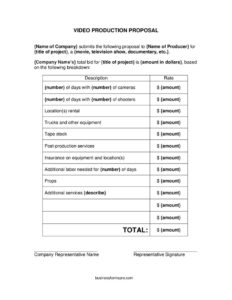
Video Production Proposal
Download a free Video Production Proposal template to bid on film, TV, and documentary projects with a clear cost breakdown — free download in PDF/DOCX.
PDF
DOCX
3 downloads
0
likes
Download Files
- DOCX
A Video Production Proposal is a document a production company submits to a producer or client to bid on a specific project, laying out the total cost and a detailed line-item breakdown of crew, equipment, locations, and post-production. People most often use it to win a shoot by presenting a clear, professional quote that the producer can compare and approve. You can download this Video Production Proposal template free in both PDF and DOCX formats — no signup required.
What Is a Video Production Proposal?
A Video Production Proposal is a formal bid issued by a production company to a producer, brand, agency, or studio for a defined video project — a movie, television show, commercial, documentary, or similar work. It documents the scope of the work, the total dollar amount the company is proposing to charge, and the exact cost breakdown behind that number. Beyond the price, it identifies the project by title and type, names both parties, and is signed by a company representative. In practice it functions as both a sales pitch and the foundation for a production agreement, giving the producer a transparent view of how shoot days, cameras, crew, equipment rentals, and post-production add up to the final bid.
When Do You Need a Video Production Proposal?
This proposal is the standard first step whenever a production company wants to formally compete for or confirm a paid project. Common situations include:
- Bidding to shoot a commercial or branded video for an advertising agency that requested competing quotes.
- Quoting a documentary with multiple shoot days, travel, and location rentals that need to be itemized.
- Pitching to produce episodes of a television show where camera counts and crew sizes drive the budget.
- Responding to a producer’s request for proposal (RFP) on a short film or music video.
- Presenting a transparent cost breakdown to a corporate client funding an internal training or promotional video.
- Locking in scope and price before contracts are drafted for a multi-day shoot involving rented trucks, equipment, and additional labor.
What a Video Production Proposal Should Have
A complete proposal makes the price easy to understand and easy to approve. The essential elements are the names of both the production company and the producer, the project title and type, and the total bid amount stated clearly up front. Below that, an itemized breakdown should account for every cost driver: the number of shoot days, the number of cameras and shooters, location rentals, trucks and equipment, tape stock or media, post-production services, equipment and location insurance, additional labor, and props. Each line should pair a clear description with a rate. Finally, the proposal needs a company representative’s printed name and signature to show it is an authorized offer.
How to Fill Out a Video Production Proposal
- Enter your Name of Company and the Name of Producer the proposal is submitted to.
- Add the title of project and select the project type — movie, television show, documentary, commercial, etc.
- State your company’s total bid as a dollar amount; this is the headline figure the breakdown will justify.
- For each line, write a description and the corresponding rate.
- Specify the number of days with the number of cameras, and separately the number of days with the number of shooters.
- List location rental costs, then trucks and other equipment.
- Add tape stock (media/storage), post-production services, and insurance on equipment and locations.
- Enter additional labor needed and the number of days it covers, plus props.
- Describe any additional services in the space provided.
- Have the company representative print their name and sign to authorize the bid.
Building an Accurate Line-Item Breakdown
The credibility of a proposal lives in its breakdown. Producers want to see that your total isn’t a guess — it’s the sum of defensible parts. Tie each line to a unit and a rate: a camera day, a shooter day, a location flat fee, or a per-item equipment charge. Separating cameras from shooters matters because a two-camera, single-operator day costs differently than a multi-shooter day. Group post-production (editing, color, sound, graphics) clearly, since clients often scrutinize it. Listing insurance on equipment and locations signals professionalism and protects you if something goes wrong on set. When the math is transparent, the producer can negotiate specific lines rather than rejecting the whole bid.
From Proposal to Production Agreement
A signed proposal is an offer, not always a binding contract on its own. Once the producer accepts, many teams convert the agreed scope and price into a formal production services agreement covering payment schedules, deliverables, ownership and licensing of footage, revision rounds, and cancellation terms. Treat the proposal as the commercial backbone that those later documents reference. Keep a dated copy of every version you submit, because revised camera counts, added shoot days, or expanded post-production should each be reflected in an updated bid so there are no surprises when the invoice arrives.
Common Mistakes to Avoid
- Vague line items. “Production costs — $X” invites doubt; break it into cameras, crew, locations, and post.
- Omitting insurance. Leaving out equipment and location insurance can expose you to losses and looks unprofessional to seasoned producers.
- Mismatched totals. Always confirm the itemized lines actually add up to the stated total bid.
- Forgetting day and unit counts. Listing cameras or shooters without the number of days makes the rate impossible to verify.
- No defined scope for additional services. An open-ended “additional services” line should describe exactly what’s included to prevent scope creep.
- Missing signature. An unsigned proposal is just a draft — the representative’s name and signature make it a real offer.
Frequently Asked Questions
What is a Video Production Proposal used for? It is used by a production company to formally bid on a video project, stating the total cost and a detailed breakdown of crew, cameras, equipment, locations, and post-production. Producers use it to compare options and decide whether to award the project. It also serves as the basis for a later production agreement.
How do I fill out a Video Production Proposal? Start by naming your company and the producer, the project title, and its type, then state your total bid amount. Below that, itemize each cost — camera days, shooter days, locations, trucks and equipment, tape stock, post-production, insurance, labor, and props — pairing every line with a clear rate. Finally, have your company representative print their name and sign.
Is a Video Production Proposal legally binding? On its own, a proposal is generally an offer rather than a binding contract. It typically becomes enforceable once both parties agree and sign, or when it is incorporated into a formal production services agreement. Requirements vary by jurisdiction, so confirm what makes an agreement binding where you operate.
Does the proposal need to be notarized or witnessed? Video production proposals usually do not require notarization or witnesses; a company representative’s signature is normally sufficient to present a valid offer. Some clients or larger projects may request additional formalities or countersignatures. Check the producer’s procurement requirements before submitting.
How much does this template cost? This Video Production Proposal template is completely free to download from Business Forms Pro in both PDF and DOCX formats, with no signup required. You can edit the DOCX version to match your branding, rates, and the specific scope of each project. Reuse it for as many bids as you like.
Should I include taxes and a payment schedule in the proposal? It is good practice to clarify whether your total bid includes applicable taxes and to outline expected payment milestones, such as a deposit before the shoot and a balance on delivery. Doing so prevents disputes after the project is awarded. Tax treatment varies by location, so confirm the correct handling for your area.
This Video Production Proposal template is a general example provided for informational purposes only and is not legal, financial, or tax advice. Requirements for bids, contracts, and production agreements vary by jurisdiction and project. Consult a qualified attorney or professional advisor before relying on this document.
Related Forms
- Actor Release Form
- Script Supervisor Notes
- Production Assistant Breakdown
- Daily Production Report
- Appearance Release Form
- Extras Release Form
Browse more in Film Production Forms.