
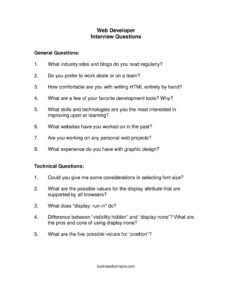
Web Developer Interview Questions
Use this free Web Developer Interview Questions template to structure consistent technical and general interviews — free download in PDF and DOCX.
PDF
DOCX
2 downloads
0
likes
Download Files
- DOCX
A Web Developer Interview Questions template is a ready-made list of general and technical prompts that hiring managers use to evaluate front-end and full-stack candidates consistently. Most teams reach for it to standardize interviews so every applicant is judged against the same criteria. It’s free to download here in both PDF and DOCX, with no signup required.
What Is a Web Developer Interview Questions Template?
A Web Developer Interview Questions template is a structured interview guide that combines behavioral and personality questions with hands-on technical questions about HTML, CSS, and front-end fundamentals. It’s typically used by hiring managers, technical leads, recruiters, and HR coordinators when screening candidates for web development roles. The document captures what to ask and provides space to gauge how a candidate thinks, communicates, and applies knowledge. Rather than improvising on the spot, interviewers use the template to keep conversations on track, compare applicants fairly, and surface both soft skills (like teamwork and curiosity) and concrete technical depth (like understanding CSS positioning or the difference between visibility:hidden and display:none). It works equally well for phone screens and in-person rounds.
When Do You Need a Web Developer Interview Questions Template?
- You’re filling a front-end, full-stack, or junior web developer position and want every interviewer asking the same baseline questions.
- A startup or small business is hiring its first developer and the founders aren’t sure what technical questions to ask.
- An HR coordinator needs to pre-screen candidates before passing them to the technical team.
- You’re building a structured interview process to reduce bias and document evaluations consistently.
- A senior developer is asked to interview but wants a quick framework instead of preparing questions from scratch.
- You’re refreshing an outdated question bank and need a starting point that mixes culture-fit and skills-based prompts.
Two Types of Questions Inside
This template intentionally splits into two halves. The General Questions section explores how a candidate works, stays current, and grows — covering the blogs they follow, whether they prefer solo or team work, their comfort writing HTML by hand, favorite tools, what they want to learn, past websites, personal projects, and graphic design experience. The Technical Questions section drills into CSS fundamentals: font-size considerations, valid display values across browsers, what display: run-in does, the contrast between visibility:hidden and display:none, and the five values for position. Together they reveal both mindset and mastery.
What a Web Developer Interview Should Cover
- Background and motivation — past projects, personal work, and what excites the candidate about the field.
- Working style — comfort with collaboration versus independent work and how they fit your team.
- Core technical fundamentals — HTML and CSS knowledge that signals real hands-on experience.
- Problem-solving and reasoning — how clearly they explain trade-offs, like the pros and cons of display:none.
- Tooling and continuous learning — favorite development tools and the skills they want to improve.
- Space to score and take notes — so you can compare candidates objectively afterward.
How to Fill Out a Web Developer Interview Questions Template
- Start with the General Questions to build rapport. Ask what industry sites and blogs they read regularly to gauge how current they stay.
- Ask whether they prefer to work alone or on a team and note how their answer fits your environment.
- Probe technical comfort with writing HTML entirely by hand — a quick signal of fundamentals versus reliance on builders.
- Have them name a few favorite development tools and explain why, then which skills or technologies they most want to improve.
- Review past work by asking what websites they’ve worked on and whether they’re building any personal web projects.
- Ask about graphic design experience to understand their visual range.
- Move into the Technical Questions: discuss font-size considerations, list possible display values supported by all browsers, explain display: run-in, contrast visibility:hidden with display:none, and name the five values for position.
- Record answers and a score in the margins as you go so you can compare candidates fairly later.
How to Get the Most From the Technical Questions
The technical prompts in this template are deliberately conceptual rather than puzzle-style, so they work even in a short conversation. Listen less for textbook-perfect answers and more for clear reasoning. For example, when a candidate explains the difference between visibility:hidden (the element is invisible but still occupies space) and display:none (the element is removed from layout entirely), the strongest candidates will mention the accessibility and reflow implications without being prompted. Likewise, asking for the five position values — static, relative, absolute, fixed, and sticky — quickly separates people who have actually built layouts from those who memorized definitions. Feel free to follow up with a real scenario from your own codebase to see how they apply the concept.
Tips for a Fair, Effective Interview
Ask the same core questions of every candidate so your comparisons are apples-to-apples, and reserve follow-up questions for genuine curiosity rather than tripping people up. Give candidates a moment to think on technical items — silence is fine. Take notes immediately while answers are fresh, and define in advance what a strong, average, and weak response looks like so the panel scores consistently. Finally, leave time at the end for the candidate to ask their own questions; what they ask is often as revealing as how they answer yours.
Common Mistakes to Avoid
- Only asking technical questions and ignoring working style, communication, and growth mindset.
- Treating answers as pass/fail instead of evaluating the reasoning behind them.
- Not standardizing questions across interviewers, which makes fair comparison impossible.
- Skipping note-taking and trying to recall details hours later.
- Over-indexing on trivia like obscure CSS values rather than real-world problem-solving.
- Forgetting to tailor the questions to the actual seniority and stack of the role.
Frequently Asked Questions
What is a Web Developer Interview Questions template? It’s a structured guide that combines general behavioral questions with technical HTML and CSS questions to help interviewers evaluate web developer candidates consistently. It keeps interviews focused and makes it easier to compare applicants fairly.
How do I use this template in an interview? Start with the general questions to build rapport and understand the candidate’s background and working style, then move into the technical questions to assess fundamentals. Take notes and score answers as you go so you can review them objectively afterward.
Can I customize the questions for my role? Yes. The template is fully editable in DOCX, so you can add framework-specific questions, remove items that don’t apply, or adjust difficulty for junior versus senior candidates. Tailoring it to your actual tech stack makes the interview far more useful.
Are these technical questions still relevant? The CSS fundamentals covered — display values, positioning, and the difference between visibility and display — remain core knowledge for front-end developers. You can supplement them with questions about modern frameworks, responsive design, or JavaScript to round out the picture.
Is this interview template free to download? Yes, it’s completely free to download in both PDF and DOCX formats with no signup required. Use the PDF as a print-ready interview sheet or edit the DOCX to fit your team’s process.
Should I ask candidates the same questions every time? For fairness and easier comparison, ask every candidate the same core set of questions, then use follow-ups to explore individual answers. Consistency reduces bias and helps your hiring panel reach a defensible decision.
This template is a general example provided for informational purposes only and is not legal, HR, or employment advice. Hiring and interview practices vary by jurisdiction and organization — consult a qualified human resources or legal professional to ensure your process complies with applicable laws.
Official resource: for the rules that apply to your situation, see the U.S. Department of Labor.
Related Forms
- System Administrator Interview Questions
- Restaurant Manager Interview Questions
- Car Salesperson Interview Questions
- Quality Assurance Engineer Interview Questions
- Personal Assistant Interview Questions
- Teacher Interview Questions
Browse more in Interview Questions.