
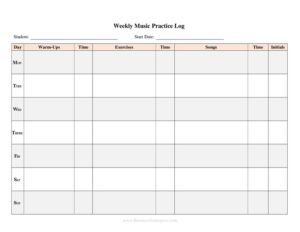
Weekly Music Practice Log
Track daily practice time, songs, and progress with our free Weekly Music Practice Log template — free download in PDF and DOCX, no signup.
PDF
DOCX
7 downloads
0
likes
Download Files
- DOCX
A Weekly Music Practice Log is a simple one-page sheet for recording how much you practice each day, what you worked on, and the progress you made over a single week. Students, parents, and teachers use it most often to keep practice consistent and to prove that assigned minutes were actually completed. It’s free to download in both PDF and DOCX formats, with no signup required.
What Is a Weekly Music Practice Log?
A Weekly Music Practice Log is a tracking sheet that breaks one week into days and captures the details of each practice session for an instrument or voice. It typically records the date, instrument, pieces or exercises worked on, the number of minutes practiced, and a short note on what improved or still needs attention. Music teachers issue these logs to students so practice happens between lessons; parents use them to supervise younger players; and self-directed musicians keep them to build a steady habit. Rather than relying on memory, the log turns vague “I practiced some” into concrete, reviewable data that both student and teacher can act on at the next lesson.
When Do You Need a Weekly Music Practice Log?
A practice log is useful any time you want practice to be intentional and measurable rather than random. Common situations include:
- Weekly lessons with assigned homework — your teacher wants proof that you practiced specific scales, etudes, or songs the required number of minutes.
- Parents tracking a child’s progress — a parent signs off each day to confirm the young musician sat down and played.
- Preparing for a recital, audition, or exam — you need to log focused repetition on difficult passages in the weeks leading up to a performance.
- Building a daily habit — a beginner uses the log to hit a target like 20 minutes a day and to see streaks form.
- Music programs or schools — band, orchestra, or private studios require a signed log for grading or participation credit.
- Adult learners juggling busy schedules — the log helps fit practice into the week and shows where time actually went.
What a Weekly Music Practice Log Should Have
A complete log balances enough detail to be useful with enough simplicity that it gets filled out. The essentials are: a place for the student’s name and instrument, the week’s date range, a row for each day of the week, columns for the minutes practiced and the material covered, a notes or goals area, and a signature or initial line for verification. A running total of weekly minutes is helpful for spotting whether you hit your target. Many logs also leave room for the teacher’s comments or the next assignment, so the single sheet carries information in both directions between lessons.
How to Fill Out a Weekly Music Practice Log
- Enter your name and instrument at the top so the log is clearly identified, especially in a studio with many students.
- Write the week’s date range (for example, Monday through Sunday) so each completed sheet covers one defined period.
- Note your weekly goal, such as a target number of minutes or a specific piece to memorize, so you have something to measure against.
- For each day, fill in the date on the matching row.
- Record the minutes practiced for that day, writing zero honestly on days you skip.
- List the songs, scales, or exercises you worked on, being specific (“C major scale, measures 12–20 of the sonatina”).
- Add a short progress note describing what improved or what felt hard.
- Total the week’s minutes at the bottom and compare against your goal.
- Have a parent or teacher sign or initial if verification is required, then bring the log to your next lesson.
Tips for Practice That Actually Sticks
The log works best when you treat it as a tool, not a chore. Fill it out immediately after each session while the details are fresh — trying to reconstruct a whole week on Sunday night defeats the purpose. Be specific about material: writing “played guitar” tells you nothing next month, but “worked the B-section chord changes slowly with metronome at 70 bpm” tells you exactly where you left off. Use the notes column to flag trouble spots so your teacher can target them. Many musicians find that short, daily sessions logged honestly beat one long cram session, and the log makes that pattern visible. Over several weeks, stack the sheets to see real trends in consistency and growth.
Practice Log vs. Lesson Notes
It helps to know how a practice log differs from lesson notes. Lesson notes are written during or right after a lesson and capture what the teacher assigned and corrected. The practice log, by contrast, documents what the student did on their own between lessons. Together they form a feedback loop: the teacher assigns, the student logs the work, and the next lesson begins by reviewing the log. Keeping them separate keeps each clear, though some studios combine an assignment box and a practice grid on the same page for convenience.
Common Mistakes to Avoid
- Logging minutes but not content — knowing you practiced 30 minutes is far less useful than knowing what those minutes covered.
- Filling it in from memory at the end of the week, which leads to inflated or inaccurate numbers.
- Counting unfocused time — noodling or repeatedly restarting a song isn’t the same as deliberate practice.
- Skipping the goal line, so there’s nothing to measure the week’s effort against.
- Leaving the notes blank, which wastes the chance to tell your teacher where you struggled.
- Losing the sheet before the lesson — keep it in your instrument case or music folder so it travels with you.
Frequently Asked Questions
What is a Weekly Music Practice Log used for? It is used to record daily practice sessions over one week, including how long you practiced and what you worked on. Students bring it to lessons to show progress, and teachers use it to assign the next steps. It turns practice into trackable, reviewable data.
How do I fill out a practice log? Write your name, instrument, and the week’s dates at the top, set a goal, then complete one row per day with the date, minutes practiced, material covered, and a quick progress note. Total the week’s minutes at the bottom and have a parent or teacher sign if required. Filling it in right after each session keeps it accurate.
How many minutes should I practice each day? That depends on your level, age, and goals, so follow what your teacher recommends. Beginners often start with 15–20 minutes a day, while more advanced players practice considerably longer. The log’s value is consistency, not hitting an arbitrary number.
Does the log need a parent or teacher signature? Only if your teacher or program requires verification — many studios ask a parent to initial each day for younger students. For self-directed adult learners, a signature is usually optional. Check what your specific instructor expects.
Can I use this log for any instrument? Yes. The format works for piano, guitar, violin, voice, drums, or any instrument because the fields — minutes, material, and notes — apply to all practice. Just write your specific exercises and pieces in the material column.
Is this Weekly Music Practice Log really free? Yes, you can download it free in PDF and DOCX with no signup. Use the PDF to print blank copies for a binder, or edit the DOCX to add your studio name, custom goals, or extra columns.
This template is a general example provided for informational purposes only and is not professional teaching, medical, or other advice. Practice recommendations vary by instrument, age, and instructor — follow the guidance of your qualified music teacher for your specific situation.
Related Forms
- Conference Room Schedule
- Individual Computer Inventory
- Project Status Report
- Home Repair Bid Comparison
- Document Tracker
- Sterilization Log
Browse more in Log and Inventory.