
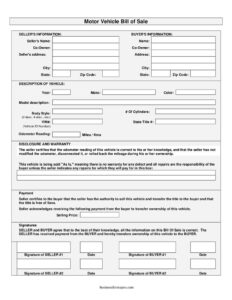
Bill Of Sale
Free bill of sale template in PDF & DOCX. Learn what a bill of sale is, the types, how to fill one out, and whether it needs notarizing — download today.
PDF
DOCX
5 downloads
0
likes
Download Files
- DOCX
A bill of sale is a written record that proves ownership of an item has legally passed from a seller to a buyer. It’s most often used for private sales of vehicles, boats, and equipment, and it protects both sides if a dispute comes up later. Download the free bill of sale below in PDF or DOCX, fill it in, and print. No signup or email required.
What Is a Bill of Sale?
A bill of sale is a short legal document that records the essentials of a sale: who sold the item, who bought it, what changed hands, the price, and the date of the transaction. The seller issues it, and once both parties sign, it becomes the buyer’s proof of purchase and the seller’s proof that they no longer own — or are liable for — the item.
It’s easy to confuse a bill of sale with a receipt or a title, but they do different jobs. A receipt simply confirms that money was paid. A title is an official government record of ownership for certain assets, like a car. A bill of sale sits between them: it documents the *transfer* itself in enough detail that it can support a title change, settle a dispute, or prove a purchase price for tax purposes. Many DMVs and county offices accept a completed bill of sale as supporting evidence when a buyer registers a vehicle or transfers a title.
Types of Bills of Sale
Not every sale needs the same form. The most common versions are:
- General (personal property) bill of sale — for furniture, electronics, tools, livestock, or other everyday items.
- Vehicle bill of sale — for cars, trucks, motorcycles, and trailers, with extra fields for the VIN, odometer, and plate.
- Boat or vessel bill of sale — includes the hull identification number and motor details.
- Firearm bill of sale — records make, model, and serial number where private sales are allowed.
- “As-is” vs. “with warranty” — an as-is sale means the buyer accepts the item in its current condition with no guarantees, while a warranty version commits the seller to certain repairs or conditions.
- Absolute vs. conditional — an absolute bill of sale transfers ownership immediately, while a conditional one transfers it only once the buyer meets a condition, such as paying in full.
Choosing the right type keeps the document relevant and avoids blank or irrelevant fields.
When Do You Need a Bill of Sale?
- Selling or buying a used car, motorcycle, or trailer between private parties
- Transferring a boat, firearm, or piece of farm equipment
- Documenting an “as-is” sale so the seller isn’t blamed for later repairs
- Registering a vehicle at the DMV when the title needs supporting proof of purchase
- Showing how much you paid for sales tax, insurance, or personal records
- Settling an estate or gifting property, where a paper trail matters
What a Valid Bill of Sale Must Include
For the document to hold up, it needs a few core elements: the full legal names and addresses of the buyer and seller; a clear description of the item, including any serial or identification numbers; the sale price (or a note that it was a gift); the date of sale; the terms (as-is or with warranty); and the signatures of both parties. Missing any of these is the most common reason a bill of sale is later questioned.
How to Fill Out a Bill of Sale
- Enter the date of sale and the seller’s full name, address, and city/state — add a co-owner if the item is jointly owned.
- Enter the buyer’s full name and address.
- Describe the item. For a vehicle, list the year, make, model, color, body style, number of cylinders, VIN, state title number, and odometer reading (miles/km). For other property, give a clear description and any serial numbers.
- State the sale price and the payment received, and note whether it’s paid in full or in installments.
- Complete the “as-is” disclosure if you’re offering no warranty, or list any repairs the seller agrees to cover.
- Both parties sign and date. Add a notary block if your state requires one.
Fill in every field — blanks are where disputes start. If a field doesn’t apply, write “N/A” instead of leaving it empty.
Does a Bill of Sale Need to Be Notarized?
It depends on where you are and what you’re selling. Many states accept a signed bill of sale on its own, while others require it to be notarized or witnessed, especially for vehicles and boats. Notarization doesn’t change what the document says — it simply adds an impartial confirmation that the signatures are genuine, which makes the bill of sale harder to challenge later. When in doubt, check your state DMV or county clerk before signing, and have both parties sign in front of the notary if one is required.
After the Sale: Title Transfer and Records
A bill of sale rarely works alone. For a vehicle, the buyer usually needs the signed title *and* the bill of sale to register the car in their name, and the seller may need to notify the DMV that they’ve sold it. Make at least two copies so the buyer and seller each keep a signed original, and store yours with your tax or insurance records. If license plates stay with the seller in your state, remove them before handing over the vehicle.
Common Mistakes to Avoid
- Leaving the VIN or odometer reading blank on a vehicle sale
- Forgetting to mark the sale “as is,” which can leave the seller liable for problems
- Only one party signing, or not dating the form
- Making just one copy — each party should keep a signed original
- Skipping notarization in states that require it
- Writing a vague item description that can’t identify what was actually sold
Frequently Asked Questions
What is a bill of sale? It’s a document that records the transfer of an item from seller to buyer, including the price, date, and a description of what was sold. It serves as the buyer’s proof of ownership.
How do I write a bill of sale? Fill in the seller and buyer details, describe the item, state the price and payment, add an “as-is” line if applicable, and have both parties sign and date it. The template above includes every field.
Does a bill of sale need to be notarized? It depends on your state. Some accept a signed bill of sale on its own; others require notarization or a witness, especially for vehicles. Check your state DMV before signing.
Can you register a car with a bill of sale and no title? Sometimes — rules vary by state. A bill of sale helps, but most states still require the signed title or a bonded-title process. Confirm with your local DMV.
Is a bill of sale the same as a receipt? No. A receipt only shows that money was paid; a bill of sale documents the full transfer of ownership, with descriptions and terms that can support a title change or settle a dispute.
How much does a bill of sale cost? Nothing here — this template is free to download in PDF and DOCX.
Related Forms
Car Bill of Sale · Boat Bill of Sale · Motorcycle Bill of Sale · Firearm Bill of Sale · ATV Bill of Sale · Odometer Statement
This template is provided for general informational purposes only and is not legal advice. Requirements vary by state and situation — consult a qualified professional for your jurisdiction.
Official resource: for the rules that apply to your situation, see your state DMV.
Related Forms
- Commission Voucher
- Miles Per Gallon Comparison
- Used Vehicle Appraisal
- Used Car Comparison
- Salesperson Commission Voucher
- Vehicle Registration Tracker
Browse more in Auto Sales.