
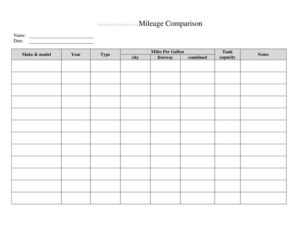
Miles Per Gallon Comparison
Use this free Miles Per Gallon Comparison template to compare fuel economy across vehicles and estimate savings — free PDF and DOCX download.
PDF
DOCX
1 downloads
0
likes
Download Files
- DOCX
A Miles Per Gallon Comparison is a simple worksheet that lets you place two or more vehicles side by side and measure how their fuel economy stacks up — the single most common reason people use it is to decide which car will cost less to drive before they buy or trade. It’s free to download here in both PDF and DOCX, with no signup required.
What Is a Miles Per Gallon Comparison?
A Miles Per Gallon Comparison is a structured chart that records the fuel efficiency of different vehicles so a buyer, salesperson, or fleet manager can evaluate them objectively. It’s used in auto sales lots, dealership showrooms, and by private shoppers who want to translate advertised MPG numbers into real driving costs. The form typically captures each vehicle’s city, highway, and combined MPG, along with estimated annual fuel costs based on miles driven and fuel price. Rather than relying on a vague sense that one car is “more efficient,” the comparison turns mileage ratings into dollars. That makes it a practical tool for justifying a purchase decision, demonstrating long-term value to a customer, or simply choosing the most economical option for a household budget.
When Do You Need a Miles Per Gallon Comparison?
This worksheet is useful any time fuel economy is part of the buying conversation. Common scenarios include:
- A car shopper deciding between two or three finalists and wanting to know which one is cheaper to drive over five years.
- A salesperson highlighting the fuel savings of a hybrid or efficient model against a competing vehicle.
- A fleet manager evaluating which makes and models to add when fuel is a major operating cost.
- A family comparing a current vehicle against a potential upgrade to see whether the savings justify the change.
- A buyer weighing a gas vehicle against a hybrid or electric option using estimated annual energy costs.
- A dealership preparing a transparent, written comparison to support a customer’s financing or value discussion.
What a Miles Per Gallon Comparison Should Have
To be genuinely useful, the comparison should let you line up vehicles on identical assumptions. The key elements include vehicle identification (year, make, model, and trim), the city MPG, highway MPG, and combined MPG for each, the annual miles you expect to drive, the current fuel price per gallon, and the resulting estimated annual and multi-year fuel cost. A strong sheet also leaves room for notes — for example, whether a figure is an EPA estimate or a real-world observed average. Keeping the mileage assumptions and fuel price the same across every vehicle is what makes the comparison fair and the dollar figures meaningful.
How to Fill Out a Miles Per Gallon Comparison
Work through the worksheet one vehicle at a time, keeping shared assumptions identical so the comparison stays apples-to-apples:
- Enter the year, make, model, and trim for the first vehicle in its own column or row so each option is clearly labeled.
- Record the city MPG rating, typically from the EPA window sticker or manufacturer specs.
- Record the highway MPG rating the same way.
- Enter the combined MPG, or calculate it if only city and highway figures are provided.
- Fill in your estimated annual miles driven — use the same number for every vehicle.
- Enter the current fuel price per gallon, again identical across vehicles.
- Divide annual miles by combined MPG to get gallons used per year, then multiply by fuel price to get the estimated annual fuel cost.
- Repeat for each additional vehicle, then add any notes about real-world economy or fuel type before comparing totals.
Turning MPG Into Real Costs
The number that actually changes minds is the dollar figure, not the MPG rating. To get it, divide your expected annual mileage by the combined MPG to find how many gallons you’ll burn in a year, then multiply by the price per gallon. For example, 12,000 miles at 30 MPG is 400 gallons; at $3.50 per gallon that’s $1,400 a year. A vehicle rated at 24 MPG over the same distance burns 500 gallons, or $1,750 — a $350 annual difference that compounds to $1,750 over five years. Running the math this way reveals gaps that raw MPG numbers can hide, and it gives a buyer a concrete, defensible reason to lean one way.
City, Highway, and Combined — Which Number to Use
Vehicles are usually rated with three figures, and choosing the right one matters. City MPG reflects stop-and-go driving and is generally lower; highway MPG reflects steady cruising and is higher; combined MPG blends the two using a standard weighting. If your driving is mostly urban commuting, lean on the city figure when estimating real costs. If you log long highway trips, the highway number is more representative. For a balanced estimate, the combined figure is the safest default. Hybrids and electric vehicles complicate this slightly — their efficiency may be expressed as MPGe — so note that distinction on the sheet to avoid comparing unlike units.
Common Mistakes to Avoid
- Using different annual mileage or fuel prices for each vehicle, which makes the comparison meaningless.
- Comparing city MPG on one vehicle against highway MPG on another instead of using the same rating type.
- Treating EPA estimates as guaranteed — real-world economy varies with driving style, terrain, and load.
- Forgetting to account for fuel type differences, such as premium gas, diesel, or electric MPGe.
- Leaving out the trim level, since engine and drivetrain options within the same model can change MPG noticeably.
- Focusing only on fuel cost and ignoring other ownership factors like insurance, maintenance, and resale value.
Frequently Asked Questions
What is a Miles Per Gallon Comparison used for? It’s used to evaluate the fuel economy of two or more vehicles side by side and translate their MPG ratings into estimated yearly and long-term fuel costs. Buyers, salespeople, and fleet managers use it to make a more informed, cost-based decision. The dollar estimates often reveal differences that raw MPG numbers alone don’t make obvious.
How do I calculate annual fuel cost from MPG? Divide your expected annual miles by the vehicle’s combined MPG to find the gallons used per year, then multiply by the price per gallon. For instance, 15,000 miles at 25 MPG equals 600 gallons, and at $3.50 each that’s $2,100 per year. Use the same mileage and fuel price for every vehicle so the comparison is fair.
Should I use city, highway, or combined MPG? Use the figure that best matches your driving: city MPG for mostly urban commuting, highway MPG for long-distance travel, and combined MPG for a balanced estimate. Whichever you choose, apply the same type consistently across all vehicles. Mixing rating types is one of the most common ways comparisons get distorted.
Are EPA MPG ratings accurate? EPA ratings are standardized estimates that make vehicles comparable, but real-world mileage varies with driving habits, traffic, weather, terrain, and cargo. Many drivers see numbers a few MPG higher or lower than the sticker. Use the EPA figures as a starting point and note any real-world averages you have available.
Can I compare a gas car against a hybrid or electric vehicle? Yes, but be careful with units. Hybrids and electric vehicles are often rated in MPGe rather than MPG, and electricity costs differ from gasoline. Note the energy type and cost basis for each vehicle so the dollar comparison reflects their true operating expense.
Is this template free to download? Yes. The Miles Per Gallon Comparison template is completely free to download in both PDF and DOCX formats, with no signup or account required. You can fill it out digitally or print it for use on the lot or at the dealership.
This template is a general example provided for informational purposes only and is not financial, tax, or purchasing advice. Fuel cost estimates depend on assumptions that vary by driver and location, and actual results will differ. Consult a qualified professional and verify manufacturer ratings before making a vehicle purchase decision.
Official resource: for the rules that apply to your situation, see your state DMV.
Related Forms
- Motor Vehicle Bill of Sale
- Odometer Statement
- Used Vehicle Appraisal
- Vehicle Inspection Report
- Vehicle Options Form
- Vehicle Loan Payment Calculator
Browse more in Auto Sales.