
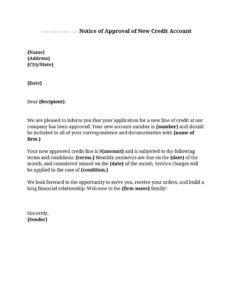
Notice Of Approval Of New Credit Account
Tell a customer their credit application was approved with this free Notice of Approval of New Credit Account template — free download in PDF and DOCX.
DOCX
0
likes
Download Files
- DOCX
A Notice of Approval of New Credit Account is a business letter sent to a customer to confirm that their credit application has been accepted and to spell out the account number, credit limit, and payment terms. Companies use it most often to formally welcome a new credit customer while documenting the conditions of the account in writing. You can download this template free in both PDF and DOCX formats, with no signup required.
What Is a Notice of Approval of New Credit Account?
A Notice of Approval of New Credit Account is a short, professional letter issued by a seller, supplier, or lender to an applicant who has been granted trade credit or a line of credit. It is typically signed by a credit manager, accounts receivable lead, or business owner. The letter documents the approved credit line, assigns an account number, and states the key terms — when payments are due, when they are considered missed, and what triggers service charges. Beyond the practical details, it serves a relationship-building purpose: it welcomes the customer and signals the start of an ongoing financial arrangement. Because it puts the terms in writing, it also reduces later disputes about what was agreed.
When Do You Need a Notice of Approval of New Credit Account?
This letter is useful any time a business extends credit to a customer and wants to confirm the decision clearly. Common situations include:
- A wholesaler or distributor approves a retail customer for net-30 or net-60 trade credit after reviewing their application.
- A supplier grants a recurring business customer a revolving credit line so they can place orders without paying upfront each time.
- A service provider approves a corporate client for billing on account rather than per-invoice prepayment.
- A manufacturer extends credit to a new dealer and needs to communicate the limit and payment schedule.
- A company that ran a credit check wants to formally close the application loop and assign an account number.
- A finance or accounts department standardizes onboarding by sending the same welcome-and-terms letter to every approved applicant.
In each case, the letter doubles as both a customer-service touchpoint and a written record of the credit arrangement.
What a Notice of Approval Letter Should Have
A complete approval notice does more than say “yes.” To be useful and reduce future confusion, it should include the recipient’s name and address, the date, a clear statement of approval, the newly assigned account number, the approved credit limit, and the governing terms and conditions. It should also state the payment due date, the date a payment is considered missed, and the circumstances under which service charges apply. Finally, a courteous welcome and a signature from an authorized representative round out the letter. Keeping all of these elements in one document means the customer has a single reference point for how their account works.
How to Fill Out a Notice of Approval of New Credit Account
- Enter the recipient’s Name, Address, and City/State in the heading so the letter reaches the right contact.
- Add the Date the notice is issued.
- Open with the salutation, replacing {Recipient} with the applicant’s name or company contact.
- Confirm the approval, then insert the assigned account {number} and ask the customer to reference it in all correspondence with your firm.
- Fill in your {name of firm} where indicated so the customer knows exactly who the account is with.
- State the approved credit line in the ${amount} field — for example, the maximum outstanding balance allowed.
- Spell out the {terms} and conditions that govern the account, such as net payment periods or order limits.
- Enter the monthly payment {date} when payments are due, and the second {date} on which an unpaid balance is considered missed.
- Describe the {condition} that triggers service charges, such as a late or missed payment.
- Close with the welcome line, insert the {firm name}, and sign as the {Sender}, including your title.
Tips for a Clear, Professional Approval Notice
Because this letter sets expectations for an ongoing financial relationship, clarity matters. State the credit limit and payment dates in plain numbers and avoid vague phrasing. If your full terms run long, reference an attached credit agreement rather than cramming everything into the body. Keep a copy of the signed letter in the customer’s account file alongside their original application and any credit-check documentation. Sending the notice promptly after approval also makes a strong first impression and helps the customer start ordering without delay. If you use accounting software, set up the account number and credit limit in your system on the same day you send the letter so billing and the notice always agree.
How This Differs From a Credit Denial or Account Statement
An approval notice is the positive counterpart to a credit rejection letter, which declines an application and may reference adverse-action requirements. It is also distinct from a monthly statement or invoice, which reports activity and amounts owed on an account that already exists. The approval notice is a one-time onboarding document: it establishes the account, communicates the limit and rules, and welcomes the customer. Once the relationship is active, ongoing communication shifts to statements, invoices, and, if needed, payment reminders or past-due notices.
Common Mistakes to Avoid
- Leaving the account number or credit limit blank, which forces follow-up emails and delays the first order.
- Listing two different payment dates that contradict the terms in your underlying credit agreement.
- Being vague about when a payment is “missed,” leaving room for disputes over service charges.
- Forgetting to specify the exact {condition} that triggers service charges or fees.
- Sending the letter without setting up the matching account in your billing system.
- Omitting the sender’s name and title, so the customer doesn’t know who approved the account or whom to contact.
Frequently Asked Questions
What is a Notice of Approval of New Credit Account? It is a business letter that tells an applicant their request for credit has been approved. It confirms the new account number, the approved credit line, and the payment terms, while welcoming the customer to your company.
How do I fill out this approval letter? Add the recipient’s contact details and the date, then insert the assigned account number, the approved dollar amount, and your terms. Finish by stating the payment due date, the missed-payment date, the service-charge condition, and signing as an authorized representative.
Is this letter legally binding? The letter itself documents the terms you are offering, and a customer who begins ordering on the account generally accepts those terms. For the credit arrangement to be fully enforceable, many businesses pair it with a signed credit application or agreement, since requirements vary by jurisdiction.
Does the notice need to be notarized or witnessed? No. A credit approval letter is a routine business communication and does not require notarization or witnesses. An authorized signature and your company details are typically sufficient.
How much does this template cost? It is completely free to download from Business Forms Pro in both PDF and DOCX formats, with no account or signup required. You can edit the DOCX version to match your company’s branding and terms.
Can I customize the credit limit and payment terms? Yes. Every field — the account number, credit amount, terms, due dates, and service-charge conditions — is meant to be edited to fit your specific arrangement with each customer. Adjust the language so it aligns with your internal credit policy.
This template is a general example provided for informational purposes only and is not legal, financial, or tax advice. Credit and lending requirements vary by jurisdiction and industry, so consult a qualified attorney or financial professional before relying on this document for your business.
Related Forms
- Employee Termination For Drug Use
- Landlord Smoking Warning
- Payment Inquiry
- Landlord Temporary Repairs
- Billing Error Apology Letter
- Sales Order Confirmation
Browse more in Business Letters.