
Landlord Eviction For Renovation
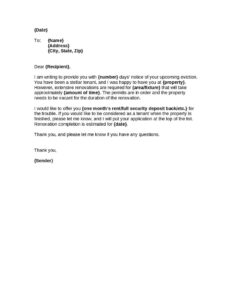
Free landlord notice-to-vacate-for-renovation letter template in PDF & DOCX. Inform a tenant of a renovation that requires the unit — download and adapt locally.
DOCX
0
likes
Download Files
- DOCX
A notice to vacate for renovation is a letter a landlord sends when a planned renovation requires a tenant to move out of a rental unit. Because ending a tenancy for renovation is heavily regulated, this letter must be handled carefully and in line with your local laws. Download this free template in PDF or DOCX as a starting point. No signup required.
What Is a Notice to Vacate for Renovation?
This is a formal written notice in which a landlord informs a tenant that the rental unit will undergo significant renovation or repair work that cannot be carried out while it is occupied, and that the tenant will need to vacate by a stated date. It is sometimes called a renovation notice or a “no-fault” notice, because the tenant has done nothing wrong — the reason is the property itself. The letter typically states the nature of the work, why it requires the unit to be empty, the date the tenant must vacate, and any rights or assistance the tenant is entitled to. Because this kind of notice is one of the most regulated areas of landlord-tenant law, the document is only the visible part of a process that must follow specific legal rules.
When Is It Used?
- A landlord is undertaking major renovation, rehabilitation, or repairs that genuinely cannot be done with a tenant in place.
- Structural work, gut renovation, or remediation makes the unit temporarily uninhabitable.
- Work is required to comply with building or safety codes and the unit must be vacant.
- A landlord needs to give the legally required advance notice before such work begins.
- Documenting the reason and the timeline in writing for both parties’ records.
Know the Law Before You Send This
This is the most important section, and it is not optional reading. Ending a tenancy for renovation — sometimes called a “renoviction” — is restricted or tightly controlled in many states, cities, and provinces. Depending on where the property is, the law may require a long notice period, a genuine and provable intent to do substantial work, permits to be in place first, relocation assistance or compensation to the tenant, a right of first refusal to return after the work, and protections that are stronger still in rent-controlled or rent-stabilized units. Using a renovation notice as a pretext to remove a tenant for other reasons is unlawful in many places and can carry serious penalties. A template cannot tell you which of these rules apply to your property. Before you send any notice of this kind, confirm exactly what your local and state or provincial law requires, and consider consulting a qualified attorney — getting the process wrong can invalidate the notice and expose you to legal liability.
What the Letter Should Include
A clear, lawful notice generally identifies the tenant and the rental address, describes the renovation work and explains why it requires the unit to be vacant, states the date by which the tenant must move out (consistent with the required notice period), and sets out any rights, relocation assistance, or compensation the tenant is owed under local law. It should be dated, signed by the landlord, and served in the manner your jurisdiction recognizes, with proof of service kept on file.
How to Use the Template
- First confirm your local legal requirements — notice period, permits, compensation, and tenant protections.
- Fill in the date, the tenant’s name, and the rental address.
- Describe the renovation work and explain why the unit must be vacant for it.
- State the vacate date, ensuring it meets or exceeds the legally required notice period.
- Set out any relocation assistance, compensation, or right to return the tenant is entitled to.
- Sign, date, and serve the notice using a method your jurisdiction recognizes, and keep proof of service.
Common Mistakes to Avoid
- Sending the notice without first checking what your local law actually requires.
- Giving too short a notice period, which can void the notice.
- Using renovation as a pretext rather than for genuine, substantial work.
- Failing to provide relocation assistance or compensation where it’s required.
- Ignoring stronger protections that apply to rent-controlled or stabilized units.
- Not keeping proof of how and when the notice was served.
Serving the Notice and the Move-Out
How a notice is delivered can matter as much as what it says. Many jurisdictions specify exactly how a notice of this kind must be served — in person, by a particular class of mail, by posting, or some combination — and may require proof that service was completed. Using the wrong method can invalidate an otherwise correct notice, so confirm the accepted method for your location and keep a dated record of how and when you served it. Give the tenant the full notice period the law requires, measured correctly from the date of valid service, and avoid any action that could be read as pressuring them to leave sooner than that. As the move-out approaches, communicate clearly and in writing about expectations — the condition the unit should be left in, the return of keys, and the handling of the security deposit under your local rules. Where the law grants the tenant a right to return after the renovation, or requires you to offer the unit back at a comparable rent, make sure you understand and honor those obligations, because failing to do so is a common and costly mistake. Throughout, keep careful records of every communication, the permits and scope of the work, and the timeline, so you can demonstrate that the renovation was genuine and the process followed the rules. This is exactly the kind of situation where a short consultation with a local attorney before you act is worth far more than it costs.
Frequently Asked Questions
What is a notice to vacate for renovation? It’s a landlord’s written notice telling a tenant they must move out by a certain date because planned renovation work requires the unit to be empty. It’s a “no-fault” notice based on the property, not the tenant’s conduct.
Can a landlord evict a tenant just to renovate? Sometimes, but it’s heavily regulated. Many areas allow it only for genuine, substantial work and require long notice, permits, and often relocation assistance or a right to return. Some restrict it sharply. Always check local law.
How much notice is required? It varies widely by jurisdiction and can be much longer than an ordinary notice — sometimes several months — especially in rent-controlled areas. Confirm the exact requirement for your location before setting a vacate date.
Does the tenant get compensation? In many places, yes — relocation assistance or compensation may be legally required, and tenants may have a right to return after the work. The amount and rules depend entirely on local law.
Should I get legal advice before sending this? Given how regulated renovation-related evictions are, it’s strongly recommended. A qualified attorney can confirm the notice period, required compensation, and process so the notice is valid and lawful.
How much does this template cost? Nothing — it’s free to download in PDF and DOCX, with no signup required.
Related Forms
- Employee Termination For Drug Use
- Congratulations on Promotion
- Notice of Product Defect
- Demand Payment on Promissory Note
- Recommendation for a Raise
- Employee Termination For Theft
Browse more in Business Letters.