
Reference Request
Download a free Reference Request letter template to verify a job candidate's past employment and references, available as a free PDF and DOCX download.
DOCX
2 downloads
0
likes
Download Files
- DOCX
A Reference Request is a formal business letter an employer sends to a candidate’s previous employer to verify employment history and gather an honest assessment of the candidate’s performance. People most often use it during the final stages of hiring, when they need to confirm what an applicant has claimed on a resume before extending an offer. You can download this Reference Request template free in both PDF and DOCX formats — no signup required.
What Is a Reference Request?
A Reference Request is a written letter sent by a hiring company to an organization where a job candidate previously worked. Its purpose is to confirm factual details — such as job title, dates of employment, and final salary — and to solicit a former supervisor’s candid opinion of the candidate. Unlike a casual phone call, a written Reference Request creates a documented, consistent record of the questions asked and the answers received. It is typically issued by a hiring manager, recruiter, or HR representative and addressed to a specific contact at the previous employer. The structured format ensures every reference is evaluated against the same set of questions, which supports fair and consistent hiring decisions.
When Do You Need a Reference Request?
This letter comes into play whenever you want documented confirmation of a candidate’s background. Common situations include:
- You are nearing the end of the hiring process and need to verify the employment claims a candidate made on their resume or application.
- You want a previous supervisor’s perspective on a candidate’s reliability, performance, and reason for leaving.
- You are deciding between two finalists and need objective input to break the tie.
- Your company policy requires written reference checks before any offer is formally extended.
- You are hiring for a sensitive or senior role where confirming salary history and rehire eligibility matters.
- You prefer a written paper trail over phone calls so that references answer the same standardized questions.
What a Reference Request Should Have
An effective Reference Request is brief, courteous, and easy to answer. It should clearly identify the candidate by name and explain why you are contacting the former employer. It must include your company’s name and the name of the person making the request, so the recipient knows who to respond to. The heart of the letter is a short list of specific, answerable questions covering position held, dates of employment, final salary, reason for leaving, and rehire eligibility. Leaving space for written responses — or inviting a reply by email or phone — makes it convenient for the recipient. A polite tone and a thank-you go a long way toward earning a complete, honest reply.
How to Fill Out a Reference Request
Follow these steps to complete the template using the fields provided:
- In the To block, enter the recipient’s Name, Address, and City, State, Zip — the contact at the candidate’s former employer.
- In the salutation, replace {Recipient} with that person’s name, for example “Dear Ms. Carter.”
- In the opening paragraph, insert the candidate’s name where indicated and choose the correct pronoun (he/she) so the letter reads naturally.
- Sign off by entering the Sender name and your Company Name beneath “Sincerely.”
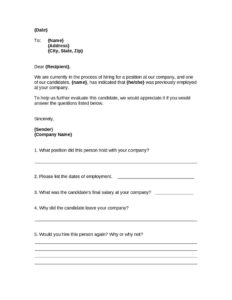
- Leave the five numbered questions as written, or tailor them to your role. Question 1 asks the position held; Question 2 asks the dates of employment; Question 3 asks the candidate’s final salary; Question 4 asks why the candidate left; Question 5 asks whether they would hire the person again, and why.
- Proofread, then send the letter by mail or email with a return method clearly indicated.
Tips for Getting a Useful Response
Many companies limit what they will disclose about former employees, so frame your request to make replying easy and low-risk. Keep the letter short and the questions specific. Consider attaching a signed consent form from the candidate authorizing the former employer to release information — this often unlocks more detailed answers, including salary. Provide a clear deadline and your preferred reply method, whether that is a returned letter, an email, or a brief phone call. If you do not hear back within a week or two, a polite follow-up is appropriate. Finally, treat any information you receive as confidential and use it only to evaluate the candidate for the role.
Reference Request vs. Reference Letter
It is easy to confuse these two documents, but they move in opposite directions. A Reference Request is sent by the prospective employer to a former employer, asking for information about a candidate. A reference letter (or letter of recommendation) is written by the former employer or supervisor and given to the candidate or the new employer to vouch for them. This template is the request — the formal ask that prompts the former employer to share their assessment.
Common Mistakes to Avoid
- Sending the letter to a generic address rather than a specific person, which often leads to no reply at all.
- Forgetting to obtain the candidate’s consent before requesting salary and other sensitive details.
- Leaving placeholder text like {name} or {he/she} in the final version because you did not proofread.
- Asking vague or overly broad questions that the recipient cannot easily answer in writing.
- Omitting your company name and contact details, so the recipient has no clear way to respond.
- Failing to provide a deadline or preferred reply method, which slows down your hiring timeline.
Frequently Asked Questions
What is a Reference Request letter used for? It is used by an employer to contact a job candidate’s former employer and verify details such as job title, dates of employment, final salary, and reason for leaving. It also asks whether the former employer would rehire the candidate. The goal is to confirm the candidate’s claims before making a hiring decision.
How do I fill out the Reference Request template? Enter the recipient’s name and address, address the salutation to the right contact, insert the candidate’s name and correct pronoun, and sign with your name and company name. The five numbered questions can be used as written or tailored to the role. Then send the letter by mail or email with a clear way to reply.
Do I need the candidate’s permission to send it? While the letter itself does not legally require consent, it is best practice to obtain the candidate’s written authorization before requesting employment and salary information. Many former employers will only release detailed information when they have proof the candidate has consented. A signed release attached to your request often produces a fuller response.
Is a Reference Request legally binding? No, a Reference Request is simply a formal inquiry, not a contract, so it does not bind either party. However, the information shared in the reply may be subject to privacy and employment laws that vary by location. Both the requesting and responding companies should handle the information responsibly and confidentially.
Can the former employer refuse to answer? Yes. Many organizations have policies that limit reference responses to confirming dates of employment and job title only. If you receive a limited reply, it usually reflects company policy rather than a negative signal about the candidate.
How much does this Reference Request template cost? It is completely free to download from Business Forms Pro in both PDF and DOCX formats, with no signup or payment required. You can edit the DOCX version to add your branding or adjust the questions. Use it as many times as you need across your hiring process.
This Reference Request template is provided as a general example for informational purposes only and is not legal, HR, or compliance advice. Laws governing employment references, privacy, and information disclosure vary by jurisdiction. Consult a qualified professional to ensure your reference-checking practices comply with applicable rules.
Related Forms
- Auto Insurance Verification Letter
- Merger Announcement Letter
- Unpaid Invoice
- 30 Days Past Due Letter
- Contract Modification
- Customer Service Alteration Letter
Browse more in Business Letters.