
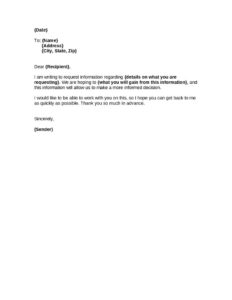
Information Request
Download a free Information Request letter template to formally ask a company, agency, or vendor for details—free download in PDF and DOCX, no signup.
DOCX
3 downloads
0
likes
Download Files
- DOCX
An Information Request letter is a short, polite business letter used to formally ask a person, company, or organization to provide specific details you need. People most often use it to gather facts before making a decision—such as pricing, product specs, account records, or policy details—in writing so there is a clear paper trail. You can download this Information Request template free in both PDF and DOCX formats, with no signup required.
What Is an Information Request Letter?
An Information Request letter is a written communication addressed to a recipient asking them to supply particular information you do not currently have. It is typically issued by a customer, business representative, researcher, or applicant and sent to a vendor, agency, institution, or another company. The letter documents exactly what was requested, why it was requested, and the date it was sent. Because it is written rather than verbal, it creates a record that protects both parties and makes follow-up easier. The tone is courteous and professional, signaling that you intend to cooperate while making your needs clear. It works equally well for routine inquiries and for more formal situations where documentation matters.
When Do You Need an Information Request Letter?
This letter is useful any time you need details in writing rather than over a quick phone call. Common situations include:
- Requesting a quote or pricing from a supplier before placing a large order or signing a contract.
- Asking a vendor for product specifications, compliance documents, or technical data to evaluate suitability.
- Gathering details from a service provider—for example, contract terms, availability, or scope—before committing.
- Requesting records or account information from a bank, insurer, utility, or institution you do business with.
- Seeking clarification from a government agency about a program, application status, or policy that affects your business.
- Collecting data for research, due diligence, or a proposal where you need a written response to cite or reference later.
What an Information Request Letter Should Have
A complete and effective Information Request letter contains a few core elements. It should open with the date and the recipient’s full name and mailing address so the document is properly directed. It needs a clear salutation and a one-line statement of purpose so the reader immediately understands what you want. The body must specify exactly what information you are requesting—the more precise you are, the faster and more accurate the response. Many writers also explain why they need the information, which helps the recipient prioritize and respond appropriately. Finally, the letter should include a polite request for a timely reply, a thank-you, and a professional closing with the sender’s name. Keeping it concise and specific improves your chances of a quick, complete answer.
How to Fill Out an Information Request Letter
This template uses simple placeholders you replace with your own details. Follow these steps:
- Enter the {Date} you are sending the letter at the top.
- In the address block, fill in the recipient’s {Name}, their {Address}, and the {City, State, Zip} so the letter reaches the right party.
- Replace {Recipient} in the greeting with the contact’s name (for example, “Dear Ms. Carter”).
- In the opening line, fill in {details on what you are requesting}—be specific, listing the exact documents, figures, or facts you need.
- Complete {what you will gain from this information} by explaining your purpose, such as comparing vendors or finalizing a budget, so the reader understands the context.
- Keep the cooperative tone and the request for a prompt reply, then sign off by replacing {Sender} with your name and, if helpful, your title and company.
Review the finished letter to confirm every placeholder is replaced before sending.
Tips for Getting a Faster, Fuller Response
The clearer your request, the better your reply. Instead of writing “information about your services,” itemize precisely what you want—”your 2024 commercial pricing schedule and standard delivery timelines.” If you have a deadline, mention a specific date rather than just “as quickly as possible.” Provide a reference number, account number, or order detail when one applies, so the recipient can locate your file immediately. Offer your preferred method of reply (email, phone, or mail) and include your contact details in the signature. If the matter is routine, a brief and friendly tone works best; if it is formal or contractual, keep the wording neutral and factual. A well-structured request signals professionalism and tends to receive priority.
Sending and Following Up
You can send an Information Request as a printed letter, an email attachment, or pasted into an email body—choose the channel the recipient prefers or the one that creates the record you need. For important or sensitive requests, keep a dated copy and note when you sent it. If you have not heard back within a reasonable window, a short, polite follow-up referencing your original letter and its date is usually effective. Keep all correspondence together so you have a clear timeline of who you asked, what you asked for, and when. This is especially valuable if the information feeds into a contract, dispute, or compliance matter later.
Common Mistakes to Avoid
- Being vague. Asking for “more details” forces the reader to guess; list the exact items you need.
- Leaving placeholders unfilled. Sending a letter that still says {Name} or {Recipient} looks careless and confusing.
- Omitting your purpose. Explaining why you need the information helps the recipient give you a relevant, useful answer.
- Forgetting your contact details. If the reader cannot easily reply, your request stalls—include phone or email in the signature.
- Setting no expectation for a response. A polite timeframe encourages action without sounding demanding.
- Making it too long. A focused, one-page request gets read and answered faster than a dense, rambling one.
Frequently Asked Questions
What is an Information Request letter used for? It is used to formally ask a person or organization to provide specific information you need, such as pricing, records, specifications, or policy details. Putting the request in writing creates a clear record of what was asked and when. It is common in business, customer service, and administrative settings.
How do I fill out this Information Request template? Replace the bracketed placeholders with your own details: the date, the recipient’s name and address, the salutation, exactly what you are requesting, and why you need it. Then sign it with your name and contact information. Review the letter to ensure no placeholder text remains.
Is an Information Request letter legally binding? No. It is simply a request and does not create a contract or obligate the recipient to respond. However, it does serve as useful documentation of what you asked for and the date you asked, which can matter in business or compliance contexts.
Does this letter need to be notarized or witnessed? Generally no. An ordinary Information Request is informal correspondence and does not require notarization or witnesses. Specialized requests—such as certain records governed by privacy or public-records laws—may have their own procedures, so check the relevant rules for your situation.
Should I send it by email or mail? Either works; choose the channel the recipient uses and the one that gives you the record you want. Email is fast and easy to save, while a mailed letter can feel more formal. Keep a dated copy regardless of the method.
How much does this template cost? Nothing. You can download this Information Request letter free in PDF and DOCX from Business Forms Pro, with no signup or payment required. Edit it as many times as you need for different recipients.
This template is a general example provided for informational purposes only and is not legal, financial, or professional advice. Requirements and procedures vary by jurisdiction and by the type of information requested. Consult a qualified professional for guidance on your specific situation.
Related Forms
- Employee Termination For Gross Misconduct
- Speaker Invitation
- Recall To Work Letter
- Customer Complaint Explanation
- Prospective Lead
- Quote Invitation
Browse more in Business Letters.