
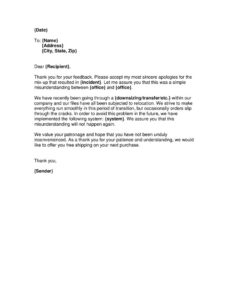
Customer Complaint Explanation
Respond professionally with this free Customer Complaint Explanation letter template — apologize, explain the issue, and rebuild trust. Free download in PDF and DOCX.
PDF
DOCX
5 downloads
0
likes
Download Files
- DOCX
A Customer Complaint Explanation letter is a written response a business sends to a customer to acknowledge their feedback, apologize for a mistake, explain what went wrong, and outline how it will be prevented in the future. People most often use it to repair a damaged relationship after an order mix-up or service error and to retain a valued customer. This template is free to download in both PDF and DOCX formats, with no signup required.
What Is a Customer Complaint Explanation Letter?
A Customer Complaint Explanation letter is a formal business letter written by a company representative — such as a customer service manager, account owner, or business owner — directly to a customer who has raised a concern. It documents the company’s acknowledgment of the issue, a sincere apology, a clear explanation of the underlying cause, and the corrective steps being taken. Unlike an internal incident report, this letter is customer-facing and tone-sensitive: its goal is to reassure, not to make excuses. It typically closes with a goodwill gesture, such as free shipping or a discount, to demonstrate that the company values the relationship and wants to keep the customer’s business going forward.
When Do You Need a Customer Complaint Explanation Letter?
This letter is useful any time a customer’s experience falls short and a thoughtful written response can preserve goodwill. Common situations include:
- Order mix-ups: The wrong item shipped, an order was duplicated, or a request slipped through during a busy period.
- Internal miscommunication: A handoff between two departments or offices caused a delay or error in fulfilling the customer’s request.
- Company transitions: Downsizing, a department transfer, a move, or a system migration disrupted normal operations and affected service quality.
- Billing or account confusion: A customer was charged incorrectly or received conflicting information from different staff members.
- Repeat patronage at risk: A long-standing or high-value customer expresses frustration, and a personal written reply can prevent them from leaving.
- Documented follow-up: A complaint was raised by phone or email, and the business wants a formal record of its resolution and goodwill offer.
What a Customer Complaint Explanation Letter Should Have
A complete and effective letter balances accountability with reassurance. It should clearly identify the recipient and the date, open with genuine thanks for the feedback, and offer a sincere apology for the specific incident. It should briefly and honestly explain the cause without shifting blame onto the customer, describe a concrete corrective measure that prevents a repeat, and reaffirm that the customer is valued. A goodwill gesture — like free shipping or a discount — gives the apology weight, and a warm, professional sign-off from a named sender adds personal accountability. Keep the tone respectful and avoid defensive or legalistic language.
How to Fill Out a Customer Complaint Explanation Letter
- Enter the {Date} the letter is written at the top.
- Address the recipient by completing the {Name}, {Address}, and {City, State, Zip} fields so it reaches the right customer.
- Open the greeting with Dear {Recipient}, using the customer’s name for a personal touch.
- In the apology line, describe the specific {incident} — for example, “the duplicate billing on your March order” — so the customer knows you understand exactly what happened.
- Identify the two {office} fields, naming the departments or locations where the misunderstanding occurred (for instance, “our sales office and our shipping warehouse”).
- Specify the transition in the {downsizing/transfer/etc.} field that explains the disruption, such as a recent office relocation or staffing change.
- Describe the corrective {system} you have implemented — a new order-tracking process, double-check procedure, or updated software — to assure the customer it won’t recur.
- Confirm the goodwill offer (free shipping is included by default) and sign off by entering your name in the {Sender} field.
Tips for Striking the Right Tone
The single most important quality of this letter is sincerity. Customers can detect a templated brush-off, so personalize every variable field rather than leaving placeholder phrasing. Lead with empathy before explanation — apologize first, then briefly explain the cause. Keep the explanation honest but concise; a long, defensive justification can read as making excuses. The phrase “a simple misunderstanding” works well only when paired with a genuine apology and a concrete fix, otherwise it can feel dismissive. Finally, make sure the goodwill gesture is something you can actually honor, and consider tailoring it to the customer’s situation — free shipping for a shipping error, a discount for an overcharge.
How This Differs From a Formal Resolution Notice
A Customer Complaint Explanation letter is warmer and more relationship-focused than a formal resolution notice or a legal settlement document. It is not a refund authorization, a liability admission for legal purposes, or a binding contract; it is a goodwill communication intended to preserve the customer relationship. If a complaint involves potential legal exposure, significant financial liability, or a safety issue, you may need a more carefully reviewed response and should involve the appropriate professionals. For everyday service hiccups, however, this letter is exactly the right tool — quick, personal, and reassuring.
Common Mistakes to Avoid
- Leaving placeholders unfilled: Sending a letter with “{incident}” or “{office}” still in the text instantly undermines your credibility.
- Blaming the customer: Even if the customer contributed to the confusion, the letter should take ownership and avoid an accusatory tone.
- Vague corrective action: Saying “we’ll do better” without naming a specific new system feels hollow and unconvincing.
- Over-explaining: A lengthy account of internal problems shifts focus away from the customer and can sound like excuse-making.
- Offering something you can’t deliver: Promising free shipping or a discount you won’t actually honor turns one complaint into two.
- No personal sign-off: An unsigned or generic “The Team” closing reduces accountability — name a real sender.
Frequently Asked Questions
What is a Customer Complaint Explanation letter used for? It is used to formally respond to a customer who has raised a complaint, acknowledging the issue, apologizing, explaining what caused it, and describing how it will be prevented. The goal is to retain the customer’s trust and continued business. It also creates a written record of how the complaint was addressed.
How do I fill out this letter? Start with the date and the customer’s name and address, then personalize the greeting. Fill in the specific incident, the departments involved, the transition that caused the disruption, and the new system you’ve put in place to prevent it. Finish with your goodwill offer and your signature in the sender field.
Is this letter legally binding? No, a Customer Complaint Explanation letter is a goodwill communication, not a legal contract. It does not by itself create enforceable obligations beyond any specific promise you make in it, such as offering free shipping. If a complaint has legal or financial implications, consult a qualified professional before responding.
Should I admit fault in the letter? Taking ownership of a genuine mistake builds trust and is usually the right approach for routine service issues. However, avoid phrasing that admits legal liability in disputes that could escalate. When in doubt about a serious matter, have the response reviewed before sending.
What should I offer as a goodwill gesture? Choose something meaningful and relevant to the inconvenience — the template suggests free shipping, but a discount, store credit, or a replacement may fit better. Make sure it is something your business can realistically honor without creating new problems.
Is this template really free to download? Yes. You can download the Customer Complaint Explanation letter for free in both PDF and DOCX formats, with no signup or payment required. Edit the DOCX version freely to match your company’s voice, branding, and the specifics of the complaint.
This template is provided as a general example for informational purposes only and does not constitute legal, financial, or professional advice. Customer complaint situations vary, and some may carry legal or contractual implications that differ by jurisdiction. For complaints involving potential liability or significant disputes, consult a qualified professional before responding.
Related Forms
- 30 Days Past Due Letter
- Final Demand For Payment
- Sales Follow Up
- New Sale for a Preferred Customer
- Follow Up Letter
- Pandemic Attendee Event Letter
Browse more in Business Letters.