
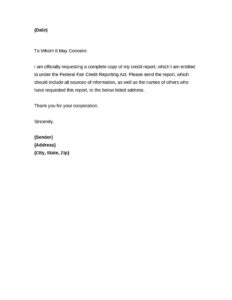
Request for Credit Report
Download a free Request for Credit Report letter template to formally obtain your credit file under the Fair Credit Reporting Act — free PDF and DOCX download.
DOCX
1 downloads
0
likes
Download Files
- DOCX
A Request for Credit Report is a short, formal letter you send to a credit reporting agency to ask for a complete copy of your credit file. People most often use it to review their own credit history for accuracy, prepare for a major loan, or check for signs of identity theft. You can download this template free in PDF and DOCX with no signup required.
What Is a Request for Credit Report?
A Request for Credit Report is a written notice addressed to a credit bureau or reporting agency stating that you are exercising your right to obtain a copy of the information they hold about you. Under the federal Fair Credit Reporting Act (FCRA), consumers are entitled to access the data that credit bureaus compile and share with lenders, landlords, and employers. The letter formally documents your request, identifies who you are, and specifies the address where the report should be mailed. It serves as a paper trail showing when and how you asked, which can be useful if a dispute arises later about whether the agency responded.
When Do You Need a Request for Credit Report?
This letter is helpful any time you want to see what is in your credit file or need a documented record of the request. Common situations include:
- Before a major loan application — reviewing your report ahead of a mortgage, auto loan, or refinance so you can correct errors before a lender sees them.
- After being denied credit — checking the file to understand what information may have influenced the decision.
- Suspected identity theft — looking for unfamiliar accounts, inquiries, or addresses that could signal fraud.
- Routine annual review — confirming that balances, payment history, and personal details are accurate.
- Before renting or job hunting — knowing what a landlord or potential employer might find when they pull your report.
- To see who has accessed your file — the letter specifically asks for the names of others who have requested your report.
What a Request for Credit Report Should Have
To be clear and actionable, the letter should include a current date, a direct statement that you are requesting a complete copy of your credit report, a reference to your rights under the Fair Credit Reporting Act, and a request that the report include all sources of information as well as a list of parties who have requested the file. Just as important, it must clearly state your full name and the mailing address where the report should be sent, followed by your signature. A complete, well-organized letter reduces back-and-forth and helps the agency match the request to your file.
How to Fill Out a Request for Credit Report
- Date: Enter the date you are sending the letter in the {Date} field. This establishes the timeline for the agency’s response.
- Recipient line: The template opens with “To Whom It May Concern,” which works for a general credit bureau contact desk. If you have a specific department or agency name, you may address it directly.
- Body statement: The pre-written paragraph states that you are officially requesting a complete copy of your credit report under the Federal Fair Credit Reporting Act, including all sources of information and the names of others who have requested the report. Keep this intact for a clear request.
- Sender name: Print or type your full legal name in the {Sender} field so the agency can locate your file.
- Address: Fill in the {Address} field with the street address where the report should be mailed.
- City, State, Zip: Complete the {City, State, Zip} line to finish the mailing destination.
- Sign it: Add your handwritten signature above your typed name before mailing.
Tips for Sending the Letter
Send the letter to the correct address for the specific credit reporting agency you are contacting, since each bureau has its own consumer correspondence address. Many agencies require you to verify your identity, so be prepared to include copies of supporting documents — never originals — such as proof of address or identification, as the agency directs. Keep a copy of the signed letter for your records, and consider sending it by a trackable mail method so you have proof of delivery. If you are requesting the free annual report many consumers are entitled to, follow the agency’s stated process; this letter can supplement or document that request.
How This Differs From a Credit Dispute Letter
A Request for Credit Report simply asks to see the information in your file. A credit dispute letter, by contrast, challenges specific items you believe are inaccurate and asks the agency to investigate and correct them. It often makes sense to request and review your report first, then send a separate dispute letter if you find errors. Keeping the two purposes separate keeps your correspondence clear and helps the agency route each request appropriately.
Common Mistakes to Avoid
- Leaving the address incomplete — an unclear or partial mailing address can delay or prevent delivery of your report.
- Forgetting to sign — an unsigned letter may not be honored as a valid request.
- Sending originals of ID documents — always send copies if identity verification is required.
- Using a name that doesn’t match your file — use your full legal name as it appears on your accounts.
- Not keeping a copy — without a saved copy and proof of mailing, you have no record of when you asked.
- Sending to the wrong agency address — confirm the correct consumer correspondence address before mailing.
Frequently Asked Questions
What is a Request for Credit Report letter? It is a formal written request asking a credit reporting agency to send you a complete copy of your credit file. It documents that you are exercising your rights under the Fair Credit Reporting Act and specifies where the report should be mailed.
How do I fill out the template? Add the date, keep the pre-written request paragraph, and complete the sender name, address, and city/state/zip fields with your information. Then sign the letter by hand before mailing it to the appropriate credit bureau.
Does this letter need to be notarized or witnessed? No. A request for your own credit report does not generally require notarization or witnesses. The agency may, however, ask you to verify your identity with copies of supporting documents.
Am I entitled to a copy of my credit report? Under the federal Fair Credit Reporting Act, consumers have the right to access the information credit bureaus hold about them. Specific free-report entitlements and procedures vary, so follow each agency’s stated process.
How much does this template cost? The template is completely free to download here in PDF and DOCX formats, with no signup required. Note that the credit agency itself may have its own rules about free versus paid reports.
How long until I receive my report? Response times vary by agency and by how the request is submitted. Sending the letter by a trackable method and keeping a copy helps you confirm delivery and follow up if you do not hear back.
This template is provided as a general example for informational purposes only and is not legal or financial advice. Consumer credit rules and agency procedures vary by jurisdiction and over time — consult a qualified professional or the relevant agency for guidance specific to your situation.
Related Forms
- Service Pause Request Letter
- Loan Comparison Chart
- Letter Firing a Lawyer
- Letter Demanding Action
- Credit Freeze Security Letter
- Bank Statement Request
Browse more in Customer Letters.