
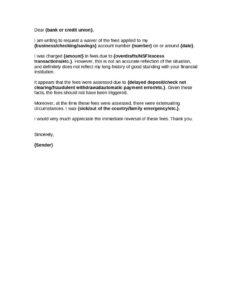
Bank Fee Waiver Letter
Use our free Bank Fee Waiver Letter template to politely request a refund of overdraft, maintenance, or late fees — free download in PDF and DOCX.
DOCX
6 downloads
0
likes
Download Files
- DOCX
A Bank Fee Waiver Letter is a short, polite written request asking your bank to remove or refund a charge such as an overdraft fee, monthly maintenance fee, or late payment penalty. People most often use it when a one-time mistake or an isolated event triggered a fee they feel was avoidable. You can download this template free in both PDF and DOCX formats with no signup required.
What Is a Bank Fee Waiver Letter?
A Bank Fee Waiver Letter is a formal customer communication addressed to a bank or credit union requesting that a specific fee be waived, reversed, or credited back to an account. It is typically written by an account holder and sent to a branch manager, customer service department, or relationship banker. The letter documents which fee was charged, when it appeared, the account it affected, and the reason the customer believes a waiver is justified. While banks are not obligated to grant a waiver, a clear, courteous letter that references a strong account history often improves the chances of a favorable outcome and creates a written record of the request.
When Do You Need a Bank Fee Waiver Letter?
This letter is useful any time a fee feels unfair, accidental, or out of character for how you normally manage your account. Common situations include:
- An accidental overdraft caused by a timing mismatch between a deposit and a debit that posted earlier than expected.
- A monthly maintenance fee charged because your balance briefly dipped below the minimum required to qualify for a free account.
- A late payment fee on a loan or credit card when a payment was delayed by a bank system error or a one-day slip.
- A returned item or NSF fee triggered by a single bounced transaction that you have since covered.
- A wire transfer, ATM, or foreign transaction fee you were not clearly told about in advance.
- A long-standing, loyal customer requesting a goodwill waiver after a rare and isolated error.
What a Bank Fee Waiver Letter Should Have
A strong waiver request is specific, factual, and respectful. To be effective, your letter should include the date, your full name and contact details, and your account number (or a partial number for security). State the exact fee, the amount charged, and the date it posted. Explain clearly and briefly why you are requesting the waiver, and reference your relationship with the bank — how long you have banked there and your general track record. Make a direct, polite request for the specific outcome you want, whether that is a full refund, a credit, or removal of the charge. Close with a thank-you and your signature so the recipient knows exactly how to respond.
How to Fill Out a Bank Fee Waiver Letter
- Add the date at the top so there is a clear record of when the request was made.
- Enter your name and contact information, including your mailing address, phone number, and email so the bank can reach you.
- Address the recipient — the branch manager, customer service team, or a named banker if you have one.
- Include your account number or the last four digits, and specify the account type (checking, savings, or loan).
- Identify the fee precisely: name it (for example, “overdraft fee”), state the dollar amount, and give the posting date.
- Explain the circumstances in two or three sentences — what happened and why you believe a waiver is fair.
- Reference your history, such as years as a customer or a clean record of on-time payments.
- State your request clearly — ask for a full refund or removal of the charge.
- Close politely, thank the reader, and sign your name above your printed name.
How to Improve Your Chances of a Waiver
Banks frequently grant one-time courtesy waivers to customers in good standing, so framing matters. Keep your tone calm and appreciative rather than demanding — you are asking for a favor, not lodging a complaint. If this is your first fee in a long time, say so directly, because account history is one of the strongest arguments you have. Mention any steps you have already taken to prevent the issue from recurring, such as setting up low-balance alerts or linking a backup account for overdraft protection. If a bank error genuinely caused the charge, describe it factually and, where possible, note the date and reference number of any related transaction so the staff can verify it quickly.
Sending the Letter and Following Up
You can deliver a Bank Fee Waiver Letter by mail, in person at a branch, or by uploading it through your bank’s secure message center. A phone call sometimes works for small, recent fees, but a written letter creates a paper trail you can reference if the issue escalates. Keep a copy of everything you send, along with the date and the name of any representative you speak with. If you do not hear back within a reasonable period — often a week or two — follow up politely and reference your original request. If the waiver is denied, you can ask to speak with a supervisor or escalate to the bank’s formal dispute process.
Common Mistakes to Avoid
- Being vague about the fee — always include the exact amount, type, and date so the bank can locate it.
- Using an angry or accusatory tone, which makes staff less inclined to use their discretion in your favor.
- Omitting your account details, forcing the bank to track you down before they can act.
- Requesting waivers for routine, repeated fees rather than isolated incidents — banks rarely waive recurring charges.
- Forgetting to keep a copy of the letter and any confirmation of when it was sent.
- Failing to follow up if you receive no response within a couple of weeks.
Frequently Asked Questions
What is a Bank Fee Waiver Letter? It is a written request asking your bank to refund or remove a specific charge, such as an overdraft, maintenance, or late fee. It documents the fee, your account, and your reason for requesting relief. Banks use it to review and decide whether to grant a courtesy waiver.
Is a bank required to waive a fee if I send this letter? No. Waivers are granted at the bank’s discretion and are not guaranteed. However, customers in good standing who request a one-time courtesy for an isolated mistake often have a strong chance, and a clear, polite letter makes your case easier to approve.
How do I fill out the letter? Add the date, your contact details, and your account number, then identify the exact fee and amount. Briefly explain why a waiver is fair, reference your history with the bank, and make a clear, polite request. Sign and keep a copy for your records.
Does this letter need to be notarized or witnessed? No. A Bank Fee Waiver Letter is an informal customer communication and does not require notarization or witnesses. Your signature and accurate account information are enough for the bank to process the request.
How much does this template cost? Nothing — it is completely free to download here in both PDF and DOCX formats, with no signup or payment required. You can edit the DOCX version to fit your specific fee and circumstances.
What should I do if my waiver request is denied? Stay courteous and ask whether a supervisor or relationship manager can reconsider. You can also ask about steps to prevent the fee in the future, such as overdraft protection or a different account type, and escalate through the bank’s formal dispute channel if you believe the charge was an error.
This template is a general example provided for informational purposes only and does not constitute legal, financial, or tax advice. Bank policies and fee practices vary by institution and jurisdiction, so consult your bank’s terms or a qualified professional for guidance on your specific situation.
Related Forms
- Credit Card Dispute Letter
- Mortgage Assumption Letter
- Credit Freeze Security Letter
- BBB Complaint Letter
- Request to Correct Credit Report
- License Verification
Browse more in Customer Letters.