
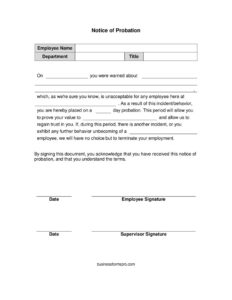
Notice of Probation
Download a free Notice of Probation form template in PDF and DOCX to formally place an employee on probation, document the issue, and set clear terms.
PDF
DOCX
3 downloads
0
likes
Download Files
- DOCX
A Notice of Probation is a formal HR document an employer gives an employee to place them on a defined probationary period following a workplace incident or performance problem. People most often use it to put expectations in writing after a verbal warning, giving the employee a clear chance to correct their behavior before any decision about termination is made. You can download this Notice of Probation template free in PDF and DOCX — no signup required.
What Is a Notice of Probation?
A Notice of Probation is a written notice issued by an employer, manager, or HR representative that documents a specific incident or pattern of conduct and formally places an employee on a probationary period. It records who is being placed on probation, what behavior triggered the action, how long the probation lasts, and what will happen if the issue is not resolved. The document also asks the employee to sign an acknowledgment confirming they received the notice and understand its terms. Its purpose is twofold: to give the employee a fair, clearly communicated opportunity to improve, and to create a dated paper trail that protects both parties if the situation escalates to disciplinary action or dismissal.
When Do You Need a Notice of Probation?
This form is used whenever an employer wants to formalize a corrective period rather than acting on memory or informal conversations alone. Common situations include:
- An employee was verbally warned about a behavior or performance issue and it has continued.
- An incident occurred — such as repeated tardiness, missed deadlines, or a policy violation — that warrants a documented response short of termination.
- HR needs a consistent, written process to apply discipline fairly across the workforce.
- A manager wants to give a struggling but valued employee a structured chance to prove their value before more serious steps.
- The company needs a clear record showing the employee was notified and understood the consequences of further incidents.
- An employer wants to set expectations before deciding whether to retain or release a worker after a defined review period.
What a Notice of Probation Should Have
A complete Notice of Probation contains the elements that make it clear, fair, and defensible. It should identify the employee by name, department, and title, and clearly state the company issuing the notice. It must reference the specific date the prior warning was given and describe the incident or behavior that prompted the action. The notice should state the length of the probationary period in days, explain the purpose of that period, and spell out the consequences of any further incident — including possible termination. Finally, it needs an acknowledgment line and signature so the employee confirms they received and understood the terms. A date next to the signature anchors the document in time.
How to Fill Out a Notice of Probation
- Employee name: Enter the full legal name of the employee being placed on probation so the record is unambiguous.
- Department: Write the department or team the employee works in, such as Sales, Operations, or Customer Service.
- Title: Add the employee’s job title to identify their role within that department.
- Date of warning: Fill in the date the employee was previously warned about the issue, completing the line that reads “On {date} you were warned about…”
- Incident: Describe the specific incident or behavior in factual terms — for example, “arriving late on multiple occasions” or “failing to follow safety procedures.”
- Company name: Insert your company name where indicated so the notice clearly reflects the employer issuing it.
- Number of probation days: Enter the length of the probationary period, such as 30, 60, or 90 days.
- Signature and date: Have the employee sign on the signature line and add the date to acknowledge receipt and understanding.
Setting a Fair Probationary Period
The probation length you choose should give the employee a realistic window to demonstrate improvement. A 30-day period may suit a behavioral issue like punctuality, while performance problems that require building new skills often warrant 60 or 90 days. Whatever number you enter, make sure it matches what you communicate verbally and what your company policy allows. During the period, document any check-ins, coaching sessions, or follow-up incidents in writing as well. This running record supports a consistent, good-faith process and makes any later decision — whether reinstatement to good standing or termination — easier to explain and justify.
Keeping the Language Clear and Professional
The most effective probation notices are direct without being inflammatory. Describe behavior objectively rather than labeling the person, and avoid emotional or accusatory phrasing. The template’s wording sets clear expectations and consequences, but you should tailor the incident description to the facts of your situation. Keep a signed copy in the employee’s personnel file and give the employee their own copy. If an employee refuses to sign, note the refusal and the date, ideally with a witness present, since a refusal does not invalidate the notice itself.
Common Mistakes to Avoid
- Leaving the incident description vague — be specific about what happened and when.
- Forgetting to fill in the date of the original warning, which weakens the timeline.
- Setting an unclear or unrealistic probation length, or leaving the number blank.
- Failing to have the employee sign, or not noting a refusal to sign.
- Not keeping a dated copy in the personnel file for your records.
- Applying probation inconsistently compared with how similar issues were handled for other employees.
Frequently Asked Questions
What is a Notice of Probation used for? It is used to formally place an employee on a defined probationary period after a documented incident or warning. The notice records the issue, sets a clear timeframe for improvement, and states the consequences of further problems. It gives the employee a fair chance to correct course while creating a written record for the employer.
How do I fill out a Notice of Probation? Enter the employee’s name, department, and title, then add the date of the prior warning and a factual description of the incident. Insert your company name, specify the number of probation days, and have the employee sign and date the acknowledgment. Tailor the incident description to your specific situation rather than leaving it generic.
Does a Notice of Probation need to be signed by the employee? The signature line confirms the employee received the notice and understood its terms, which is why it is included. If an employee declines to sign, the notice is still valid — simply note the refusal and the date, ideally with a witness. Always provide the employee with a copy regardless of whether they sign.
Is a Notice of Probation legally binding? The notice documents an internal employment action rather than functioning as a standalone contract. Its weight depends on your company policies, any applicable employment agreement, and local employment laws. To ensure your disciplinary process is compliant, follow your written policies and consult HR or a qualified professional.
How long should the probation period be? There is no universal answer — common periods range from 30 to 90 days depending on the nature of the issue and your company’s policy. Behavioral issues may resolve in a shorter window, while performance improvement often needs more time. Choose a length that is realistic and consistent with how you have handled similar situations.
How much does this Notice of Probation template cost? It is completely free to download from Business Forms Pro in both PDF and DOCX formats, with no signup required. You can edit the DOCX version to add your company details and adjust the wording. Download it, customize it, and use it as many times as you need.
This Notice of Probation template is a general example provided for informational purposes only and is not legal, HR, or employment advice. Employment laws and disciplinary requirements vary by jurisdiction and by company policy. Consult a qualified HR professional or employment attorney before relying on this document.
Official resource: for the rules that apply to your situation, see the U.S. Department of Labor.
Related Forms
- Employee Self Evaluation
- Praising Employee Input
- Employee Personnel Data Change
- Direct Deposit Authorization
- Report of Absence for Military Duty
- Raise Request Letter
Browse more in Employment.