
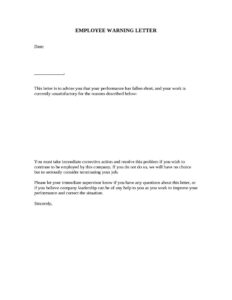
Employee Warning Letter
Download a free Employee Warning Letter template in PDF and DOCX to document performance issues, set expectations, and protect your business — free download.
DOCX
2 downloads
0
likes
Download Files
- DOCX
An Employee Warning Letter is a formal document an employer uses to notify a worker that their performance or conduct is unsatisfactory and must improve. It is most commonly used to create a written record of a problem and the corrective action expected before more serious steps, like termination, are considered. You can download this Employee Warning Letter free in both PDF and DOCX formats — no signup required.
What Is an Employee Warning Letter?
An Employee Warning Letter is a written notice issued by a manager, supervisor, or HR representative to an employee whose work has fallen short of expectations. It documents the specific problem, communicates that immediate corrective action is required, and makes clear that failure to improve could lead to termination. The letter serves two purposes at once: it gives the employee a fair, clear chance to fix the issue, and it builds a paper trail showing the company acted reasonably and consistently. Because it forms part of the employment record, the warning letter is often a key piece of documentation if a dispute or wrongful-termination claim arises later. It is typically signed by the issuer and acknowledged by the employee.
When Do You Need an Employee Warning Letter?
This letter is appropriate any time a performance or conduct issue is serious enough to require a formal, documented response rather than a casual conversation. Common situations include:
- Repeated poor performance — missed targets, low-quality work, or failure to meet deadlines that continues after informal feedback.
- Attendance problems — chronic lateness, unexplained absences, or leaving early without authorization.
- Policy violations — breaching company rules on safety, dress code, technology use, or confidentiality.
- Misconduct or behavior issues — unprofessional conduct, insubordination, or conflicts with coworkers.
- Failure to follow procedures — ignoring established workflows, skipping required steps, or disregarding supervisor instructions.
- Progressive discipline — when a verbal warning has already been given and the issue persists, escalating to a written warning.
Types of Warning Letters
Warning letters generally fall into a few categories. A verbal warning confirmation documents that an earlier conversation took place. A first written warning, like this template, formally records the problem in writing. A final written warning is the last step before termination and states the consequences in stronger terms. Many employers follow a progressive discipline approach, moving from verbal to written to final warnings, which demonstrates fairness and gives employees genuine opportunities to improve.
What an Employee Warning Letter Should Have
A complete and effective warning letter includes several core elements. It should be dated and addressed to the specific employee. It must describe the unsatisfactory performance or conduct clearly and factually, citing concrete examples rather than vague opinions. It should state the corrective action expected and a reasonable timeframe. The letter should explain the consequence of failing to improve — in this case, possible termination — and invite the employee to ask questions or seek support. Finally, it should be signed by the issuing manager or HR representative, and ideally include a space for the employee to acknowledge receipt.
How to Fill Out an Employee Warning Letter
This template is short and direct. Work through it field by field:
- Date — Enter the date the letter is issued. Accurate dating matters because it establishes the timeline of the disciplinary process.
- Reasons described below — In the space provided, document the specific performance or conduct problem. Be factual and specific: note dates, incidents, missed targets, or policy breaches. Avoid emotional language or personal judgments; stick to observable facts.
- Corrective action statement — The template advises the employee to take immediate corrective action. Where possible, spell out exactly what improvement looks like and any deadline or review date.
- Consequence notice — The letter states the company will seriously consider termination if the issue is not resolved. Keep this language clear and consistent with your policies.
- Support and questions — The letter invites the employee to contact their immediate supervisor with questions or for help. Make sure the named supervisor is informed.
- Signature — Sign the letter after “Sincerely,” with your name and title. Consider adding a line for the employee to sign acknowledging receipt.
Delivering the Letter and Next Steps
How you deliver a warning letter is as important as what it says. Whenever possible, hand the letter to the employee in a private meeting rather than emailing it cold, so you can explain the concerns and answer questions in person. Ask the employee to sign a copy acknowledging they received it — acknowledgment confirms receipt, not agreement, and you can note this distinction. Keep the original or a copy in the employee’s personnel file. After issuing the letter, follow through: monitor the employee’s progress against the expectations you set, document improvements or continued issues, and schedule any review you promised. Consistent follow-up shows good faith and strengthens the record.
Common Mistakes to Avoid
- Being vague — Writing “your attitude is bad” instead of citing specific dates, incidents, or measurable shortfalls weakens the letter.
- Letting emotion creep in — Personal, sarcastic, or angry language can undermine professionalism and create legal risk.
- Skipping documentation — Failing to keep a signed copy in the file leaves you without a record if the matter escalates.
- Inconsistency — Disciplining one employee for behavior tolerated in others can expose the company to discrimination claims.
- No clear path forward — Omitting what improvement looks like or a timeframe leaves the employee unsure how to comply.
- Ignoring company policy — Issuing a written warning out of sequence with your own progressive discipline process can be challenged.
Frequently Asked Questions
What is an Employee Warning Letter used for? It is used to formally notify an employee that their performance or conduct is unsatisfactory and must improve. It documents the problem, sets expectations for correction, and warns that continued issues could lead to termination. The letter also creates a written record for the employee’s file.
How do I fill out an Employee Warning Letter? Enter the date, then describe the specific problem clearly using facts and examples. State what corrective action is expected and the consequence of not improving, then sign with your name and title. Adding a line for the employee to acknowledge receipt is also recommended.
Does an Employee Warning Letter need to be signed or witnessed? It should be signed by the manager or HR representative issuing it, and it is good practice to have the employee sign to acknowledge receipt. A witness is not legally required, but having an HR representative present during delivery can be helpful in sensitive cases.
Is an Employee Warning Letter legally binding? The letter itself is a disciplinary record rather than a contract, but it can carry legal weight as evidence that the employer gave fair notice. To be useful, it should be accurate, consistent with company policy, and free of discriminatory motives. Employment laws vary by location.
How much does this template cost? Nothing — this Employee Warning Letter template is completely free to download from Business Forms Pro. It is available in both PDF and DOCX formats with no signup or account required. You can edit the DOCX version to fit your company’s specific situation.
Can I customize the warning letter for my company? Yes. The DOCX version is fully editable, so you can add your company letterhead, specify deadlines and review dates, reference your internal policies, and tailor the consequences. Adjust the wording to match the severity of the issue and whether this is a first or final warning.
This Employee Warning Letter template is provided as a general example for informational purposes only and is not legal, HR, or employment advice. Employment laws and disciplinary requirements vary by jurisdiction and by company policy. Consult a qualified employment attorney or HR professional before relying on this document.
Official resource: for the rules that apply to your situation, see the U.S. Department of Labor.
Related Forms
- Interview Invitation
- Employee Official Warning Letter
- Hazard Assessment
- Paycheck Authorization Form
- Interview Schedule
- Employee Turnover Rate
Browse more in Employment.