
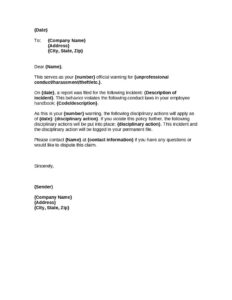
Employee Official Warning Letter
Document workplace policy violations clearly with our free Employee Official Warning Letter template, available as a free download in PDF and DOCX.
DOCX
1 downloads
0
likes
Download Files
- DOCX
An Employee Official Warning Letter is a formal document an employer issues to notify an employee that their conduct, performance, or behavior has fallen below the expected standard and must improve. It is most commonly used to create a written record of a disciplinary issue after verbal feedback has not produced change. You can download this template for free in both PDF and DOCX formats — no signup required.
What Is an Employee Official Warning Letter?
An Employee Official Warning Letter is a written communication from an employer, manager, or human resources department to an employee that documents a specific workplace problem. It typically describes the issue, references any prior conversations or warnings, states the standard the employee is expected to meet, and outlines the consequences if the behavior continues. The letter serves two purposes: it gives the employee a fair, clear opportunity to correct the issue, and it builds an objective paper trail the company can rely on if further disciplinary action — including termination — becomes necessary. It is a core part of progressive discipline and helps protect both parties by putting expectations in writing.
When Do You Need an Employee Official Warning Letter?
This letter is appropriate whenever an informal conversation has not resolved a recurring or serious workplace concern. Common situations include:
- Repeated attendance problems — chronic lateness, unexcused absences, or leaving early without approval.
- Underperformance — consistently missing deadlines, targets, or quality standards after coaching.
- Policy violations — breaching company rules on safety, dress code, technology use, or confidentiality.
- Misconduct — unprofessional behavior, insubordination, or disruptive conduct toward colleagues or clients.
- Failure to follow procedures — ignoring documented processes despite training and reminders.
- Escalation after a verbal warning — when an earlier informal warning did not produce the required improvement.
Many organizations use a tiered approach — a verbal warning, then a first written warning, then a final written warning — and this template can be adapted to any stage by adjusting the tone and the stated consequences.
What an Employee Official Warning Letter Should Have
A complete and defensible warning letter is specific, factual, and free of emotional language. The strongest letters include the following elements:
- The company name, date, and the employee’s full name and job title.
- A clear statement that the document is a formal/official warning.
- A precise description of the issue, including dates, incidents, and the policy or standard breached.
- A reference to any previous warnings or discussions.
- The specific improvement expected and a reasonable timeframe to achieve it.
- The consequences of failing to improve.
- Signature lines for the manager or HR representative and the employee.
How to Fill Out an Employee Official Warning Letter
Work through the template carefully, keeping every statement factual and verifiable:
- Enter the company name and address in the header so the letter is clearly identified as official correspondence.
- Add the date the letter is issued.
- Fill in the employee’s full name, job title, and department, plus their employee ID if your organization uses one.
- State that this is an official warning and indicate the level — for example, first written warning or final warning.
- Describe the specific incident or behavior, including the exact dates, what happened, and which policy or performance standard was not met.
- Reference any prior verbal or written warnings and the dates they were given.
- Spell out the required improvement and the timeframe for review or follow-up.
- List the consequences if performance or conduct does not improve.
- Have the issuing manager or HR representative sign and date the letter, then provide a line for the employee’s signature acknowledging receipt.
Keeping the Letter Fair and Objective
The value of a warning letter depends on its fairness. Stick to observable facts rather than opinions: write “submitted the monthly report three days after the deadline on April 3” instead of “is lazy and unreliable.” Give the employee a genuine, achievable path to improve, and offer support such as training or a check-in schedule where appropriate. Whenever possible, deliver the letter in a private meeting rather than by email alone, and allow the employee to respond or add comments. This approach demonstrates good faith and reduces the risk of the discipline being seen as arbitrary or retaliatory.
Acknowledgment, Records, and Next Steps
Ask the employee to sign the letter to confirm they received it — note that signing acknowledges receipt, not necessarily agreement. If the employee refuses to sign, record that fact and have a witness present. Keep the signed letter in the employee’s confidential personnel file along with any supporting documentation, such as timekeeping records or performance reports. Schedule the follow-up review you promised, and document the outcome. A warning letter is only effective if the company consistently follows through on the timeline and consequences it describes; inconsistent enforcement weakens its credibility and may expose the employer to claims of unfair treatment.
Common Mistakes to Avoid
- Vague descriptions — failing to include dates, examples, or the specific policy breached makes the warning hard to enforce.
- Emotional or accusatory language — personal attacks undermine the document’s professionalism and fairness.
- No clear expectations — omitting the required improvement or timeframe leaves the employee without a path forward.
- Skipping the consequences — the employee should understand what happens if the issue continues.
- Inconsistent treatment — disciplining one employee while ignoring the same conduct in others invites claims of bias.
- Failing to keep a copy — without a signed, filed record, the warning provides little protection later.
Frequently Asked Questions
What is an Employee Official Warning Letter? It is a formal written notice from an employer to an employee that documents a specific performance or conduct problem and states the improvement required. It typically follows informal feedback or a verbal warning and forms part of a progressive discipline process. The letter both gives the employee a chance to correct course and creates a record for the employer.
How do I fill out the warning letter? Enter the company details, the date, and the employee’s name and role, then describe the issue with specific dates and facts. Reference any earlier warnings, state the expected improvement and a deadline, and list the consequences of not improving. Finally, sign as the issuer and provide a line for the employee to acknowledge receipt.
Does an employee have to sign the warning letter? An employee’s signature usually confirms they received the letter, not that they agree with it. If the employee refuses to sign, you can note the refusal on the document and have a witness initial it. Either way, the letter remains a valid part of the employment record.
Is a warning letter legally binding? A warning letter is an internal disciplinary document rather than a contract, but it can carry significant weight as evidence if a dispute or termination later occurs. Its strength depends on being accurate, consistent with company policy, and applied fairly. Employment laws vary by location, so follow your organization’s procedures and local rules.
How much does this template cost? Nothing — this Employee Official Warning Letter template is completely free to download in PDF and DOCX formats, with no signup or payment required. You can edit the DOCX version to match your company’s branding, policies, and disciplinary stages.
How many warnings should be given before termination? There is no universal number; many employers use a graduated approach of verbal, first written, and final written warnings, but practices and legal requirements differ by jurisdiction and by the severity of the misconduct. Serious offenses such as theft or violence may justify immediate action. Always follow your written policy and consult HR or legal counsel for serious cases.
This template is a general example provided for informational purposes only and does not constitute legal, HR, or employment advice. Employment and disciplinary requirements vary by jurisdiction and by company policy. Consult a qualified employment law professional or your human resources department before issuing formal warnings or taking disciplinary action.
Official resource: for the rules that apply to your situation, see the U.S. Department of Labor.
Related Forms
- Applicant Interview Schedule
- Sexual Harassment Complaint
- Notice of Probation
- Employee Termination Notice
- Proof Of Employment
- Employee Evaluation Form
Browse more in Employment.