
Employee Evaluation Form
Download a free Employee Evaluation Form template in PDF and DOCX to rate performance, skills, and attitude fairly and consistently at review time.
PDF
DOCX
0
likes
Download Files
- DOCX
An Employee Evaluation Form is a structured document managers use to assess and document an employee’s job performance over a defined review period. People most often reach for it during scheduled performance reviews, when they need a consistent, written record of strengths and areas for growth. You can download this Employee Evaluation Form free in PDF and DOCX, with no signup required.
What Is an Employee Evaluation Form?
An Employee Evaluation Form is a standardized appraisal tool that lets a reviewer rate an employee across multiple performance categories using a common scale. It is typically issued by a manager, supervisor, or HR department and completed during annual, semi-annual, or probationary reviews. The form documents how an employee performs on measurable aspects such as work quality, attendance, and interpersonal skills, and it gives both the reviewer and the employee space to add comments. By recording ratings and dates side by side, the form creates a paper trail that supports raise decisions, promotions, training plans, and, when necessary, corrective action — while keeping every employee measured against the same criteria.
When Do You Need an Employee Evaluation Form?
This form is useful any time you need a documented, apples-to-apples assessment of an employee’s contribution. Common situations include:
- Annual or scheduled performance reviews where you compare current results against the date of the last review.
- Probationary check-ins for new hires reaching the end of a 30, 60, or 90-day introductory period.
- Promotion or raise decisions that require objective evidence of consistent strong performance.
- Identifying training needs by spotting low ratings in specific skills, knowledge, or managerial areas.
- Supporting corrective action when attendance, dependability, or productivity have slipped and you need a documented baseline.
- Department-wide review cycles where a department head needs uniform records across an entire team.
What an Employee Evaluation Form Should Have
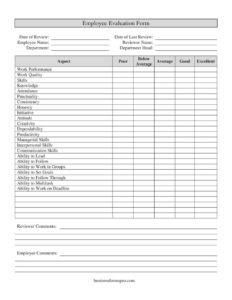
A complete evaluation form balances structure with room for context. At minimum it should include identifying details — the employee name, reviewer name, department, and department head — plus both the date of review and the date of last review so progress can be measured over time. The heart of the form is a rating scale, in this case Poor, Below Average, Average, Good, and Excellent, applied to each performance aspect. It should cover a broad range of competencies, from technical work quality to soft skills like communication and attitude. Finally, dedicated reviewer comments and employee comments sections turn a checklist into a two-way conversation and a fairer, more defensible record.
How to Fill Out an Employee Evaluation Form
- Enter the Date of Review and the Date of Last Review so the appraisal period is clear.
- Record the Employee Name, Reviewer Name, Department, and Department Head at the top.
- Familiarize yourself with the five-point scale: Poor, Below Average, Average, Good, Excellent. Apply it consistently to every aspect.
- Rate core performance items: Work Performance, Work Quality, Skills, Knowledge, Attendance, Punctuality, Consistency, and Honesty.
- Rate behavioral and character traits, including Initiative, Attitude, Creativity, Dependability, and Productivity.
- Assess leadership and collaboration: Managerial Skills, Interpersonal Skills, Communication Skills, Ability to Lead, Ability to Follow, and Ability to Work in Groups.
- Rate execution-focused abilities: Ability to Set Goals, Ability to Follow Through, Ability to Multitask, and Ability to Work on Deadline.
- Write specific, example-backed Reviewer Comments, then give the employee space to respond in Employee Comments before both parties sign off.
Understanding the Rating Categories
The form groups its many aspects into recognizable themes, which makes it easier to discuss results with the employee. Work-related items — work performance, work quality, skills, knowledge, and productivity — measure the output and technical competence of the role. Reliability items such as attendance, punctuality, consistency, dependability, and honesty reflect how trustworthy and steady the employee is day to day. Interpersonal and leadership items, including communication skills, the ability to lead, follow, and work in groups, capture how well the person operates within a team. Finally, self-management aspects like initiative, the ability to set goals, follow through, multitask, and work on deadline reveal how independently the employee drives their own results.
Tips for a Fair and Useful Review
To get the most from this form, anchor each rating in concrete examples rather than general impressions — note a specific project, deadline, or interaction that justifies a Good or Below Average mark. Try to evaluate the entire review period, not just the most recent few weeks, to avoid recency bias. Comparing the current ratings against the date of the last review helps you frame the conversation around growth and trends. Whenever you assign a low rating, pair it in the reviewer comments with a clear, actionable suggestion for improvement. Inviting the employee to add their own comments before finalizing keeps the process collaborative and surfaces context a manager may have missed.
Common Mistakes to Avoid
- Halo or horns effect: letting one strong or weak trait skew unrelated ratings instead of judging each aspect independently.
- Central tendency: rating everyone "Average" to avoid difficult conversations, which makes the form useless for decisions.
- No supporting detail: leaving reviewer comments blank so ratings can’t be explained or defended later.
- Recency bias: focusing only on recent events rather than the full period since the last review.
- Skipping the employee’s voice: finalizing the form without giving the employee a chance to add comments.
- Inconsistent scales: applying the Poor-to-Excellent ratings differently across team members, undermining fairness.
Frequently Asked Questions
What is an Employee Evaluation Form used for? It is used to document and rate an employee’s job performance across categories like work quality, attendance, and communication during a review period. Managers use it to support decisions about raises, promotions, training, and corrective action, and to give employees clear, written feedback.
How do I fill out an Employee Evaluation Form? Start with the identifying fields — employee name, reviewer, department, and both review dates — then rate each listed aspect on the Poor-to-Excellent scale. Finish by writing specific reviewer comments tied to real examples and allowing the employee to add their own comments before signing.
What rating scale does this form use? This template uses a five-point scale: Poor, Below Average, Average, Good, and Excellent. Applying the same scale consistently to every aspect and every employee is what keeps evaluations fair and comparable.
Is an Employee Evaluation Form legally binding? The form itself is an internal HR record rather than a contract, but it can become important evidence in employment matters, so accuracy matters. Document ratings objectively and back them with examples, and follow any policies your organization has for storing and sharing reviews.
Do employees need to sign the evaluation? Many organizations ask employees to sign to acknowledge they received and reviewed the evaluation — not necessarily that they agree with it. The employee comments section lets staff add their perspective, which is good practice even when a signature is optional.
How much does this Employee Evaluation Form cost? Nothing — you can download this Employee Evaluation Form completely free in PDF and DOCX formats with no signup required. The editable DOCX version lets you adjust the aspects and rating labels to fit your own roles and review process.
This Employee Evaluation Form template is provided as a general example for informational purposes only and does not constitute legal, HR, or professional advice. Employment laws and review requirements vary by jurisdiction and organization — consult a qualified HR or legal professional before relying on this form for personnel decisions.
Official resource: for the rules that apply to your situation, see the U.S. Department of Labor.
Related Forms
- First Warning Notice Employee Behavior
- Harassment Report Form
- Employee Turnover Rate
- Employee Separation Form
- Job Application Comparison Chart
- Employee Orientation Checklist
Browse more in Employment.