
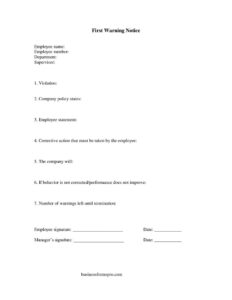
First Warning Notice Employee Behavior
Use this free First Warning Notice for employee behavior to document violations, corrective action, and next steps — free PDF and DOCX download.
PDF
DOCX
0
likes
Download Files
- DOCX
A First Warning Notice for employee behavior is a formal written record that an employer uses to document a workplace policy violation and outline the corrective steps an employee must take. It is most commonly issued as the first official step in a progressive discipline process, after informal coaching has not resolved the issue. This template is free to download in both PDF and DOCX, with no signup required.
What Is a First Warning Notice?
A First Warning Notice is a disciplinary document, usually issued by a supervisor or manager and acknowledged by the employee, that records a specific behavioral or performance problem. It identifies what happened, which company policy was broken, what the employee must do to correct it, and what the employer commits to do in return. By putting the issue in writing and capturing both parties’ signatures, it creates a dated record that supports fair, consistent treatment and protects both the employee and the organization if the matter escalates later.
When Do You Need a First Warning Notice?
This notice is appropriate when a problem has crossed the line from a casual conversation into something that warrants a formal record. Common situations include:
- Repeated tardiness or absenteeism after a verbal reminder has already been given.
- Failure to follow company policy, such as dress code, safety procedures, or use of company equipment.
- Performance shortfalls where an employee is consistently missing targets or quality standards.
- Unprofessional conduct toward coworkers, customers, or supervisors.
- Insubordination or refusal to complete reasonable, assigned tasks.
- Misuse of time, such as excessive personal phone use or unauthorized breaks.
In each case, the goal of a first warning is corrective, not punitive — it gives the employee a clear, documented chance to improve before more serious measures are considered.
What a First Warning Notice Should Have
A complete and useful notice leaves no room for confusion about what went wrong or what happens next. The strongest versions include the employee’s identifying details, a factual description of the violation, the specific policy that applies, the employee’s own account of events, the corrective action expected, the employer’s commitment to support improvement, and a clear statement of consequences if the behavior continues. Including the number of warnings remaining before termination makes the progressive discipline path transparent. Signature and date lines for both the employee and the manager confirm the conversation took place and the document was delivered.
How to Fill Out a First Warning Notice
- Enter the Employee name, Employee number, Department, and Supervisor at the top so the record is correctly attributed.
- In 1. Violation, describe what happened in objective, factual terms — include the date, time, and place where relevant, avoiding opinion or labels.
- In 2. Company policy states, quote or paraphrase the exact rule or standard that was breached, referencing the handbook section if possible.
- Give the employee space in 3. Employee statement to add their perspective; capturing their account supports fairness.
- Under 4. Corrective action that must be taken by the employee, list the specific, measurable changes expected and any deadline.
- In 5. The company will, note the support offered, such as training, a schedule adjustment, or a follow-up review.
- In 6. If behavior is not corrected, state the next disciplinary step clearly.
- Record the 7. Number of warnings left until termination to make the process transparent.
- Have the employee and manager add signatures and dates to confirm delivery.
Where a First Warning Fits in Progressive Discipline
Most progressive discipline systems move in stages: a verbal warning, a first written warning, a final written warning, and then termination. The First Warning Notice formalizes the second stage and signals that the employer considers the issue serious enough to document. The line asking how many warnings remain before termination helps the employee understand exactly where they stand and reinforces that the company is following a consistent, predictable process rather than acting arbitrarily. Used correctly, this stage often resolves the problem before more severe action becomes necessary.
Tips for Delivering the Notice Effectively
Hold the conversation in private and keep the tone professional and supportive — the document should read as a path to improvement, not a personal attack. Stick to facts and observable behavior rather than character judgments. Allow the employee to respond and record their statement in their own words. If the employee refuses to sign, note that refusal on the form and have a witness initial it; a signature confirms receipt, not agreement. Keep a copy in the employee’s personnel file and give the employee a copy as well, so everyone works from the same record.
Common Mistakes to Avoid
- Being vague. “Bad attitude” is not actionable; describe specific incidents, dates, and observable conduct.
- Skipping the policy reference. Tying the violation to a written rule shows the standard was known and applied consistently.
- Omitting corrective steps. Without clear expectations and a deadline, the employee cannot know what success looks like.
- Inconsistency. Disciplining one employee but ignoring the same behavior in another invites claims of unfair treatment.
- Forgetting signatures and dates. An undated or unsigned notice is far weaker as a record.
- Letting emotion drive the language. Stay factual; opinionated wording can undermine the document’s credibility.
Frequently Asked Questions
What is a First Warning Notice for employee behavior? It is a formal written document that records a specific workplace policy violation or performance issue and outlines the corrective action the employee must take. It is typically the first official step in a progressive discipline process after informal coaching. The notice protects both parties by creating a clear, dated record.
How do I fill out a First Warning Notice? Enter the employee’s identifying details, then describe the violation factually and reference the specific company policy involved. Record the employee’s statement, list the required corrective action, note what the company will do to support improvement, and state the consequences if the behavior continues. Finish with both signatures and dates.
Does an employee have to sign the warning? A signature usually confirms that the employee received the notice, not that they agree with it. If an employee refuses to sign, note the refusal on the form and have a witness initial it. The notice remains valid as a record even without the employee’s signature.
Is a First Warning Notice legally binding? It is an internal disciplinary record rather than a contract, but it can carry significant weight if a dispute or termination is later challenged. Employment laws and documentation requirements vary by jurisdiction, so follow your organization’s policies and local rules. Consistent, factual documentation strengthens the employer’s position.
What happens after a first warning is issued? The employee is expected to take the corrective action described within any stated deadline, and the manager typically schedules a follow-up review. If the behavior improves, no further action is needed; if it does not, the next disciplinary step — often a final written warning — may follow. The notice should make this path clear.
How much does this template cost? Nothing — this First Warning Notice template is completely free to download in PDF and DOCX formats with no signup required. You can edit it to match your company’s policies and disciplinary stages. Use it as a starting point and adapt the wording to your workplace.
This template is a general example provided for informational purposes only and does not constitute legal, HR, or employment advice. Employment laws and disciplinary requirements vary by jurisdiction and by organization. Consult a qualified HR professional or employment attorney before relying on this document.
Official resource: for the rules that apply to your situation, see the U.S. Department of Labor.
Related Forms
- Monthly Time Card With Approval
- Direct Deposit Authorization
- Employee Name Change Notification
- Employee Separation Report
- Check Driving Record
- Lactation Accommodation Request
Browse more in Employment.