
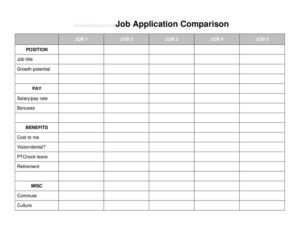
Job Application Comparison Chart
Compare candidates side by side with a free Job Application Comparison Chart template, available as a free PDF and DOCX download to simplify hiring decisions.
PDF
DOCX
4 downloads
0
likes
Download Files
- DOCX
A Job Application Comparison Chart is a side-by-side evaluation tool that lets hiring teams line up multiple candidates against the same criteria so the strongest applicant becomes obvious at a glance. People most often reach for one when they have narrowed a pool down to a handful of finalists and need a fair, organized way to choose. It is free to download here in both PDF and DOCX formats, with no signup required.
What Is a Job Application Comparison Chart?
A Job Application Comparison Chart is a structured grid used by recruiters, hiring managers, and interview panels to evaluate several job candidates against a consistent set of factors. Instead of relying on memory or scattered notes, the chart places each applicant in a column and each evaluation criterion in a row, making differences in experience, skills, and fit easy to spot. It documents who was considered, how each person scored, and why a particular candidate was selected. This creates a transparent, defensible record of the decision and helps reduce unconscious bias by holding every applicant to the same standard.
When Do You Need a Job Application Comparison Chart?
This chart is most valuable whenever a decision involves more than one viable candidate. Common situations include:
- Choosing between two or three finalists after a round of interviews for a single open role.
- Running a hiring committee where multiple interviewers need to compare notes on the same applicants.
- Filling several similar positions at once and needing to rank a larger applicant pool quickly.
- Documenting an objective selection process to support equal-opportunity hiring practices.
- Justifying a hiring recommendation to a department head, owner, or board.
- Revisiting a shortlist weeks later to fill a backup or second vacancy without re-interviewing everyone.
What a Job Application Comparison Chart Should Have
A useful comparison chart balances structure with flexibility. At minimum it should include the position title and date, a clearly labeled column for each candidate, and rows for the criteria that matter most to the role. Typical criteria include relevant experience, education or certifications, technical or job-specific skills, interview performance, salary expectations, availability or start date, and overall cultural fit. Many charts add a scoring system (such as 1 to 5) for each criterion, a weighting column so that critical factors count more heavily, a total or average score row, and a notes or comments area for context that numbers cannot capture. A final recommendation line ties the evaluation to a clear decision.
How to Fill Out a Job Application Comparison Chart
- Enter the position details. Write the job title, department, and the date of the evaluation at the top so the chart is easy to file and reference later.
- List your criteria. In the left-hand column, write each factor you will score — experience, skills, education, interview answers, salary expectation, availability, and culture fit.
- Add each candidate. Label one column per applicant with their name and, optionally, application or requisition number.
- Set weights if used. Assign a weight or priority to any criterion that matters more than the rest, such as a required certification.
- Score each cell. Move through one candidate at a time, rating them against every criterion using your chosen scale.
- Add notes. Capture standout strengths, red flags, or interviewer impressions in the comments area.
- Total the scores. Sum or average each column, applying weights where relevant.
- Record the recommendation. Note the selected candidate and a brief rationale, then have evaluators sign or initial.
Tips for a Fair and Useful Comparison
The chart is only as objective as the criteria behind it. Decide on your evaluation factors before you start reviewing applicants, and use the same factors for everyone — adding a new criterion partway through skews the results. Keep criteria tied to the actual requirements of the job rather than personal preferences. When several interviewers contribute, have each one score independently first, then compare; this surfaces disagreement that an averaged number alone would hide. Use the notes column generously, because a single comment about communication style or a scheduling conflict often explains why a numerically close candidate is actually the better hire. Finally, store completed charts securely, since they may contain sensitive applicant information.
How It Differs From an Interview Scorecard
People sometimes confuse a comparison chart with an interview scorecard, but they serve different stages. An interview scorecard captures one interviewer’s impression of one candidate during or right after a conversation. A Job Application Comparison Chart aggregates information from across the whole process — resumes, interviews, references, and scorecards — and places candidates next to one another so you can rank them. In practice, you often use scorecards to gather raw data and then transfer the results into a comparison chart to make the final call. Using both gives you depth on each individual and a clear, side-by-side overview for the decision itself.
Common Mistakes to Avoid
- Changing criteria mid-process so candidates are no longer measured against the same standard.
- Scoring on gut feeling without tying ratings to defined, job-relevant factors.
- Leaving the notes blank and relying only on numbers, which loses important context.
- Ignoring weighting so a minor criterion outweighs a must-have qualification.
- Recording discriminatory or non-job-related observations that could create legal exposure.
- Failing to save the completed chart, leaving no record of how or why the hire was made.
Frequently Asked Questions
What is a Job Application Comparison Chart used for? It is used to evaluate multiple job candidates side by side against the same set of criteria. By scoring each applicant on factors like experience, skills, and interview performance, it helps hiring teams identify the strongest fit and document an objective, consistent decision.
How do I fill out a Job Application Comparison Chart? Start by entering the position and date, then list your evaluation criteria down the side and one candidate per column. Score each applicant against every criterion, add notes for context, total the columns, and record your final recommendation. Working one candidate at a time keeps your scoring consistent.
How many candidates should I compare at once? The chart works best with a shortlist of finalists, typically two to six people. Comparing too many at once makes the grid hard to read and the scoring less meaningful, so it is usually better to screen out weaker applicants before building the chart.
Should I use a scoring or weighting system? A simple scale, such as 1 to 5 per criterion, makes comparisons clearer and easier to total. Adding weights is helpful when some factors matter far more than others — for example, a required license should count more than a nice-to-have skill.
Is a comparison chart legally required for hiring? No, it is not required, but keeping a consistent, criteria-based record can help demonstrate a fair selection process if a hiring decision is ever questioned. Just be sure your criteria are job-related and avoid noting protected characteristics.
Is this Job Application Comparison Chart template free? Yes. You can download this template completely free in both PDF and DOCX formats with no signup required, then customize the criteria, candidates, and scoring to fit your specific role.
This Job Application Comparison Chart template is a general example provided for informational purposes only and does not constitute legal, HR, or professional advice. Employment and hiring requirements vary by jurisdiction and industry — consult a qualified professional to ensure your selection process complies with applicable laws and regulations.
Official resource: for the rules that apply to your situation, see the U.S. Department of Labor.
Related Forms
- Letter Of Demotion
- Job Description Template
- Salary Verification Request Letter
- Job Acceptance Letter
- Bi-Weekly Time Card With Approval
- Shift Trade Tracker
Browse more in Employment.