
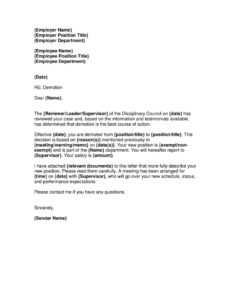
Letter Of Demotion
Use this free Letter of Demotion template to formally notify an employee of a change in role, pay, and reporting line — free PDF and DOCX download.
PDF
DOCX
2 downloads
0
likes
Download Files
- DOCX
A Letter of Demotion is a formal written notice an employer gives an employee to confirm a reduction in their job title, responsibilities, or pay. Most organizations use it to document the outcome of a disciplinary or performance review in a clear, professional way that protects both parties. This template is free to download in PDF and DOCX, with no signup required.
What Is a Letter of Demotion?
A Letter of Demotion is an official employment document issued by an employer, HR department, or manager to inform an employee that they are being moved to a lower-ranking position. It records the effective date, the old and new titles, the reason for the change, the new reporting structure, and the revised salary. Because a demotion affects pay, status, and duties, putting it in writing creates a clear paper trail and reduces the chance of misunderstanding. It is typically the final step after warnings, performance reviews, or a disciplinary council decision, and it gives the employee written confirmation of exactly what is changing and when.
When Do You Need a Letter of Demotion?
Employers reach for this letter whenever a role change needs to be documented formally rather than handled in conversation alone. Common situations include:
- Performance-related demotions — an employee has not met the expectations of a role despite prior coaching, warnings, or a performance improvement plan.
- Disciplinary outcomes — a disciplinary council or review board determines that demotion is more appropriate than termination.
- Organizational restructuring — a role is eliminated or reduced and the employee is reassigned to a lower position rather than let go.
- Voluntary or requested demotions — an employee asks to step down from a management role for personal, health, or workload reasons.
- Probationary reassignment — a promotion did not work out and the employee returns to their previous level.
- Conduct issues — repeated policy violations that warrant a loss of authority but not dismissal.
What a Letter of Demotion Should Have
A complete demotion letter leaves no room for ambiguity. It should clearly identify the employer and employee by name, title, and department; state the effective date of the change; name both the old and new positions; explain the reason for the decision with reference to prior documentation; specify the new exempt or non-exempt status; list the revised salary; identify the new supervisor; and outline next steps such as a transition meeting. Attaching a new job description and any supporting records makes the letter stronger and ensures the employee understands the full scope of their changed role.
How to Fill Out a Letter of Demotion
- Enter the employer name, position title, and department of the person issuing the letter at the top.
- Add the employee name, position title, and department so the recipient is clearly identified.
- Insert the date the letter is written and keep the RE: Demotion subject line.
- Open with the greeting using the employee’s name.
- Reference the reviewer, leader, or supervisor of the disciplinary council and the date the case was reviewed.
- State the effective date and name the position the employee is moving from and the position they are moving to.
- Explain the reason(s) for the decision and cite the prior meeting, warning, or memo and its date(s).
- Indicate whether the new role is exempt or non-exempt and name the department it belongs to.
- Identify the new supervisor the employee will report to and state the new salary amount.
- List the relevant documents attached, set the time and date of the transition meeting, and sign with the sender name.
Exempt vs. Non-Exempt Status in a Demotion
One field in this template asks whether the new position is exempt or non-exempt, and it matters more than it might appear. Exempt employees are typically salaried and not entitled to overtime, while non-exempt employees are usually paid hourly and qualify for overtime. A demotion can change an employee’s classification, which affects how they are paid, how their hours are tracked, and what benefits or overtime rules apply. Always confirm the correct classification with your HR or payroll team before issuing the letter, because misclassifying a role can create wage-and-hour problems. Spelling this out in the letter helps the employee understand how their compensation and schedule will work going forward.
Delivering the Letter Professionally
How you deliver a demotion letter shapes how the employee receives it. Whenever possible, hand the letter over in a private meeting rather than by email alone, and have a member of HR present. Give the employee time to read the document, ask questions, and review any attached job description. The template builds in a follow-up meeting with the new supervisor to walk through schedule, status, and performance expectations — use it. A calm, respectful conversation paired with clear written terms reduces the risk of conflict and helps the employee transition into their new role.
Common Mistakes to Avoid
- Leaving out the effective date — without it, the employee and payroll cannot determine when the new terms start.
- Failing to reference prior warnings — citing the earlier meeting, memo, or warning shows the decision followed a fair process.
- Forgetting the salary change — omitting the new amount creates confusion and possible payroll disputes.
- Skipping the new reporting line — the employee needs to know exactly who their new supervisor is.
- Using vague reasons — state specific, documented reasons rather than general dissatisfaction.
- Not attaching the new job description — the employee should be able to read the full duties of their new position.
Frequently Asked Questions
What is a Letter of Demotion used for? It is used to formally notify an employee that their job title, responsibilities, and often their pay are being reduced. The letter documents the effective date, the reason, the new position, the new supervisor, and the revised salary so both the employer and employee have a clear written record of the change.
How do I fill out a Letter of Demotion? Start by entering the employer and employee names, titles, and departments, then state the effective date and the old and new positions. Add the documented reason, reference any prior warnings, specify exempt or non-exempt status and salary, name the new supervisor, and set up a transition meeting before signing.
Is a Letter of Demotion legally binding? The letter itself documents an employment decision rather than creating a binding contract, but the change it describes has real legal and financial consequences for pay and status. Employment laws vary by jurisdiction, so it is wise to have HR or legal counsel review a demotion before it is issued.
Does a demotion letter need to be signed or witnessed? It should be signed by the person issuing it, and many employers ask the employee to acknowledge receipt by signing or initialing a copy. A witness or HR representative present at delivery is not legally required everywhere but is a strong best practice for documentation.
Can an employee refuse a demotion? An employee can decline a demotion, though the consequences depend on their employment agreement, company policy, and local law. In some cases refusing may lead to termination or be treated as a resignation, so the letter and any conversation should make the options and expectations clear.
How much does this Letter of Demotion template cost? Nothing — you can download it free in both PDF and DOCX formats from Business Forms Pro with no signup required. You are free to edit the fields to match your organization’s situation and branding.
This Letter of Demotion template is a general example provided for informational purposes only and is not legal, financial, or HR advice. Employment laws and notice requirements vary by jurisdiction, so consult a qualified attorney or human resources professional before issuing any demotion notice.
Official resource: for the rules that apply to your situation, see the U.S. Department of Labor.
Related Forms
- Employee Reference Request
- Key Assignment Form
- Interview Invitation
- Shift Change Request
- Direct Deposit Authorization
- Disciplinary Action Form
Browse more in Employment.