
Disciplinary Action Form
Free disciplinary action form template in PDF & DOCX. Learn what disciplinary action is, how to document it fairly, and how to fill one out — download today.
PDF
DOCX
5 downloads
0
likes
Download Files
- DOCX
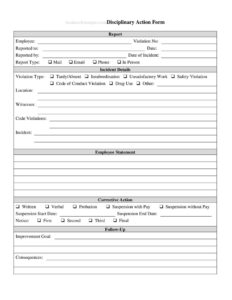
A disciplinary action form documents a workplace rule violation and the action taken in response, creating a fair, consistent record for both the employer and the employee. Download the free template below in PDF or DOCX. No signup or email required.
What Is a Disciplinary Action Form?
A disciplinary action form — sometimes called an employee write-up — is the document a manager or HR uses to formally record that an employee broke a workplace rule and what was done about it. It captures the facts of the incident, the type of violation, any witnesses, and the corrective step being taken, from a verbal warning up to termination. The purpose is twofold: it makes sure the employee clearly understands the problem and what’s expected going forward, and it gives the company a consistent, dated record. That record matters — handled fairly and documented well, disciplinary action protects both sides if the situation escalates or the decision is ever questioned.
When Is a Disciplinary Action Form Used?
Disciplinary action usually follows a process rather than a single bad day. Most employers use progressive discipline: a verbal warning first, then a written warning, then more serious steps if the behavior continues. A form is typically completed when an issue is serious enough to document or when earlier informal feedback hasn’t worked. Common triggers include repeated lateness, breaking company policy, poor performance that hasn’t improved, or a one-off serious incident like a safety breach. Documenting each step builds a clear history, so that if termination eventually becomes necessary, there’s a fair record showing the employee was warned and given a chance to correct course.
Types of Violations
A good form lets you categorize the issue clearly. The template above includes the most common violation types:
- Tardiness or absence — repeated lateness or unexcused absences
- Insubordination — refusing reasonable instructions
- Unsatisfactory work — performance below the required standard
- Safety violation — ignoring safety rules or creating a hazard
- Code of conduct violation — breaching company policies or behavior standards
- Drug or alcohol use — violating substance policies
- Other — anything not covered above, described in the details
What to Include on a Disciplinary Action Form
Accuracy and specificity are everything. The template records the employee name, the violation number (first, second, and so on), who it was reported to and reported by, and the date of the incident. It documents the report type (mail, email, phone, or in person), the incident details, the violation type, the location, and any witnesses. Sticking to facts — what happened, when, and where — rather than opinions is what makes the record fair and credible.
How to Fill Out a Disciplinary Action Form
- Enter the employee name and the violation number to show where this falls in the sequence.
- Record who the incident was reported to and reported by, with the date of the incident.
- Note the report type — how the issue was raised (in person, email, phone, or mail).
- Write clear, factual incident details: what happened, when, and where.
- Mark the violation type and list any witnesses and the location.
- State the corrective action and next steps, then have the manager and employee sign — the employee’s signature acknowledges receipt, not necessarily agreement.
Keeping It Fair and Consistent
The value of disciplinary documentation comes from fairness. Apply the same rules to everyone, base the form on facts rather than feelings, and give the employee a chance to respond — their side belongs in the record too. An employee’s signature usually confirms only that they received the form, so note clearly that signing isn’t an admission. Consistency is also your best legal protection: discipline that’s applied evenly and documented carefully is far harder to challenge as unfair or discriminatory than action that seems to single someone out.
Common Mistakes to Avoid
- Recording opinions or labels instead of specific facts
- Applying rules inconsistently across different employees
- Skipping documentation until you’ve already decided to fire someone
- Not letting the employee read or respond to the form
- Leaving out the date, witnesses, or details that make the record credible
The Progressive Discipline Ladder
Most workplaces escalate consequences step by step rather than jumping straight to dismissal. A typical ladder runs: an informal verbal warning, then a documented written warning, then a final warning or short suspension, and finally termination if the behavior continues. Documenting each rung with a form like this one is what makes the ladder fair and defensible — it shows the employee was told about the problem, given clear expectations, and offered a genuine chance to improve before the most serious step was taken. Serious misconduct, such as violence or theft, may skip the lower rungs, but even then a clear written record of what happened and why action was taken is essential to protect everyone involved.
Frequently Asked Questions
What is disciplinary action? It’s the corrective step an employer takes when an employee breaks a workplace rule — ranging from a verbal warning to a written warning, suspension, or termination — usually documented on a form.
What is a disciplinary action form? A document that records a workplace violation and the action taken, including the incident details, violation type, witnesses, and corrective step, so there’s a fair and consistent record.
Is a performance improvement plan a disciplinary action? It can overlap, but they differ in focus. A PIP is aimed at improving performance with goals and support; disciplinary action documents a rule violation. Some employers use a PIP as part of a disciplinary process.
How do I write a disciplinary action form? Record the employee, the incident facts, the violation type, witnesses, and the corrective action, then have both parties sign. Stick to facts, not opinions. The template above guides each step.
Does the employee have to sign it? Usually the signature only confirms they received the form, not that they agree. If they refuse, note that on the form and have a witness confirm it was presented.
How much does this template cost? It’s free to download in PDF and DOCX.
Related Forms
Employee Warning Letter · Performance Improvement Plan · Employee Evaluation Form · Employee Termination Notice · Employee Complaint Form
This template is provided for general informational purposes only and is not legal or HR advice. Employment and fair-process laws vary by location — consult a qualified professional or your HR department before taking action.
Official resource: for the rules that apply to your situation, see the U.S. Department of Labor.
Related Forms
- Salary Verification Request Letter
- Semi-Monthly Time Card With Approval
- Arrival And Departure Record
- Termination Checklist
- Manual Timecard Semi-Monthly Mini
- Employee Checkout
Browse more in Employment.