
Termination Checklist
Download a free Termination Checklist template to manage employee offboarding, asset returns, and final pay — quick PDF and DOCX free download.
PDF
DOCX
5 downloads
0
likes
Download Files
- DOCX
A Termination Checklist is a structured offboarding form that HR and managers use to track every task that must be completed when an employee leaves the company. The most common reason people use it is to make sure nothing slips through the cracks — from collecting the ID badge to issuing the final paycheck. It’s free to download here in both PDF and DOCX formats, with no signup required.
What Is a Termination Checklist?
A Termination Checklist is an internal document used by employers to organize and verify the steps involved in ending an employment relationship. It is typically completed by a supervisor, HR representative, or office manager during an employee’s final days. The checklist documents the return of company property, the settlement of pay and benefits, and the completion of administrative steps such as the exit interview. By centralizing these items on one form, the company creates a clear record that offboarding was handled consistently and that all loose ends — security access, equipment, final wages — were addressed before the departure is finalized.
When Do You Need a Termination Checklist?
This form is useful any time an employee separates from the organization, regardless of the reason. Common situations include:
- Voluntary resignation — an employee gives notice and you need to coordinate property return and final pay before their last day.
- Involuntary termination — a layoff or dismissal where security access and company materials must be recovered quickly and carefully.
- End of a contract or seasonal role — a temporary or project-based worker wraps up and equipment must be reclaimed.
- Retirement — a long-tenured employee departs and benefits, PTO, and a recommendation letter need attention.
- Internal transfer or restructuring — when a role is eliminated and access permissions must be updated.
- Remote employee offboarding — where laptops, badges, and credentials must be returned or remotely disabled.
In each case, the checklist provides a repeatable framework so every separation is handled the same professional way.
What a Termination Checklist Should Have
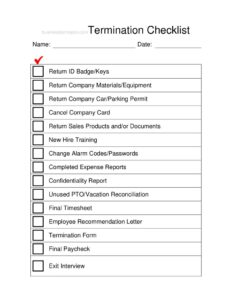
A complete Termination Checklist captures three broad categories of tasks: property return, security and access, and pay and administrative closure. Property items cover the ID badge, keys, equipment, company car, parking permit, sales products, and documents. Security items include changing alarm codes and passwords and canceling the company card. Pay and administrative items include the final timesheet, expense reports, unused PTO reconciliation, the final paycheck, the termination form, and the exit interview. The form should also identify the employee by name, record the date of separation, and provide a space to confirm each item as it is completed so accountability is clear.
How to Fill Out a Termination Checklist
- Name and Date: Enter the departing employee’s full name and the effective date of termination at the top.
- Return ID Badge/Keys: Confirm the badge and any physical keys have been collected and check the item off.
- Return Company Materials/Equipment: Verify return of laptops, phones, tools, or any issued equipment.
- Return Company Car/Parking Permit: Recover any vehicle and parking access where applicable.
- Cancel Company Card: Deactivate corporate credit or purchasing cards.
- Return Sales Products and/or Documents: Collect samples, inventory, or confidential paperwork.
- New Hire Training: Note any knowledge transfer or handover to a replacement.
- Change Alarm Codes/Passwords: Update facility codes and system credentials.
- Completed Expense Reports: Ensure outstanding expenses are submitted and reconciled.
- Confidentiality Report: Review and confirm any confidentiality or NDA obligations.
- Unused PTO/Vacation Reconciliation: Calculate accrued, unused leave.
- Final Timesheet, Employee Recommendation Letter, Termination Form, Final Paycheck, and Exit Interview: Complete each closing task and mark it done.
Coordinating Pay and Final Wages
One of the most sensitive parts of any termination is the final paycheck. Many jurisdictions have specific rules about when final wages must be paid — sometimes on the last day of work, sometimes within a set number of days, and sometimes depending on whether the separation was voluntary or involuntary. The Termination Checklist helps payroll coordinate the final timesheet, reconcile unused PTO or vacation that may be payable, and confirm that any outstanding expense reimbursements are included. Treat these line items as a prompt to verify your local requirements rather than as a fixed schedule, since rules differ widely from one state or country to another.
Protecting Security and Company Property
Recovering access and assets is just as important as settling pay, especially in involuntary terminations. The checklist groups badge and key returns alongside alarm code changes, password resets, and company card cancellations so these steps happen promptly — ideally on or before the employee’s last day. Disabling network and email access at the right moment protects sensitive data and reduces the risk of unauthorized use. Documenting each recovered item on the form also creates a clear record in case there is any later dispute about what was or wasn’t returned.
Common Mistakes to Avoid
- Forgetting digital access: Returning a badge but leaving email, VPN, or cloud accounts active is a frequent and risky oversight.
- Delaying the final paycheck: Missing local deadlines for final wages can create legal exposure.
- Skipping PTO reconciliation: Failing to calculate accrued, unused leave can shortchange the employee or the company.
- Overlooking the exit interview: Missing this step means losing valuable feedback about why people leave.
- Not tracking who collected what: Leaving items unchecked makes it hard to prove property was recovered.
- Using the same process for every case: Treating a voluntary resignation identically to a for-cause dismissal can create unnecessary friction or security gaps.
Frequently Asked Questions
What is a Termination Checklist used for? It is an internal tool that helps employers track all the tasks involved in offboarding a departing employee. It covers property returns, security access changes, and final pay and administrative steps so nothing is overlooked. Using one creates a consistent, documented process for every separation.
Who fills out the Termination Checklist? Typically an HR representative, the employee’s direct supervisor, or an office manager completes it. In smaller organizations, a single person may handle the whole form, while larger companies often divide tasks between HR, IT, payroll, and facilities. Each responsible party checks off the items they oversee.
Is a Termination Checklist a legal document? The checklist itself is an internal administrative record rather than a binding legal contract. However, it can serve as useful documentation that proper offboarding steps were followed, which may be helpful if a dispute arises later. Keep the completed form in the employee’s file.
When should the final paycheck be issued? Final pay timing depends on your jurisdiction and sometimes on whether the separation was voluntary or involuntary. Some areas require payment on the last working day, while others allow a few days or until the next regular pay cycle. Always confirm the rules that apply to your location before issuing final wages.
Should I conduct an exit interview for every termination? Exit interviews are most valuable for voluntary resignations, where feedback can reveal patterns and improve retention. They may be brief or skipped for certain involuntary terminations depending on company policy. The checklist includes the item so you can decide case by case.
How much does this Termination Checklist template cost? It is completely free to download from Business Forms Pro in both PDF and DOCX formats, with no signup or payment required. You can customize the fields to match your company’s specific equipment, access systems, and policies. Edit the DOCX version in your word processor before use.
This Termination Checklist template is a general example provided for informational purposes only and is not legal, financial, or HR advice. Employment and final-pay requirements vary by jurisdiction and individual circumstances, so consult a qualified professional or your legal counsel before relying on this form.
Official resource: for the rules that apply to your situation, see the U.S. Department of Labor.
Related Forms
- Semi-Monthly Time Card With Approval
- Employee Evaluation Form
- Employment Confirmation Letter
- Injury Report
- Employee Turnover Rate
- Monthly Time Card With Approval
Browse more in Employment.