
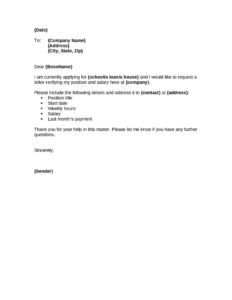
Salary Verification Request Letter
Download a free Salary Verification Request Letter template in PDF and DOCX to formally confirm an employee's income for lenders, landlords, and agencies.
DOCX
2 downloads
0
likes
Download Files
- DOCX
A Salary Verification Request Letter is a written request asking an employer or HR department to confirm an individual’s employment and earnings. People most often use it when a lender, landlord, or government agency needs proof of income before approving a loan, lease, or benefit. You can download this template for free in PDF and DOCX formats, with no signup required.
What Is a Salary Verification Request Letter?
A Salary Verification Request Letter is a formal document sent to an employer to request confirmation of an employee’s job status and compensation. It is typically issued by the employee themselves, a prospective lender, a landlord, or a third party with the employee’s consent. The letter documents who is asking, whose income is being verified, and exactly what details are needed — such as job title, start date, salary or hourly rate, and employment status. Once the employer responds, the resulting confirmation becomes trusted evidence of income. The request letter is the polite, professional first step that triggers that confirmation and gives the employer a clear record of what was asked and why.
When Do You Need a Salary Verification Request Letter?
This letter comes up in many everyday financial and administrative situations where someone must prove how much they earn. Common scenarios include:
- Applying for a mortgage or auto loan — lenders require documented proof of stable income before approving financing.
- Renting an apartment — landlords and property managers often ask for salary verification to confirm a tenant can afford the rent.
- Qualifying for government benefits — agencies handling housing assistance, childcare subsidies, or similar programs may request income confirmation.
- Refinancing or consolidating debt — financial institutions reassess income before restructuring existing obligations.
- Immigration or visa applications — some processes require evidence of steady employment and earnings.
- Applying for a personal line of credit or credit card — issuers may verify income directly with the employer.
What a Salary Verification Request Letter Should Have
A complete and effective request letter is short, courteous, and specific. To make it easy for the employer to respond accurately, it should include:
- The current date and a clear subject line identifying the request.
- The name and contact details of the requesting party (you, a lender, or an agency).
- The full name of the employee whose income is being verified, and an employee ID if available.
- A precise list of the information needed — job title, dates of employment, salary or wage, and employment status.
- The reason for the request, so the employer understands its purpose.
- The employee’s signed authorization permitting release of the information.
- A response deadline and the preferred method for the reply.
How to Fill Out a Salary Verification Request Letter
- Add the date and your details. Enter the current date at the top, followed by your full name, mailing address, phone number, and email so the employer can respond easily.
- Address the recipient. Write the employer’s company name and the HR contact or manager’s name. If you don’t have a name, address it to the Human Resources Department.
- Identify the employee. State the full legal name of the person whose salary is being verified, along with their position and, if known, employee ID number.
- State your purpose. Explain in one or two sentences why verification is needed — for example, a mortgage application or rental agreement.
- List the information requested. Specify exactly what you need: job title, start date, current annual salary or hourly rate, and whether employment is full-time, part-time, or ongoing.
- Include authorization. Add a line confirming the employee consents to the release, with space for their signature and date.
- Set a deadline and sign. Note when you need the response and how it should be sent, then sign and print your name.
Who Sends This Letter and How to Deliver It
In most cases the employee initiates the request, either by writing the employer directly or by giving a lender written permission to do so. Privacy rules generally prevent an employer from sharing salary details without the employee’s consent, which is why the authorization section matters so much. Deliver the letter by the method most likely to reach the right person quickly — email to the HR department, an internal HR portal, or a physical letter for formal records. Keep a copy of everything you send. If the matter is time-sensitive, follow up with a brief phone call to confirm the request was received and to ask roughly how long a response will take.
Request Letter vs. Verification Letter
It helps to understand the difference between the two related documents. The Salary Verification Request Letter is what you send to the employer asking them to confirm income. The salary verification letter (sometimes called an employment verification letter) is the employer’s response stating the verified details on company letterhead. The request letter is your starting point; the verification letter is the proof you ultimately hand to the lender, landlord, or agency. Sending a clear, well-structured request makes it far more likely the employer’s reply will contain exactly the information the third party requires.
Common Mistakes to Avoid
- Leaving out authorization. Without the employee’s signed consent, most employers cannot legally release salary information.
- Being vague about what you need. Asking simply to “verify income” forces the employer to guess; list each specific detail instead.
- Forgetting your contact information. If the employer can’t reach you, the response stalls or goes to the wrong place.
- Omitting the reason for the request. Context reassures the employer the request is legitimate and routine.
- Not setting a deadline. A reasonable response date keeps your loan or rental timeline on track.
- Misspelling the employee’s name or title. Errors can delay matching the request to the correct personnel record.
Frequently Asked Questions
What is a Salary Verification Request Letter used for? It is used to formally ask an employer to confirm an employee’s job and income. The confirmation is typically needed for loans, rentals, government benefits, or visa applications where proof of stable earnings is required.
Who should write the letter? The employee, a lender, a landlord, or an authorized third party can write it. In nearly all cases the employee must provide written consent before the employer releases any salary details, so the request usually includes an authorization line.
Does this letter need to be notarized? No, a Salary Verification Request Letter does not generally require notarization. It only needs to clearly identify the parties, state what is requested, and include the employee’s signed authorization for the release of information.
Is a Salary Verification Request Letter legally binding? The request itself is not a binding contract; it is a formal communication. However, the employer’s response and the employee’s authorization can carry legal weight, since income details are protected and must be shared only with proper consent.
How long does it take to get a response? Timing varies by employer, but many HR departments respond within a few business days. Setting a clear deadline and following up politely helps keep the process moving when you have a financing or rental timeline to meet.
How much does this template cost? Nothing — this Salary Verification Request Letter template is completely free to download in both PDF and DOCX formats. There is no signup required, and you can edit it to fit your specific situation.
This template is provided as a general example for informational purposes only and does not constitute legal, financial, or tax advice. Requirements for releasing salary and employment information vary by jurisdiction and employer. Consult a qualified professional for guidance on your specific situation.
Official resource: for the rules that apply to your situation, see the U.S. Department of Labor.
Related Forms
- Arrival And Departure Record
- Monthly Time Card With Approval
- Job Offer Letter
- Absentee Report Form
- Attendance Record
- Accrued Benefits Statement
Browse more in Employment.