
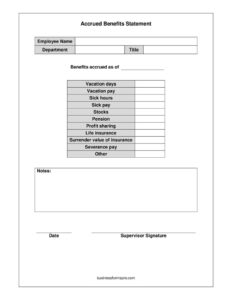
Accrued Benefits Statement
Download a free Accrued Benefits Statement template to document an employee's vacation, pension, stock, and severance balances — free PDF and DOCX download.
PDF
DOCX
3 downloads
0
likes
Download Files
- DOCX
An Accrued Benefits Statement is a document that summarizes the total value of benefits an employee has earned but not yet received, such as unused vacation, sick pay, pension, and stock holdings. Employers most often prepare one when an employee leaves the company, requests a benefits summary, or needs a clear snapshot of accumulated entitlements. You can download this Accrued Benefits Statement free in both PDF and DOCX formats, with no signup required.
What Is an Accrued Benefits Statement?
An Accrued Benefits Statement is an internal document issued by an employer, HR department, or payroll team that lists everything an employee has accrued over their tenure. “Accrued” simply means earned and owed but not yet paid out or used. The statement typically captures time-based balances like vacation days and sick hours, monetary balances like vacation pay and severance pay, and long-term holdings like pension contributions, profit sharing, stocks, and life insurance values. It serves as a transparent record for both employer and employee, helping confirm what is owed at a point in time — often during offboarding, an annual review, or a benefits inquiry.
When Do You Need an Accrued Benefits Statement?
This statement is useful any time an accurate picture of earned benefits matters. Common situations include:
- Employee resignation or termination: to calculate final pay including unused vacation and severance.
- Annual benefits review: to give employees a clear summary of what they have accumulated over the year.
- Retirement planning: when an employee wants to see pension, profit sharing, and stock values before deciding to retire.
- Internal transfers or role changes: documenting carried-over balances when an employee moves departments or titles.
- Loan or mortgage applications: when an employee needs proof of vested benefits or accrued value.
- Audits and recordkeeping: to support payroll accuracy and demonstrate compliance during HR or financial reviews.
What an Accrued Benefits Statement Should Have
A complete statement clearly identifies the employee and lays out each category of accrued benefit with a measurable balance or value. The essential elements include the employee’s identifying details (name, department, and title), time-based accruals such as vacation days and sick hours, their corresponding monetary values (vacation pay and sick pay), and any long-term or equity benefits like stocks, pension, and profit sharing. It should also reflect insurance-related figures — the life insurance benefit and its surrender value — plus any severance pay due. A notes field rounds it out, allowing the preparer to explain assumptions, cutoff dates, or special arrangements. Accuracy and a clear “as of” date are what make the statement trustworthy.
How to Fill Out an Accrued Benefits Statement
- Employee name: Enter the employee’s full legal name exactly as it appears in payroll records.
- Department: Record the department or business unit the employee belongs to.
- Title: List the employee’s current job title or position.
- Vacation days: Enter the number of accrued, unused vacation days as of the statement date.
- Vacation pay: Convert those days into a dollar amount based on the employee’s pay rate.
- Sick hours: Record accrued, unused sick hours.
- Sick pay: Enter the monetary value of those sick hours, if your policy pays them out.
- Stocks: List the value or number of vested company shares or stock options.
- Pension: Enter the accrued pension balance or vested employer contributions.
- Profit sharing: Record any profit-sharing amount allocated to the employee.
- Life insurance: Note the coverage amount of any employer-provided policy.
- Surrender value of insurance: Enter the cash surrender value, if the policy has one.
- Severance pay: Record any severance owed under company policy or contract.
- Notes: Add context — the calculation date, payout assumptions, or pending items.
Understanding the Difference Between Accrued and Vested Benefits
It helps to distinguish accrued benefits from vested benefits. Accrued benefits are amounts an employee has earned over time, but not all accrued benefits are immediately payable. Vesting refers to when an employee gains a non-forfeitable right to a benefit — common with pensions, stock options, and profit-sharing plans. On your statement, it is good practice to clarify in the notes field whether a listed benefit is fully vested, partially vested, or still subject to a vesting schedule. This prevents misunderstanding, especially for stocks and pension figures, where the gross accrued value and the amount an employee can actually take with them may differ significantly.
Tips for an Accurate and Useful Statement
Because this document often informs final pay or major financial decisions, precision matters. Always tie the figures to a specific “as of” date and keep your underlying calculations (pay rates, accrual policies, stock valuations) on file in case questions arise. Coordinate with payroll and your benefits administrator so insurance surrender values and pension balances reflect current plan statements rather than estimates. When the statement is part of an offboarding package, deliver it alongside the final paycheck breakdown so the employee can reconcile both. Keep a signed or acknowledged copy in the personnel file for your records.
Common Mistakes to Avoid
- No statement date: Without an “as of” date, the balances are ambiguous and can be disputed.
- Confusing days and dollars: Mixing vacation days with vacation pay (or sick hours with sick pay) without clear labels causes errors.
- Ignoring vesting rules: Listing unvested stocks or pension amounts as if they are fully payable can mislead the employee.
- Outdated valuations: Using last year’s stock price or an old insurance surrender value undermines accuracy.
- Skipping the notes field: Failing to explain assumptions or pending items leaves the document open to interpretation.
- Not reconciling with payroll: Figures that don’t match the final paycheck create confusion and erode trust.
Frequently Asked Questions
What is an Accrued Benefits Statement used for? It is used to summarize the benefits an employee has earned but not yet received, including unused vacation, sick pay, pension, stocks, profit sharing, insurance values, and severance. Employers most often issue it during offboarding, at an annual review, or when an employee requests a clear benefits summary.
How do I fill out an Accrued Benefits Statement? Start with the employee’s name, department, and title, then enter each accrued balance — vacation days and pay, sick hours and pay, stocks, pension, profit sharing, life insurance and its surrender value, and any severance. Use the notes field to record the calculation date and any vesting or payout assumptions. Always confirm figures against payroll and benefits plan records.
Is an Accrued Benefits Statement legally binding? The statement itself is generally an informational summary rather than a contract, but the underlying benefits may be governed by employment agreements, company policy, and law. Because requirements vary by jurisdiction, treat the statement as a record and rely on your formal plan documents and final pay calculations for binding obligations.
Does this statement need to be notarized or witnessed? No, an Accrued Benefits Statement typically does not require notarization or witnesses. It is an internal HR document, though many employers ask the employee and a payroll or HR representative to sign or acknowledge it for the record.
How is accrued vacation pay calculated? Accrued vacation pay is usually the number of unused vacation days multiplied by the employee’s daily pay rate, following your company’s accrual policy. Some jurisdictions require unused vacation to be paid out at separation, so check the rules that apply to you and reflect the correct figure in both the vacation days and vacation pay fields.
How much does this Accrued Benefits Statement template cost? It is completely free to download here in both PDF and DOCX formats, with no signup or payment required. You can edit the DOCX version to match your company’s benefit categories and pay structure.
This Accrued Benefits Statement template is a general example provided for informational purposes only and is not legal, financial, or tax advice. Benefit accrual, vesting, and payout requirements vary by jurisdiction and by individual plan terms — consult a qualified HR, legal, or financial professional before relying on this document.
Official resource: for the rules that apply to your situation, see the U.S. Department of Labor.
Related Forms
- Lactation Accommodation Request
- Comp Time Request Form
- Employee Separation Report
- Performance Improvement Plan
- Education Verification
- Promotion Request Letter
Browse more in Employment.