
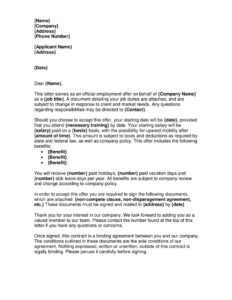
Job Offer Letter
Free job offer letter template in PDF & DOCX. Learn what a job offer letter is, what to include, and how to write one — download a printable copy today.
PDF
DOC
0
likes
Download Files
- DOC
A job offer letter is the formal document an employer sends to a chosen candidate to offer them a position, confirming the role, start date, pay, and key terms. Download the free job offer letter template below in PDF or DOCX. No signup or email required.
What Is a Job Offer Letter?
A job offer letter is a written confirmation that a company is formally offering someone a job. It usually follows a verbal offer and puts the key details in writing so both sides are clear before the candidate starts. A typical letter states the job title, the start date, who the new hire reports to, the salary or wage, and any conditions attached to the offer, such as completing training or passing a background check. It’s part welcome and part agreement: it tells the candidate they’ve got the job while setting out the terms they’re accepting. Once signed, it becomes a record both the employer and the new employee can refer back to.
What a Job Offer Letter Includes
A clear offer letter covers the essentials without trying to be a full contract:
- The candidate’s name and the company making the offer
- The job title and a reference to the duties (often attached separately)
- The start date and any training or onboarding requirements
- The salary or wage and pay schedule
- Any conditions the offer depends on, such as references or a background check
- A point of contact for questions, and a space to accept by signing
When Is a Job Offer Letter Sent?
The offer letter comes near the end of the hiring process — after interviews, once the employer has chosen their candidate, and usually right after a verbal offer has been accepted in principle. Sending it promptly matters: a good candidate may be weighing other options, and a clear written offer shows the company is organized and serious. The letter typically asks the candidate to confirm acceptance by a certain date, which gives both sides a clean deadline to finalize the hire and set a firm start date.
How to Fill Out a Job Offer Letter
- Add the sender’s details — your name, company, address, and phone number — and the applicant’s name and address.
- Enter the date and open with a clear line offering the position, naming the company and job title.
- Reference the attached job duties, and note that responsibilities may evolve with business needs.
- State the start date and any training the candidate must complete before or at the start.
- Include the salary or wage, pay schedule, and any conditions the offer depends on.
- Provide a contact for questions, and close with a space for the candidate to sign and date their acceptance.
Offer Letter vs. Employment Contract
An offer letter and an employment contract are related but not the same. An offer letter is usually a shorter, more flexible document that confirms the basics and welcomes the new hire; in many places it doesn’t, on its own, guarantee employment for a fixed term. An employment contract is a more detailed, binding agreement that spells out obligations, term length, termination conditions, and other legal terms. Some companies use only an offer letter, others follow it with a full contract, and many roles in “at-will” jurisdictions rely on the offer letter alone. Whichever you use, the language matters, so it’s worth reviewing anything that creates legal commitments.
What to Check Before You Accept
If you’ve received an offer letter, congratulations — but read it carefully before signing. Confirm the job title, start date, salary, and pay schedule match what you discussed, and look for any conditions, such as a background check, that the offer depends on. Note whether benefits, bonus, or paid time off are described or referenced elsewhere. If anything is missing or unclear, it’s completely normal to ask for clarification in writing before you accept. A signed offer letter generally does mean the job is yours, provided you meet any stated conditions — so make sure you’re comfortable with the terms first.
Common Mistakes to Avoid
- Leaving out the start date, salary, or reporting line, which causes confusion later
- Using language that accidentally promises guaranteed or long-term employment
- Forgetting to state conditions like a background check or reference check
- Sending the offer so slowly that a strong candidate accepts elsewhere
- Not giving the candidate a clear way and deadline to accept
Frequently Asked Questions
What is a job offer letter? It’s a written confirmation from an employer offering a candidate a position, stating the role, start date, pay, and key terms, usually after a verbal offer.
How do I write a job offer letter? Open by offering the position and naming the role, then state the start date, pay, any conditions, and a contact for questions, and leave space for the candidate to sign. The template above covers each part.
What does a job offer letter look like? A short, professional letter on company letterhead with the candidate’s name, the job title, start date, salary, any conditions, and a signature line for acceptance.
Does an offer letter mean I got the job? Generally yes — receiving and signing an offer letter means the job is yours, as long as you satisfy any stated conditions like a background or reference check.
Is a job offer letter the same as a contract? Not usually. An offer letter confirms the basics and may be less binding than a full employment contract, which sets out detailed legal terms. Some employers use one, some use both.
Can an employer withdraw a job offer letter? Sometimes — for example, if the offer was conditional and a condition such as a background check isn’t met, or before the candidate has accepted. Because the rules vary by location and wording, both sides should treat a signed offer seriously.
Should I sign and return the offer letter? Yes, if you’re accepting. Signing and returning it confirms your acceptance of the role and the stated terms, and gives both you and the employer a clear record to refer back to.
How much does this template cost? It’s free to download in PDF and DOCX.
Related Forms
Employment Verification Letter · Job Rejection Letter · Job Acceptance Letter · Employment Confirmation Letter · Job Description Template
This template is provided for general informational purposes only and is not legal advice. Employment terms and wording carry legal weight that varies by location — have important offers reviewed by a qualified professional.
Official resource: for the rules that apply to your situation, see the U.S. Department of Labor.
Related Forms
- Employee Separation Report
- Harassment Report Form
- Harassment Log
- Employee Evaluation Form
- Comp Time Request Form
- Employee Turnover Rate
Browse more in Employment.