
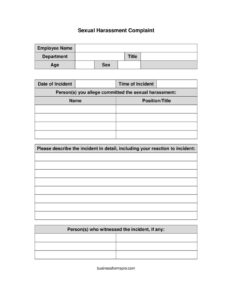
Sexual Harassment Complaint
Download a free Sexual Harassment Complaint form template in PDF and DOCX to formally document and report workplace harassment — free download, no signup.
PDF
DOCX
1 downloads
0
likes
Download Files
- DOCX
A Sexual Harassment Complaint form is a written record an employee uses to formally report unwelcome sexual conduct in the workplace to their employer or HR department. People most often use it to put a complaint in writing so it can be properly documented, investigated, and addressed. This template is free to download in PDF and DOCX, with no signup required.
What Is a Sexual Harassment Complaint?
A Sexual Harassment Complaint is a formal document submitted by an employee that describes an incident or pattern of unwelcome sexual behavior at work and identifies the person or people involved. It is typically filed with a human resources representative, a supervisor, or a designated complaint officer. The form captures the essential facts — who, what, when, where, and who witnessed it — so the organization can launch an investigation. By creating a dated, signed written record, the complaint protects both the employee raising the concern and the employer responsible for responding. It also signals that the matter should be handled seriously and confidentially, to the extent reasonably possible during a fair investigation.
When Do You Need a Sexual Harassment Complaint?
This form is useful any time an employee wants to formally document and report harassing conduct rather than rely on a verbal conversation. Common situations include:
- An employee experiences unwelcome comments, jokes, advances, or physical contact of a sexual nature from a coworker, supervisor, client, or vendor.
- A pattern of repeated inappropriate behavior continues after an informal request to stop.
- An employee feels pressured to accept advances in exchange for job benefits, promotions, or continued employment.
- A hostile work environment develops through ongoing offensive imagery, language, or conduct.
- A witness or affected coworker wants to memorialize what they observed for an internal investigation.
- HR or a manager asks the employee to provide a written account to supplement an earlier verbal report.
What a Sexual Harassment Complaint Should Have
A complete and credible complaint includes enough detail for an investigator to act on it. Essential elements are the complainant’s identifying information, the date and time of the incident, the identity and position of the person(s) accused, a thorough factual description of what happened, the names of any witnesses, and the employee’s dated signature. A strong complaint sticks to specific, observable facts rather than general accusations and avoids speculation. Including the employee’s reaction and any prior related incidents helps establish context. Finally, the acknowledgment that the matter will be investigated — with confidentiality maintained to the extent possible — sets clear, honest expectations about how the process will proceed.
How to Fill Out a Sexual Harassment Complaint
- Enter your employee name, department, and job title so the organization knows who is filing.
- Provide your age and sex as requested on the form for the record.
- Record the exact date of incident and time of incident. If there were multiple incidents, note the most recent and reference the others in your description.
- Identify the person(s) you allege committed the sexual harassment, listing each individual’s name and position/title.
- In the describe the incident in detail section, write a clear, chronological, factual account — what was said or done, where it happened, and your reaction to the incident.
- List any person(s) who witnessed the incident, including their names and roles if known.
- Use the Additional Notes field for related background, prior incidents, or supporting context.
- Review the confidentiality acknowledgment, then add the date and your employee signature to certify the complaint.
Tips for Writing an Effective Complaint
Write in the first person and stick to facts you personally observed or experienced. Use specific quotes where you can recall them, and describe behavior objectively rather than labeling it. Note the impact the conduct had on you and your work. Keep a personal copy of the completed form and any related emails, messages, or notes before submitting. If a single page is not enough, attach additional sheets and reference them in the Additional Notes section. The more concrete and organized your account, the easier it is for an investigator to follow up.
What Happens After You File
Once submitted, the employer or HR typically acknowledges receipt and begins an investigation, which may involve interviewing the complainant, the accused, and witnesses. Many organizations have written anti-harassment policies that outline timelines and steps. The form’s confidentiality acknowledgment reflects a practical reality: information is shared only with those who need it to investigate fairly. Retaliation against someone for filing a good-faith complaint is generally prohibited under workplace law, and most policies state this explicitly. If internal channels do not resolve the matter, employees may have the option to contact an external agency. Because rights and procedures vary by location and employer, review your company handbook and local rules.
Common Mistakes to Avoid
- Being vague — failing to include the specific date, time, and location makes the incident harder to investigate.
- Omitting the names or titles of the accused or of witnesses who could corroborate your account.
- Adding opinion, rumor, or accusations you cannot support instead of describing observable conduct.
- Forgetting to sign and date the form, which can call its authenticity into question.
- Not keeping a copy of the completed complaint and any supporting documents for your own records.
- Waiting too long to file, which can weaken memories and may run up against internal or legal deadlines.
Frequently Asked Questions
What is a Sexual Harassment Complaint form used for? It is used to formally document and report unwelcome sexual conduct in the workplace to an employer or HR department. The written form creates a dated, signed record that triggers an internal investigation. It helps ensure the issue is handled seriously rather than informally.
How do I fill out the form? Start with your name, department, title, age, and sex, then record the date and time of the incident. Identify the person(s) involved and their positions, describe the incident in detail including your reaction, list any witnesses, and add notes. Finish by dating and signing the form.
Will my complaint be kept confidential? The form includes an acknowledgment that the matter will be investigated but that information will be kept confidential to the extent possible. In practice, details are shared only with those who need them to conduct a fair investigation. Complete confidentiality cannot always be guaranteed, but employers should limit disclosure.
Does this complaint form need to be notarized or witnessed? No. A Sexual Harassment Complaint is an internal workplace document and generally does not require notarization. Your dated signature is what certifies the account. Witnesses listed on the form are people who observed the incident, not signature witnesses.
Can I be retaliated against for filing? Retaliation against an employee for filing a good-faith complaint is generally prohibited by workplace law and most company policies. If you experience demotion, discipline, or hostility after reporting, document it and inform HR. Specific protections and remedies vary by jurisdiction.
Is this template free to download? Yes. You can download this Sexual Harassment Complaint template free in both PDF and DOCX formats with no signup required. You can complete it digitally or print it, and edit the DOCX version to match your employer’s reporting procedures.
This template is a general example provided for informational purposes only and is not legal advice. Employment laws, complaint procedures, and reporting deadlines vary by jurisdiction and employer. Consult your company’s HR policies and a qualified employment law professional for guidance specific to your situation.
Official resource: for the rules that apply to your situation, see the U.S. Department of Labor.
Related Forms
- Employee Evaluation Form
- Job Application Form
- Promotion Request Letter
- Authorization To Travel
- Employee Incident Report Form
- Employee Reference Request
Browse more in Employment.