
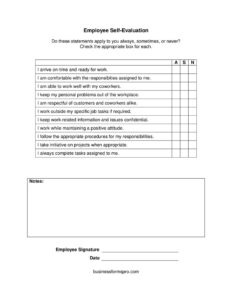
Employee Self Evaluation
Download a free Employee Self Evaluation form template in PDF and DOCX to help staff reflect on performance, attitude, and goals before review meetings.
PDF
DOCX
2 downloads
0
likes
Download Files
- DOCX
An Employee Self Evaluation is a structured form an employee completes to reflect honestly on their own performance, attitude, and workplace behavior. People most often use it during annual or mid-year performance reviews to give their own perspective before meeting with a manager. You can download this template free in PDF and DOCX with no signup required.
What Is an Employee Self Evaluation?
An Employee Self Evaluation is a self-assessment tool that asks the employee to rate how consistently they demonstrate key workplace behaviors — using simple always, sometimes, or never responses. It is typically issued by a manager, HR department, or supervisor as part of a broader performance review cycle. The form documents an employee’s own view of their punctuality, teamwork, professionalism, initiative, and reliability. Rather than replacing a manager’s appraisal, it complements it: the employee’s responses become a starting point for an honest two-way conversation about strengths, gaps, and goals. Because the questions focus on observable behaviors, the form keeps reviews objective and gives quieter team members a chance to speak up about their contributions in their own words.
When Do You Need an Employee Self Evaluation?
This form is useful any time an organization wants employees to participate actively in assessing their own work. Common situations include:
- Annual performance reviews — collect each employee’s self-assessment ahead of the formal sit-down meeting.
- Mid-year or quarterly check-ins — track progress and surface concerns before they grow.
- End of a probationary period — let new hires reflect on how they have settled into their role and responsibilities.
- Promotion or raise discussions — gather the employee’s own evidence of initiative and reliability.
- Goal-setting sessions — use honest self-ratings to identify development areas and training needs.
- Team restructuring or role changes — understand how comfortable an employee feels with current and shifting responsibilities.
What an Employee Self Evaluation Should Have
A complete self-evaluation balances clear rating questions with space for personal context. The essentials include a consistent rating scale (here, always, sometimes, or never), a focused set of behavior statements covering punctuality, teamwork, professionalism, confidentiality, attitude, and initiative, and an open notes area for the employee to explain or expand on their answers. It should also capture the employee’s signature and the date so the document is dated and attributable. Keeping the statements behavior-based — rather than vague or personality-driven — ensures the responses are fair, comparable across reviews, and genuinely useful in the follow-up conversation.
How to Fill Out an Employee Self Evaluation
Work through the form honestly and in one sitting where possible. Follow these steps:
- Read each statement carefully and decide whether it applies to you always, sometimes, or never, then check the appropriate box.
- For “I arrive on-time and ready for work,” reflect on your typical attendance pattern over recent months, not just your best week.
- Consider “I am comfortable with the responsibilities assigned to me” — note if any duties feel beyond your current skills.
- Rate “I am able to work well with my coworkers” and “I am respectful of customers and coworkers alike” based on real interactions.
- Answer the statements on confidentiality, positive attitude, following procedures, taking initiative, and completing assigned tasks as candidly as you can.
- Use the notes field to add context, examples, accomplishments, or areas where you want support.
- Add your employee signature and the date to confirm the assessment is yours.
Tips for an Honest, Useful Self-Assessment
The value of a self-evaluation depends on candor. Resist the urge to mark every statement always — a thoughtful mix of ratings signals self-awareness and is more credible to a reviewer. When you check sometimes or never, use the notes field to explain the circumstances and, ideally, what you plan to do about it. Back up positive ratings with brief concrete examples, such as a project where you took initiative or a deadline you consistently met. Treat the form as a chance to advocate for yourself: if you have taken on work outside your job tasks or handled sensitive information well, say so. Approach the exercise as a conversation starter, not a test to be aced.
How It Differs From a Manager’s Performance Review
A self-evaluation reflects the employee’s own perspective, while a manager’s performance review reflects supervisory observations and often includes ratings against department goals or company metrics. The two documents work best together: gaps between how an employee rates themselves and how a manager sees them highlight exactly where a conversation is needed. Some organizations also pair this with peer feedback or a 360-degree review for a fuller picture. This template focuses on behavior and attitude, making it a practical, low-friction starting point for almost any review process.
Common Mistakes to Avoid
- Rating everything as “always” — it reads as inflated and undermines your credibility.
- Leaving the notes blank — without context, your ratings tell only half the story.
- Being overly harsh — undervaluing your real contributions can hurt you in review discussions.
- Rushing through the statements — answering on autopilot defeats the purpose of reflection.
- Forgetting to sign and date — an unsigned form may not be accepted as part of your review record.
- Treating it as a complaint form — focus on your own behavior and growth rather than blaming others.
Frequently Asked Questions
What is an Employee Self Evaluation used for? It is used to let employees assess their own workplace performance and behavior before or during a formal review. The completed form gives managers insight into how staff view their own punctuality, teamwork, and initiative, and it creates a starting point for a productive review conversation.
How do I fill out the self-evaluation? Read each statement and check whether it applies to you always, sometimes, or never, answering honestly across all the behavior questions. Then use the notes field to add examples or context, and sign and date the form at the bottom before submitting it.
Should I be completely honest, even about weaknesses? Yes — thoughtful honesty is far more valuable than an all-positive sheet. Acknowledging an area you want to improve, paired with a brief plan in the notes, shows self-awareness and a willingness to grow, which most managers respect.
Does an Employee Self Evaluation need to be signed? This template includes an employee signature and date so the assessment is attributable and dated. While a self-evaluation is not a legal contract, signing it confirms the responses are yours and that you completed it as part of the review process.
Is this self-evaluation form free to download? Yes. You can download this Employee Self Evaluation template completely free in both PDF and DOCX formats, with no signup or account required, and edit the statements to fit your organization.
Can I customize the statements for my workplace? Absolutely. The DOCX version is fully editable, so you can add role-specific questions, adjust the rating scale, or include sections for goals and accomplishments to match your company’s review process.
This template is a general example provided for informational purposes only and does not constitute legal, HR, or professional advice. Performance review and employment practices vary by jurisdiction and organization — consult a qualified HR or legal professional to ensure your evaluation process meets applicable requirements.
Official resource: for the rules that apply to your situation, see the U.S. Department of Labor.
Related Forms
- Absentee Report Form
- Applicant Interview Schedule
- Payroll Statement
- Employee Benefits Sheet
- Raise Request Letter
- Comp Time Request Form
Browse more in Employment.