
Job Description Template
Use this free Job Description Template to clearly define roles, duties, and requirements for any position—download in PDF or DOCX, no signup needed.
PDF
DOCX
0
likes
Download Files
- DOCX
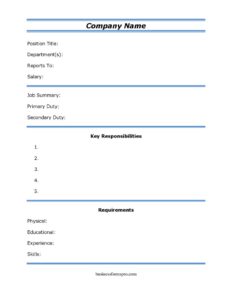
A Job Description Template is a structured document that defines the title, duties, reporting line, and qualifications for a specific role within your organization. The most common reason people use it is to standardize hiring and set clear expectations before a position is posted or filled. It’s free to download here in both PDF and DOCX, with no signup required.
What Is a Job Description Template?
A Job Description Template is a reusable framework that captures everything a candidate or employee needs to understand about a role. It is typically created by a hiring manager, HR professional, or business owner and documents the position title, the department it sits in, who the role reports to, a summary of the job, its primary and secondary duties, key responsibilities, and the education, experience, skills, and physical requirements expected. By organizing this information consistently, a job description supports recruiting, onboarding, performance reviews, and compensation decisions. It also gives applicants a transparent picture of what the job involves, helping both sides decide whether the role is a good fit before time is invested in interviews.
When Do You Need a Job Description Template?
Job descriptions are useful at many points in the employment lifecycle, not just when posting a vacancy. Common situations include:
- Opening a new position — drafting a clear posting that attracts qualified applicants and discourages mismatches.
- Restructuring a team — redefining who reports to whom and reassigning primary and secondary duties.
- Conducting performance reviews — measuring an employee’s results against the documented key responsibilities.
- Setting or revising salary bands — aligning compensation with the skills, experience, and requirements a role demands.
- Onboarding a new hire — giving the employee a written reference for what success in the role looks like.
- Ensuring compliance — documenting physical requirements and essential functions for accommodation and classification purposes.
What a Job Description Should Have
A complete job description balances enough detail to be useful with enough flexibility to stay relevant as the role evolves. The essentials are the company name and department so readers know where the role sits, a clear position title, the reporting relationship, and a concise job summary. From there it should distinguish the primary duty from secondary duties, list specific key responsibilities, and spell out the educational background, experience level, skills, and any physical demands required. Including a salary or salary range, where appropriate, builds trust and saves time. Well-written descriptions use action verbs, avoid vague jargon, and focus on measurable outcomes rather than personality traits.
How to Fill Out a Job Description Template
- Company Name and Department(s): Enter your organization’s name and the department or departments the role belongs to.
- Position Title: State the official job title clearly and consistently with how it will appear in postings and records.
- Reports To: Identify the supervisor or manager the role answers to by title.
- Job Summary: Write two to four sentences describing the purpose of the role and how it contributes to the team.
- Primary Duty: Name the single most important responsibility that defines the position.
- Secondary Duty: List the supporting tasks that are important but not the core focus.
- Key Responsibilities: Break the work into specific, action-oriented bullet points.
- Educational: Note the degree, certification, or schooling expected.
- Experience: Specify the minimum and preferred years or types of experience.
- Skills: List technical and soft skills required to succeed.
- Physical: Document any physical requirements such as lifting, standing, or travel.
- Requirements: Add licenses, background checks, or other conditions.
- Salary: Enter a figure or range if you choose to publish it.
Types of Job Descriptions
Not every job description serves the same purpose, and adapting the template to its use makes it far more effective. A recruiting job description is written to attract candidates and often emphasizes the job summary, key responsibilities, and an appealing tone. An internal job description is more granular, focusing on primary and secondary duties, reporting structure, and measurable expectations used for reviews. A classification job description documents physical requirements and essential functions in detail, which matters for compliance and for handling accommodation requests. Many organizations maintain a single master version from which they create lighter postings. Whichever type you need, keeping the underlying fields consistent makes it easy to compare roles across departments and update them over time.
Tips for Writing Stronger Descriptions
Use specific, measurable language: instead of “helps the team,” write “prepares weekly inventory reports and reconciles discrepancies.” Keep the list of key responsibilities focused—five to eight bullet points is usually enough, with the primary duty front and center. Separate true requirements from nice-to-haves so you don’t unintentionally discourage strong applicants. Review the description with the current employee or supervisor before publishing to confirm accuracy, and revisit it at least once a year because roles drift as the business grows.
Common Mistakes to Avoid
- Listing too many duties — overloading the responsibilities section makes the role feel unfocused and unrealistic.
- Confusing requirements with preferences — marking optional skills as mandatory narrows your candidate pool unnecessarily.
- Vague language — phrases like “team player” tell readers little about what the job actually involves.
- Omitting the reporting line — leaving out who the role reports to creates confusion about authority and accountability.
- Ignoring physical requirements — failing to document essential physical demands can cause compliance and accommodation issues later.
- Letting it go stale — using an outdated description for reviews or hiring leads to mismatched expectations.
Frequently Asked Questions
What is a job description template used for? It is used to define a role’s title, duties, reporting line, and qualifications in a consistent format. Employers rely on it for recruiting, onboarding, performance reviews, and setting fair compensation. Having a written version helps both the employer and the employee understand expectations clearly.
How do I fill out a job description template? Start with the company name, department, and position title, then add the reporting relationship and a short job summary. Next, fill in the primary and secondary duties, key responsibilities, and the educational, experience, skills, physical, and other requirements. Add a salary or range if you plan to publish one, and review the draft with the relevant manager before finalizing.
Should I include a salary range? Including a salary or range is optional, but it builds transparency, saves time, and is increasingly expected or even required in some locations. If you choose to omit it during recruiting, keep an internal version with the compensation band documented. Posting requirements vary by jurisdiction, so check your local rules.
Is a job description a legally binding contract? A job description on its own is generally not an employment contract; it describes a role rather than guaranteeing terms of employment. However, the wording can have legal relevance for classification, accommodations, and disputes, so it should be accurate. Avoid promises about tenure or benefits unless they are intended to be binding.
How often should job descriptions be updated? Review them at least once a year and whenever a role’s duties, reporting structure, or requirements change significantly. Outdated descriptions can mislead candidates and weaken performance evaluations. Keeping them current ensures they remain a reliable reference.
Is this job description template really free? Yes, you can download this Job Description Template for free in PDF or DOCX format with no signup required. You are welcome to edit the fields to match your company, role, and industry. Reuse it for as many positions as you need.
This template is a general example provided for informational purposes only and does not constitute legal, HR, or tax advice. Employment laws and disclosure requirements vary by jurisdiction. Consult a qualified professional before relying on any job description for compliance or contractual purposes.
Official resource: for the rules that apply to your situation, see the U.S. Department of Labor.
Related Forms
- Employee Separation Form
- Hazard Assessment
- First Warning Notice Employee Behavior
- Lactation Accommodation Request
- Request for Transfer
- Employee Warning Letter
Browse more in Employment.