
Raise Request Letter
Use this free Raise Request Letter template to professionally ask for a salary increase, backed by your achievements — free download in PDF and DOCX.
DOCX
0
likes
Download Files
- DOCX
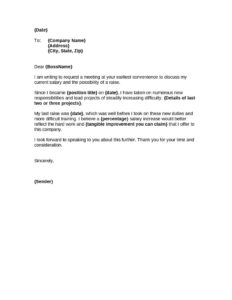
A Raise Request Letter is a formal written message in which an employee asks their employer for a salary increase, supported by accomplishments and reasoning. People most often use it to start a structured, documented conversation about pay rather than relying on a casual hallway chat. This template is free to download in both PDF and DOCX formats, with no signup required.
What Is a Raise Request Letter?
A Raise Request Letter is a professional document an employee writes to a manager, supervisor, or HR representative to request a higher salary or wage. It typically summarizes the employee’s role, highlights measurable contributions, references current market or internal pay benchmarks where relevant, and states a clear, reasonable request. Unlike a verbal ask, the letter creates a written record that decision-makers can review, forward to leadership, and reference during budget discussions. It is not a legally binding contract — it is a persuasive, respectful request. A well-crafted letter frames the raise as a reflection of the value the employee already delivers, making it easier for the employer to say yes.
When Do You Need a Raise Request Letter?
Timing and context matter when asking for more pay. A written letter is especially useful in these situations:
- You have taken on significant new responsibilities, a larger workload, or a higher-level role without a corresponding pay adjustment.
- Your annual review or performance evaluation is approaching and you want to formalize a compensation request in advance.
- You have hit major milestones — closing key accounts, launching a project, or consistently exceeding targets — and want them documented.
- Market research shows your salary is below the going rate for your position, experience level, or geographic area.
- It has been a year or more since your last raise and your cost of living or contributions have risen.
- You received a competing job offer and want to open a retention conversation with your current employer professionally.
What a Raise Request Letter Should Have
A strong letter is concise, professional, and grounded in specifics rather than emotion. The core elements include your name and current job title, the date, and the recipient’s name and title. It should open with a clear statement of purpose, then provide evidence: specific achievements, added responsibilities, and quantifiable results where possible. Include the salary increase you are requesting — either a target figure, a percentage, or a range — and a brief justification such as market data or tenure. Close with a courteous request for a meeting to discuss further, a thank-you, and your signature. Keeping the tone confident yet respectful is what separates an effective letter from one that feels demanding.
How to Fill Out a Raise Request Letter
Follow these steps to complete the template field by field:
- Add the date at the top so the request is properly timestamped for HR records.
- Enter the recipient’s details — your manager’s or HR contact’s full name, title, and the company name and address.
- Write a professional greeting, such as “Dear [Manager’s Name].”
- State your purpose in the opening line: that you are requesting a review of your current salary.
- List your current role and tenure, noting how long you have held the position and key duties.
- Highlight your achievements with concrete, measurable examples — revenue earned, projects delivered, or efficiencies created.
- Specify the increase you are seeking, expressed as a dollar amount, percentage, or salary range.
- Provide justification, referencing market benchmarks, expanded responsibilities, or time since your last raise.
- Request a meeting to discuss the request in person or over a call.
- Close courteously and add your full name, signature, and contact information.
Tips for Making Your Request Persuasive
Preparation strengthens any raise request. Research salary data for your role using reputable sources so your number is realistic and defensible. Anchor your case in outcomes the company cares about — revenue, retention, cost savings, customer satisfaction — rather than personal financial needs. Quantify wherever you can: “reduced processing time by 30%” lands harder than “improved efficiency.” Time the letter thoughtfully, ideally when the company is performing well or after a notable win, and avoid periods of layoffs or budget freezes when possible. Keep the letter to one page; busy decision-makers skim. Finally, frame the ask as a partnership: you want to keep growing with the organization, and fair pay supports that continued commitment.
Raise Request Letter vs. Verbal Request
Both approaches have a place, and many successful negotiations combine them. A verbal conversation feels natural and lets you read the room and respond in real time, but it leaves no record and can be easy for a busy manager to forget. A written Raise Request Letter documents your case, can be forwarded up the chain to people who control the budget, and gives your manager something concrete to act on. A common strategy is to send the letter ahead of, or immediately after, a verbal conversation so the discussion is anchored by your written summary. The letter does not replace dialogue — it supports it.
Common Mistakes to Avoid
- Making the request about personal expenses or bills rather than your professional value to the company.
- Failing to include specific, measurable accomplishments to justify the increase.
- Naming a vague or unrealistic figure without any market research to back it up.
- Sounding demanding, entitled, or issuing ultimatums instead of opening a respectful conversation.
- Sending the letter at a poor time, such as during budget cuts, a slow quarter, or right after a company setback.
- Letting typos, an overly long message, or an unprofessional tone undermine an otherwise solid case.
Frequently Asked Questions
What is a Raise Request Letter? It is a formal written request an employee sends to a manager or HR asking for a salary increase. The letter outlines your role, your accomplishments, and a specific raise amount, and it creates a documented record that can be reviewed and forwarded to decision-makers.
How do I fill out a Raise Request Letter? Add the date and recipient details, state your purpose, summarize your role and tenure, list measurable achievements, specify the increase you want, and justify it with results or market data. Close by requesting a meeting and signing your name. The downloadable template provides a ready-made structure you simply complete.
How much of a raise should I ask for? A common approach is to research current market rates for your role, experience, and location, then request a figure within that range. Many employees ask for a percentage increase or a target salary that reflects their added responsibilities and contributions. Always anchor your number in evidence rather than guesswork.
Is a Raise Request Letter legally binding? No. The letter is a request, not a contract, and your employer is under no obligation to grant it. Any approved raise typically becomes effective through a formal offer, an updated pay agreement, or company payroll documentation.
When is the best time to send a raise request? Strong moments include before or during a scheduled performance review, after completing a major project, or when you have clearly taken on more responsibility. Avoid periods of budget freezes, layoffs, or company financial strain when possible.
Is this Raise Request Letter template really free? Yes. You can download it from Business Forms Pro in PDF and DOCX formats at no cost and without creating an account. Customize the wording to match your role, achievements, and the figure you are requesting.
This Raise Request Letter template is a general example provided for informational purposes only and does not constitute legal, financial, or career advice. Workplace policies and compensation practices vary by employer and jurisdiction. Consult your HR department or a qualified professional for guidance specific to your situation.
Official resource: for the rules that apply to your situation, see the U.S. Department of Labor.
Related Forms
- Employee Self Evaluation
- Consent To Drug Test
- Shift Change Request
- Salary Review Request
- Check Driving Record
- First Warning Notice Employee Behavior
Browse more in Employment.