
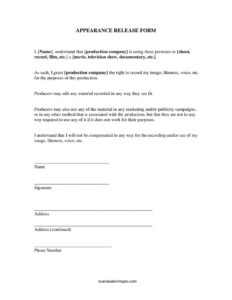
Appearance Release Form
Download a free Appearance Release Form template in PDF and DOCX to legally capture and use a person's image, likeness, and voice in your production.
PDF
DOCX
10 downloads
0
likes
Download Files
- DOCX
An Appearance Release Form is a short legal document that grants a production company the right to record and use a person’s image, likeness, and voice in a film, television show, documentary, or other production. People most commonly use it to make sure everyone who appears on camera has given written, on-the-record permission before footage is shot. You can download this Appearance Release Form free in both PDF and DOCX formats, with no signup required.
What Is an Appearance Release Form?
An Appearance Release Form is a written consent agreement signed by anyone who appears in recorded material. It is typically issued by a production company, producer, or filmmaker and signed by the on-camera participant, whether that person is an interview subject, an extra, a background performer, or a member of the public who happens to be filmed. The form documents that the participant grants permission for their recorded image, voice, and likeness to be captured, edited, and distributed. It also clarifies whether compensation is involved. In short, it protects the production from later claims that someone’s appearance was used without authorization, and it gives the producers clear rights to use the footage they capture.
When Do You Need an Appearance Release Form?
You should secure a signed release any time an identifiable person appears in material you intend to edit, publish, or promote. Common situations include:
- Filming a documentary and interviewing subjects, experts, or eyewitnesses on camera.
- Recording a television show, web series, or short film that features cast, guests, or hosts.
- Shooting on location where members of the public may be visible or audible in the footage.
- Capturing reality or unscripted content where ordinary people share their stories.
- Producing marketing videos, testimonials, or corporate films that show employees or customers.
- Recording a podcast or live event that will be filmed and distributed online.
Even when an appearance feels casual or unpaid, a signed release removes ambiguity about who consented and what the production may do with the recording.
What an Appearance Release Form Should Have
A complete appearance release should clearly identify the participant and the production company, describe the type of project being recorded, and grant the production the right to capture the person’s image, likeness, and voice. It should confirm that producers may edit the material however they see fit and may use it in marketing and publicity, while making clear they are not obligated to use any of it. The form should state whether the participant will be compensated. Finally, it needs the participant’s printed name, signature, address, and phone number so the release can be matched to a specific, contactable individual. These elements together give the production a documented, enforceable record of consent.
How to Fill Out an Appearance Release Form
- Enter the participant’s full legal Name in the opening line so it is clear who is granting permission.
- Fill in the production company name that is conducting the shoot and will hold the rights.
- Describe what the premises are being used for — for example, shoot, record, or film — in the activity blank.
- Specify the type of project in the next blank, such as a movie, television show, or documentary.
- Read the grant language confirming the production may record your image, likeness, and voice, may edit the material, and may use it in publicity — but is not required to.
- Note the clause stating that no compensation will be provided for the recording or use.
- Print your Name on the signature block line.
- Sign your Signature to make the release effective.
- Write your full Address across the two address lines provided.
- Add your Phone Number so the production can reach you if needed.
Unpaid Appearances and the Compensation Clause
This particular template includes language stating that the participant will not be compensated for the recording or use of their image, likeness, or voice. That makes it well suited to documentaries, student films, community projects, and situations where people appear voluntarily without payment. If your project does involve a fee, a stipend, or any other form of payment, you should modify the form to reflect those terms accurately rather than leaving the unpaid language in place. A release that contradicts your actual arrangement can create confusion later, so always make sure the compensation clause matches what you genuinely agreed to with the person on camera.
Keeping and Organizing Your Releases
A release is only useful if you can find it when you need it. Producers often collect dozens or hundreds of signed forms across a project, so build a simple system: label each release with the participant’s name and the shoot date, and store digital copies alongside your footage logs. When you deliver a finished film to a broadcaster, distributor, or platform, you may be asked to prove that everyone who appears gave consent. Having organized, signed releases ready can prevent delays, re-edits, or the need to blur or remove footage. Keep both the physical originals and scanned backups for the life of the production.
Common Mistakes to Avoid
- Filming first and collecting releases later, when participants may be unreachable or unwilling to sign.
- Leaving the production company name or project description blank, which weakens the grant of rights.
- Using the unpaid compensation clause when the participant is actually being paid.
- Forgetting to obtain the signature, which leaves you with an unenforceable form.
- Skipping the address and phone number, making it impossible to verify or contact the signer.
- Assuming a verbal yes is enough — written consent is far stronger if a dispute ever arises.
Frequently Asked Questions
What is an Appearance Release Form used for? It is used to obtain written permission from anyone who appears on camera, allowing a production company to record and use their image, likeness, and voice. It documents consent so the footage can be edited, published, and promoted without later disputes. Productions rely on it to protect themselves and to satisfy distributors who require proof of consent.
Does an Appearance Release Form need to be notarized? Generally no — this type of release is valid once the participant signs it, and notarization is not typically required. The signature, printed name, and contact details are what make the form useful. That said, requirements can vary, so check your local rules or consult a professional if your project has specific legal needs.
Is an Appearance Release Form legally binding? When properly completed and signed by an adult who understands its terms, an appearance release is generally treated as a binding consent agreement. It records that the participant knowingly granted the production the rights described. Enforceability can depend on jurisdiction and the circumstances, so significant productions often have releases reviewed by an attorney.
Do I get paid if I sign this release? This template specifically states that the participant will not be compensated for the recording or use of their image, likeness, or voice. If you expect payment, do not sign a form containing the unpaid clause — instead, use a version that reflects your agreed compensation. Always read the form carefully before signing.
Can a minor sign an Appearance Release Form? Typically a parent or legal guardian must sign on behalf of a minor, since a child cannot legally grant these rights on their own. The exact age and requirements vary by location. If your shoot involves children, confirm the appropriate consent process for your jurisdiction.
How much does this Appearance Release Form cost? The template is completely free to download from Business Forms Pro in both PDF and DOCX formats, with no signup required. You can fill it out by hand after printing or edit the DOCX version on your computer. Use it as a starting point and adapt the details to fit your specific production.
This Appearance Release Form template is a general example provided for informational purposes only and is not legal advice. Laws and consent requirements vary by jurisdiction and by the nature of your production. Consult a qualified attorney before relying on this form for any specific project.
Related Forms
- Camera Shooting Log
- Daily Film Production Report
- Actor Release Form
- Location Use Release Form
- Shooting Notice
- Video Production Contract
Browse more in Film Production Forms.