
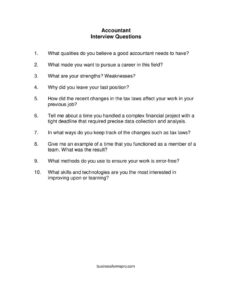
Accountant Interview Questions
Download a free Accountant Interview Questions template to structure hiring conversations, compare candidates fairly, and assess key skills — free download.
PDF
DOCX
4 downloads
0
likes
Download Files
- DOCX
The Accountant Interview Questions template is a ready-made list of ten focused questions designed to help hiring managers evaluate accounting candidates consistently and fairly. Most people use it to run structured interviews that surface a candidate’s technical skills, attention to detail, and ability to handle deadlines. It’s free to download in PDF and DOCX, with no signup required.
What Is an Accountant Interview Questions Form?
An Accountant Interview Questions form is a prepared script of questions an interviewer asks candidates applying for accounting roles. It is typically used by hiring managers, HR professionals, recruiters, or department heads at firms, businesses, or public accounting practices. The form documents the specific topics each candidate will be asked about — from professional qualities and career motivation to tax-law awareness and error-prevention methods — so every applicant is assessed against the same criteria. By standardizing the conversation, it makes interviews more objective, easier to compare side by side, and simpler to defend if a hiring decision is ever questioned. It serves as both a discussion guide and a record of the interview.
When Do You Need an Accountant Interview Questions Form?
This template is useful any time you’re evaluating someone for a role that involves financial recordkeeping, reporting, or analysis. Common situations include:
- Hiring a staff accountant, senior accountant, or bookkeeper for a growing business.
- Filling a tax-focused position where staying current with changing tax laws is essential.
- Building a shortlist when you have several candidates and want to compare answers fairly.
- Training a new interviewer or hiring panel who need a consistent question set to follow.
- Conducting phone or video screens before inviting candidates to an in-person final round.
- Documenting interviews for HR records or to support a hiring decision later.
What a Good Interview Question Set Should Have
A strong accountant interview question set balances behavioral, technical, and motivational topics. It should probe core competencies such as accuracy, analytical thinking, and teamwork while also exploring how a candidate keeps their knowledge current. The best forms mix open-ended behavioral prompts (“Tell me about a time…”) with reflective questions about strengths, weaknesses, and career goals. This template covers all of those bases: it asks about professional qualities, motivation, self-awareness, tax-law impact, project execution under deadline, staying informed, teamwork, error prevention, and areas for growth — giving you a rounded picture of each applicant in a single conversation.
How to Fill Out an Accountant Interview Questions Form
Use the template as your interview guide and take notes beside each item:
- Open with “What qualities do you believe a good accountant needs to have?” to hear how the candidate defines excellence in the role.
- Ask “What made you want to pursue a career in this field?” to gauge genuine motivation and fit.
- Explore self-awareness with “What are your strengths? Weaknesses?”, noting whether the answer is honest and specific.
- Ask “Why did you leave your last position?” to understand career history and red flags.
- Probe technical currency with “How did recent changes in tax laws affect your work?”
- Use the behavioral prompt about handling a complex financial project with a tight deadline to assess data analysis under pressure.
- Cover continuing education with “In what ways do you keep track of changes such as tax laws?”
- Ask for a teamwork example and the result it produced.
- Probe quality control with “What methods do you use to ensure your work is error-free?”
- Close with “What skills and technologies are you most interested in improving?” to reveal growth mindset. Record a rating or summary after each answer.
How to Get the Most From Each Question
The questions in this template work best when you listen for substance, not just surface answers. When a candidate names a strength, ask for a concrete example. When they describe a tight-deadline project, follow up on the tools they used, how they verified the data, and what they would do differently. The tax-law question is a strong signal for accuracy-sensitive roles — a thoughtful candidate will mention specific resources like professional publications, CPE courses, or guidance from regulatory bodies. For the error-prevention question, listen for systematic habits such as reconciliations, review checklists, and double-entry verification rather than vague reassurances. Consistent, probing follow-ups turn a basic script into a revealing conversation.
Scoring and Comparing Candidates
To make the form even more useful, add a simple rating scale (for example, 1 to 5) next to each question and jot down a one-line justification. After the interview, tally scores and write a brief overall impression while the conversation is fresh. When you’ve interviewed multiple applicants, lay the completed forms side by side: because everyone answered the same ten questions, differences in depth, technical knowledge, and communication become easy to spot. This approach reduces bias, supports fairer decisions, and creates a paper trail that helps if you need to explain your choice to leadership or HR.
Common Mistakes to Avoid
- Reading questions robotically — let the conversation breathe and ask natural follow-ups.
- Skipping note-taking — relying on memory makes it hard to compare candidates later.
- Talking too much — aim to let the candidate speak for most of the interview.
- Ignoring red flags in the “why did you leave” answer or vague error-prevention responses.
- Asking only technical questions — soft skills like teamwork and communication matter for accountants too.
- Failing to standardize — using a different question set for each applicant undermines fair comparison.
Frequently Asked Questions
What is an Accountant Interview Questions form? It’s a prepared list of questions used to interview candidates for accounting positions. It helps interviewers cover the same key topics with every applicant, making evaluations more consistent and easier to compare across candidates.
How do I use this template in an interview? Print or open it before the interview and work through the questions in order, taking notes after each answer. Use the prompts as a starting point and add follow-up questions to dig deeper into a candidate’s specific experience and reasoning.
Can I edit the questions to fit my role? Yes. The DOCX version is fully editable, so you can add questions about specific software, certifications, or industries relevant to your position, or remove items that don’t apply. Tailoring the list to your exact needs makes the interview more effective.
Are these questions suitable for entry-level and senior accountants? The set works for a range of experience levels, though you should adjust your expectations for the answers. An entry-level candidate may have fewer complex-project examples, while a senior candidate should demonstrate deeper expertise in tax-law changes, leadership, and process improvement.
Should I ask the same questions to every candidate? Yes, asking a consistent core set of questions is best practice. It allows you to compare answers fairly and helps reduce unconscious bias in your hiring decisions, while still leaving room for tailored follow-up questions based on each résumé.
How much does this template cost? It is completely free to download here in both PDF and DOCX formats, with no signup or payment required. You can use it as-is or customize it for your own hiring process at no charge.
This template is a general example provided for informational purposes only and does not constitute legal, HR, or employment advice. Interview and hiring practices, including anti-discrimination rules, vary by jurisdiction and employer — consult a qualified HR or legal professional to ensure your process complies with applicable laws.
Official resource: for the rules that apply to your situation, see the U.S. Department of Labor.
Related Forms
- Housekeeper Interview Questions
- Handyman Interview Questions
- Fitness Instructor Interview Questions
- Line Cook Interview Questions
- Quality Assurance Engineer Interview Questions
- Web Developer Interview Questions
Browse more in Interview Questions.