
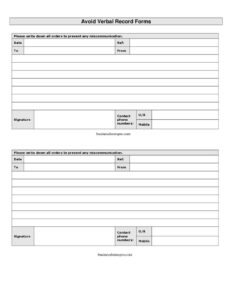
Avoid Verbal Orders AVO Form
Document spoken instructions in writing with our free Avoid Verbal Orders (AVO) form template, available as a no-signup PDF and DOCX free download.
PDF
DOCX
6 downloads
0
likes
Download Files
- DOCX
An Avoid Verbal Orders (AVO) form is a simple written record used to capture instructions, directions, or order changes that were originally given verbally. The most common reason people use it is to create a paper trail that confirms exactly what was said, who said it, and when — protecting both parties from misunderstandings on the job site, shop floor, or in the office. You can download this AVO form free in PDF and DOCX, with no signup required.
What Is an Avoid Verbal Orders (AVO) Form?
An Avoid Verbal Orders (AVO) form is a documentation tool that turns a spoken instruction into a written confirmation. It is typically issued by the person who received a verbal order — a worker, supervisor, contractor, or supplier — and given back to the person who issued the order for review. The form records the substance of the instruction, the identity of the person who gave it, the date and time, and any cost or schedule impact. Long used in construction, manufacturing, military supply, and field service, the AVO exists for one purpose: to ensure that important decisions are not lost, forgotten, or disputed simply because they were never written down.
When Do You Need an Avoid Verbal Orders (AVO) Form?
An AVO form is valuable any time a decision is made out loud but never confirmed in writing. Common situations include:
- A client or project manager phones in a change to a job already in progress and you need to confirm the new scope before proceeding.
- A supervisor gives a worker an on-the-spot instruction that affects safety, materials, or sequence of work.
- A customer verbally adds items to an existing order or asks for a substitution at the counter.
- A subcontractor receives spoken direction on site that may carry extra cost or affect the contract.
- A vendor agrees to expedite, hold, or modify a shipment during a phone conversation.
- An emergency repair is authorized verbally and you need a record before invoicing or billing.
In each case, the AVO form converts a fleeting conversation into a dated, signed document that everyone can reference later.
What an AVO Form Should Have
A complete Avoid Verbal Orders form should capture enough detail that anyone reading it weeks later can understand exactly what was authorized. The essential elements are a unique AVO or reference number, the date and time the verbal order was given, the name and title of the person who issued it, and the name of the person who received and recorded it. It should also include a clear description of the instruction or order, the project or job number it relates to, any anticipated cost or time impact, and a signature block for both parties. A space for follow-up notes or written confirmation status helps close the loop.
How to Fill Out an AVO Form
Because this template is a flexible, general-purpose layout, fill it out in the following order:
- AVO / reference number: Assign a sequential number so the form can be filed and located later.
- Date and time: Record when the verbal order was actually given, not when you wrote it down.
- Issued by: Enter the full name, title, and company of the person who gave the instruction.
- Received by: Write the name of the person recording the order so responsibility is clear.
- Project / job / order number: Tie the AVO to the relevant job, contract, or purchase order.
- Description of the verbal order: Summarize the instruction in plain, specific language — quantities, parts, scope, and any conditions.
- Cost and schedule impact: Note whether the order adds cost, changes the deadline, or has no impact.
- Action taken / follow-up: Record what was done and whether a formal written order will follow.
- Signatures: Both the issuer and recipient sign and date to confirm accuracy.
Why Written Confirmation Matters
Verbal orders are convenient in the moment but notoriously unreliable later. People misremember numbers, forget conditions, or recall different versions of the same conversation. When a dispute arises over an unexpected charge, a missed deadline, or work that was performed differently than expected, the AVO form is the document that settles it. By writing down the verbal order promptly and routing it back to the person who gave it, you give them a chance to correct any misunderstanding immediately — long before it becomes an invoice dispute or a contract argument. Used consistently, AVO forms also build a habit of accountability that reduces rework and protects relationships with clients and suppliers.
AVO Forms vs. Change Orders and Purchase Orders
It helps to understand where the AVO fits among related documents. A purchase order authorizes a planned purchase before work begins, and a change order formally amends an existing contract, usually with negotiated pricing and signatures from both parties. An AVO is lighter and faster — it captures a spoken instruction at the moment it happens so nothing is lost. In many workflows the AVO is the first step that later triggers a formal change order or revised purchase order once the cost is confirmed. Think of it as the bridge between an informal conversation and a binding contract amendment.
Common Mistakes to Avoid
- Waiting hours or days to fill out the form, by which time the exact wording is forgotten.
- Leaving out the name and title of the person who gave the order, making accountability unclear.
- Writing vague descriptions like “do the extra work” instead of specific quantities and scope.
- Failing to note cost or schedule impact, which leads to billing surprises later.
- Forgetting to route the form back to the issuer for acknowledgment or signature.
- Not assigning a reference number, so the form cannot be linked to the related job or invoice.
Frequently Asked Questions
What is an AVO form used for? An Avoid Verbal Orders form is used to put a spoken instruction into writing so there is a clear, dated record of what was authorized. It is most common in construction, manufacturing, field service, and supply work where on-the-spot directions are frequent. The goal is to prevent disputes caused by misremembered conversations.
How do I fill out an AVO form? Start by recording the date, time, and the name of the person who gave the verbal order, then describe the instruction in specific detail. Note any cost or schedule impact, document the action taken, and have both parties sign. Filling it out promptly while the conversation is fresh produces the most accurate record.
Is an AVO form legally binding? An AVO form is primarily a documentation tool rather than a contract on its own, though a signed and acknowledged form can serve as evidence of what was agreed. Whether it carries contractual weight depends on your agreement and local rules. Many organizations use the AVO as the basis for a formal change order that is binding.
Does an AVO form need to be signed? Signatures from both the person who gave the order and the person who recorded it greatly strengthen the document. At minimum, the recipient should sign to confirm what they heard, and routing it back for the issuer’s signature closes the loop. An unsigned form still helps as a contemporaneous note.
How is an AVO different from a change order? An AVO captures a verbal instruction quickly in the moment, while a change order is a formal, often negotiated amendment to a contract with agreed pricing. The AVO frequently comes first and then prompts a written change order once costs are confirmed. They work together rather than replacing one another.
Is this AVO form template free to download? Yes. You can download this Avoid Verbal Orders form free in both PDF and DOCX formats with no signup required. Use the PDF for quick printing on site or the DOCX to customize fields, add your company logo, and match your existing paperwork.
This Avoid Verbal Orders (AVO) form template is provided as a general example for informational purposes only and does not constitute legal, financial, or contractual advice. Documentation and contracting requirements vary by jurisdiction, industry, and individual agreement — consult a qualified professional before relying on this form for any contractual or legal purpose.
Need to work out sales tax? Use our free Sales Tax Calculator to add or remove sales tax from any amount in seconds.
Official resource: for the rules that apply to your situation, see the U.S. Small Business Administration.
Related Forms
- Project Change Form
- Job Invoice
- Business Quote Form
- Purchase Order
- Bill of Materials
- Tailor Alterations Form
Browse more in Invoices and Order Forms.