
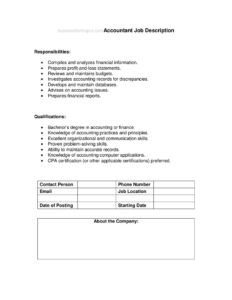
Accountant Job Description
Download a free Accountant job description template in PDF and DOCX to define responsibilities, qualifications, and attract qualified accounting candidates fast.
PDF
DOCX
0
likes
Download Files
- DOCX
An Accountant job description is a structured document that defines the duties, qualifications, and expectations for an accounting role within a company. Most employers use it to write a clear, consistent job posting and to align hiring managers, recruiters, and candidates on what the position involves. This template is free to download in both PDF and DOCX formats, with no signup required.
What Is an Accountant Job Description?
An Accountant job description is a written summary that outlines what an accountant will do on the job and the credentials needed to perform the role. It is typically created by a hiring manager, HR team, or department head and used in recruiting, onboarding, and performance reviews. The document usually covers two core areas: the responsibilities the accountant will handle day to day, and the qualifications—education, certifications, and experience—candidates must bring. A well-written job description sets expectations early, reduces mismatched applications, and serves as a reference point throughout the employment relationship. It also helps ensure the role is posted consistently across job boards, your careers page, and recruiting agencies.
When Do You Need an Accountant Job Description?
You may need this document in a range of hiring and organizational situations. Common scenarios include:
- Opening a new accountant position and preparing a job advertisement for sites like LinkedIn, Indeed, or your company careers page.
- Replacing a departing staff accountant and wanting to clarify or update the role before posting it again.
- Restructuring a finance team and needing to define where a new accountant fits among bookkeepers, controllers, and analysts.
- Briefing a staffing agency or recruiter so they can screen candidates against accurate criteria.
- Setting performance benchmarks for an existing employee whose responsibilities have grown or changed.
- Standardizing documentation during a company audit, certification, or HR policy review.
Types of Accountant Roles to Adapt This For
The word “accountant” covers several distinct roles, and this template can be tailored to each. A staff accountant focuses on day-to-day bookkeeping, reconciliations, and journal entries. A senior accountant oversees month-end close and may supervise junior staff. A cost accountant analyzes manufacturing or operational expenses, while a tax accountant specializes in returns and compliance. A forensic accountant investigates financial discrepancies. When you fill out the template, adjust the responsibilities and qualifications to match the seniority and specialty you are hiring for so the posting attracts the right applicants.
What an Accountant Job Description Should Have
A complete job description goes beyond a simple list of tasks. To make the document useful for both candidates and your internal team, it should include:
- A clear job title and, ideally, a one-line summary of the role’s purpose.
- A detailed Responsibilities section listing the recurring duties and outcomes the accountant owns.
- A Qualifications section covering required education, certifications, software skills, and years of experience.
- Distinctions between “required” and “preferred” qualifications so strong candidates are not discouraged.
- Reporting relationships—who the accountant reports to and whether they supervise anyone.
- Any details about work environment, schedule, or compensation range if your company discloses it.
How to Fill Out an Accountant Job Description
This template centers on two key fields—Responsibilities and Qualifications. Follow these steps to complete it thoroughly:
- Add a clear job title at the top, such as “Staff Accountant” or “Senior Tax Accountant,” and a brief role summary if you wish.
- In the Responsibilities field, list the core duties as bullet points. Typical entries include preparing financial statements, reconciling accounts, processing accounts payable and receivable, maintaining the general ledger, supporting month-end and year-end close, and assisting with audits and tax filings.
- Order responsibilities from most to least frequent so candidates immediately understand the focus of the role.
- In the Qualifications field, specify the education required (such as a bachelor’s degree in accounting or finance), any certifications (CPA, CMA), and the years of experience expected.
- List essential software and technical skills—for example, QuickBooks, SAP, Excel, or NetSuite—and any GAAP or regulatory knowledge.
- Separate must-have requirements from nice-to-have preferences, then review the full draft with the hiring manager before posting.
Writing Tips for a Stronger Posting
Use action verbs like “prepare,” “analyze,” “reconcile,” and “report” to make responsibilities concrete and scannable. Keep the list focused—eight to twelve responsibilities is usually enough; an overloaded list can overwhelm applicants. Be honest about the experience level, because asking for a CPA and ten years of experience on an entry-level salary will deter qualified people. Where possible, describe outcomes rather than just tasks (for example, “ensure month-end close is completed within five business days”). Inclusive, plain language widens your applicant pool and helps the posting comply with fair-hiring practices.
How It Differs from a Job Posting and an Offer Letter
A job description is the foundational document that defines the role; a job posting is the marketing-oriented advertisement built from it, often with added company branding and benefits. An offer letter comes later and formalizes terms for a specific hired candidate, including salary and start date. Keep these distinct so your internal description stays accurate even as external postings are updated for different platforms.
Common Mistakes to Avoid
- Listing vague responsibilities like “handle finances” instead of specific, measurable duties.
- Confusing the accountant role with bookkeeping or controller duties, which sets wrong expectations.
- Requiring credentials the role does not truly need, narrowing your candidate pool unnecessarily.
- Forgetting to mention key software or systems the candidate must already know.
- Copying a generic template without tailoring it to your industry or company size.
- Leaving out reporting structure, so candidates cannot gauge the role’s seniority.
Frequently Asked Questions
What is an Accountant job description used for? It is used to define an accounting role’s duties and qualifications so you can advertise the position accurately and screen candidates effectively. It also serves as a reference for onboarding and performance reviews after hiring. Many companies attach it to the internal role file for ongoing use.
How do I fill out the Responsibilities and Qualifications sections? In Responsibilities, list the recurring duties such as preparing statements, reconciling accounts, and supporting audits, ordered by frequency. In Qualifications, state the required degree, certifications like CPA, years of experience, and software skills. Tailor both sections to the seniority and specialty of the role you are hiring for.
Is this Accountant job description legally binding? A job description by itself is generally not a binding contract; it is a descriptive document that outlines expectations. Employment terms become binding through an offer letter or employment agreement. Avoid wording that implies guarantees of employment, and have HR review the final language.
How much does this template cost? Nothing—it is completely free to download from Business Forms Pro in both PDF and DOCX formats. There is no signup, subscription, or hidden fee. You can edit the DOCX version freely to match your company.
Should I include a salary range in the job description? Including a salary range is increasingly expected and is legally required in some jurisdictions, so check your local rules. A transparent range tends to attract more relevant applicants and saves time during screening. If you choose not to list it, be prepared to discuss compensation early in the interview process.
Can I edit the template for a senior or specialized accounting role? Yes. The DOCX version is fully editable, so you can expand the Responsibilities to include supervision or month-end ownership for senior roles, or add tax, cost, or forensic specialties as needed. Adjust the Qualifications to reflect the certifications and experience that match the seniority.
This template is a general example provided for informational purposes only and does not constitute legal, HR, or employment advice. Hiring and disclosure requirements vary by jurisdiction and may change over time, so consult a qualified HR or legal professional before finalizing any job description or posting.
Official resource: for the rules that apply to your situation, see the U.S. Department of Labor.
Related Forms
- Fitness Instructor Job Description
- Valet Driver Job Description
- Paralegal Job Description
- Line Cook Job Description
- Attorney Job Description
- Web Developer Job Description
Browse more in Job Descriptions.